Saudi Arabia strengthens global ranking in 2026 Soft Power Index

Saudi Arabia and the UAE either maintained or improved their rankings across all key pillars. (Brand Finance)
Short Url
Updated 20 January 2026
Follow

Saudi Arabia strengthens global ranking in 2026 Soft Power Index

  • UAE maintains 10th place, Qatar climbs 2 spots

DUBAI: Saudi Arabia climbed three positions to 17th place in this year’s Soft Power Index, released on Tuesday by marketing consultancy Brand Finance.

Other Gulf nations also performed well, with the UAE maintaining its 10th-place ranking and Qatar and Bahrain each climbing two spots to No. 20 and No. 49, respectively, marking a rebound for the region after a softer showing in 2025.

The report indicates that the performance reflects sustained investment in proactive diplomacy, economic diversification and expanded initiatives across culture, tourism and sports.

It also comes at a time when several Western powers are recording declines in their rankings, highlighting the growing influence of Gulf states.

“The UAE remains a clear regional leader, while Saudi Arabia and Qatar have strengthened their global positions through focused economic diplomacy and international engagement,” said Savio D’Souza, managing director for the Middle East and Africa, Brand Finance.

Saudi Arabia and the UAE either maintained or improved their rankings across all key pillars, including familiarity, reputation and influence.

The Kingdom recorded notable gains, with increases of 25 points in the People & Values pillar and 12 points in the Culture & Heritage pillar.

“Although perceptions across some markets remain mixed, renewed upward movement in the rankings suggests that targeted, long-term soft power strategies are beginning to pay off,” D’Souza said.

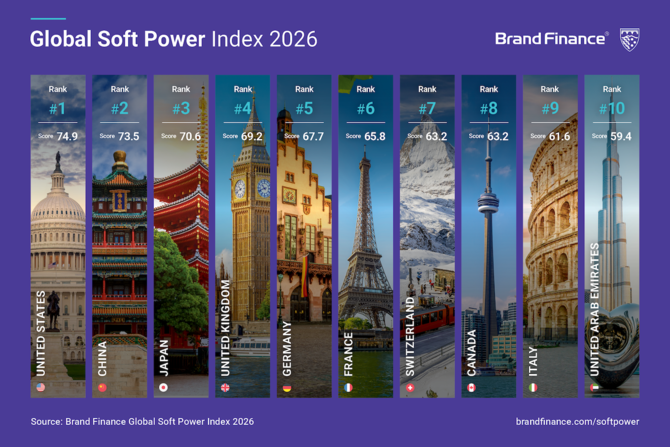
Globally, the US retained its top position despite recording the steepest overall decline in its score, followed by China in second place. Japan rose to third place, overtaking the UK, which ranked fourth, while Germany placed fifth.

Brand Finance defines “soft power” as a “nation’s ability to influence the preferences and behaviors of various actors in the international arena (states, corporations, communities, publics, etc.) through attraction and persuasion rather than coercion.” 

Each nation is assessed across 55 individual metrics, producing an overall score out of 100 and a ranking from first to 193rd.


Study finds nearly half of UK news stories on Muslims show signs of bias

Updated 09 March 2026
Follow

Study finds nearly half of UK news stories on Muslims show signs of bias

  • Centre for Media Monitoring finds 20,000 out of 40,913 articles from 30 major news outlets contain bias and 70% link Muslims to negative behaviors or themes
  • Findings reveal ‘deeply concerning evidence of structural bias’ in portrayal of Muslims by UK press and point to ‘systemic problem’ within the media, says center’s director

LONDON: Nearly half of news articles published in the UK in 2025 that referenced Muslims or Islam contained some degree of bias, according to a report issued on Monday by the Centre for Media Monitoring. It also found that about 70 percent of stories linked Muslims to negative behaviors or themes.

The nonprofit organization, which tracks the ways in which Muslims and Islam are portrayed in the media, examined 40,913 articles from 30 major news outlets and found that about 20,000 showed some form of bias.

The study looked at “structural patterns” in coverage that “shape public narratives” about Muslims amid rising hostility toward the community.

“As the largest study of its kind ever conducted in the UK, this report presents deeply concerning evidence of structural bias in how Muslims are portrayed in the UK press,” said Rizwana Hamid, the director of the organization.

It found that 70 percent of the articles it reviewed highlighted negative aspects related to Muslims, though not all of the stories were biased in themselves. The wider patterns were also troubling: 44 percent of the coverage omitted key context, 17 percent relied on generalizations, and 13 percent included outright misrepresentation.

Taken together, the monitoring center said, the findings amounted to evidence of an “information integrity crisis” that distorts public understanding, and “a deeply concerning trend” in reporting on Muslims.

The research points to a “systemic problem within our media ecosystem,” Hamid said.

“When entire communities are repeatedly framed through lenses of suspicion or threat, it inevitably shapes public attitudes, political debate and the everyday lives of British Muslims,” she added.

News brands targeting right-wing audiences were more likely to produce biased coverage, the report found.

The Spectator magazine and GB News were identified as having the highest proportion of “very biased” articles, and as the “worst across all five bias categories”: negative framing, generalizations, misrepresentation, lack of context, and problematic headlines.

Other outlets highlighted for displaying high levels of biased content about Muslims included The Telegraph, The Jewish Chronicle, Daily Express, The Sun, Daily Mail and The Times.

In contrast, the BBC, other broadcasters and left-leaning outlets recorded the lowest rates of bias in the study.

The research comes as British Muslims report rising levels of discrimination. Official figures published in October revealed that religious hate crimes against Muslims rose by 19 percent in the year to March 2025 compared with the previous 12 months.