

Israeli military kills Palestinian teenager in occupied West Bank

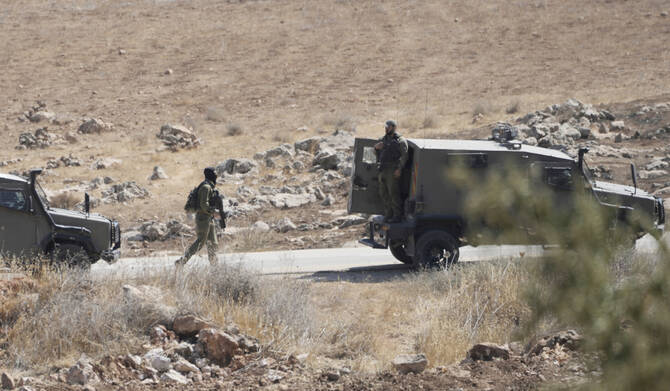
An Israeli soldier walks on a road following a military raid in the West Bank village of Al-Mughayyir, Sunday, Aug. 24, 2025. (AP)
Short Url
Updated 17 January 2026
Follow

Israeli military kills Palestinian teenager in occupied West Bank

  • Mayor of Al-Mughayyir says army raided the village when people began to exit mosques after Friday prayers
  • Israeli settlers in the West Bank also serve in the army, and sometimes carry their weapons with them when off duty
  • Israel has occupied the West Bank since 1967

AL-MUGHAYYIR: Israeli forces killed a 14-year-old Palestinian in the occupied West Bank village of Al-Mughayyir on Friday, the Palestinian Health Ministry said, while the military said soldiers had responded to stone throwing.

The Ramallah-based Health Ministry announced the death of 14-year-old Mohammed Al-Nassan by Israeli fire in Al-Mughayyir in a statement on Friday.
Shortly after, Israel’s military said its forces had come to the village after Palestinians “hurled stones toward Israelis, set tires on fire and blocked access routes to the area.”

FASTFACT

The Ramallah-based Health Ministry announced the death of 14-year-old Mohammed Al-Nassan by Israeli fire in Al-Mughayyir in a statement on Friday.

The military said dozens of Palestinians were throwing stones upon their arrival, including one who posed “an imminent threat.”
“The soldiers responded by firing warning shots into the air, followed by fire to eliminate the terrorist,” the military said, adding it had set up roadblocks in the area to search for another suspect.
Amin Abu Aliya, mayor of Al-Mughayyir, said that the army raided the village when people began to exit mosques after Friday prayers.
“This young man (Nassan) was exiting the mosque where he was praying with the people, the military vehicle stopped in front of the mosque, they opened the back door and started shooting at him directly,” Abu Aliya said.
Abu Aliya added that following the incident, the army introduced a curfew for the village, closing all shops and setting up a new checkpoint at the village’s entrance.
He pointed to the heavy military presence in his village in recent months, which he said often protected Israeli settlers who recently set up nearby outposts and took land from Al-Mughayyir farmers.
In September, a settler who the military said was an off-duty soldier shot and killed a 20-year-old who the army said had thrown stones in Al-Mughayyir.
Israeli settlers in the West Bank also serve in the army, and sometimes carry their weapons with them when off duty.
Israel has occupied the West Bank since 1967.
Violence there has soared since the Oct. 7, 2023, attack on Israel that triggered the Gaza war and has not subsided despite the truce that came into effect in October.
Since October 2023, Israeli troops and settlers have killed more than 1,000 Palestinians in the West Bank, according to Health Ministry figures.


Basic services resume at Syrian camp housing Daesh families as government takes control

Updated 3 sec ago
Follow

Basic services resume at Syrian camp housing Daesh families as government takes control

AL HOL: Basic services at a camp in northeast Syria holding thousands of women and children linked to Daesh group are returning to normal after government forces captured the facility from Kurdish fighters, a United Nations official said on Thursday.
Forces of Syria’s central government captured Al-Hol camp on Jan. 21 during a weekslong offensive against the Kurdish-led and US-backed Syrian Democratic Forces, or SDF, that had been running the camp near the border with Iraq for a decade. A ceasefire deal has since ended the fighting.
Celine Schmitt, a spokesperson for the UN refugees agency told The Associated Press that the interruption of services occurred for two days during the fighting around the camp.
She said a UNHCR team visited the recaptured came to establish “very quickly the delivery of basic services, humanitarian services,” including access to health centers. Schmitt said that as of Jan. 23, they were able to deliver bread and water inside the camp.
Schmitt, speaking in Damascus, said the situation at Al-Hol camp has been calm and some humanitarian actors have also been distributing food parcels. She said that government has named a new administrator for the camp.
Camp residents moved to Iraq
At its peak after the defeat of Daesh in Syria in 2019, around 73,000 people were living at Al-Hol. Since then the number has declined with some countries repatriating their citizens. The camp’s residents are mostly children and women, including many wives or widows of Daesh members.
The camp’s residents are not technically prisoners and most have not been accused of crimes, but they have been held in de facto detention at the heavily guarded facility.
The current population is about 24,000, including 14,500 Syrians and nearly 3,000 Iraqis. About 6,500 from other nationalities are held in a highly secured section of the camp, many of whom are Daesh supporters who came from around the world to join the extremist group.
The US last month began transfering some of the 9,000 Daesh members from jails in northeast Syria to Iraq. Baghdad said it will prosecute the transfered detainees. But so far, no solution has been announced for Al-Hol camp and the similar Roj camp.
Amal Al-Hussein of the Syria Alyamama Foundation, a humanitarian group, told the AP that all the clinics in the camp’s medical facility are working 24 hours a day, adding that up to 150 children and 100 women are treated daily.
She added that over the past 10 days there have been five natural births in the camp while cesarean cases were referred to hospitals in the eastern province of Deir Ezzor or Al-Hol town.
She said that there are shortages of baby formula, diapers and adult diapers in the camp.
A resident of the camp for eight years, who spoke on condition of anonymity due to concerns over the safety of her family, said there have been food shortages, while the worst thing is a lack of proper education for her children.
“We want clothes for the children, as well as canned food, vegetables and fruits,” she said, speaking inside a tent surrounded by three of her daughters, adding that the family has not had vegetables and fruits for a month because the items are too expensive for most of the camp residents.
‘Huge material challenges’
Mariam Al-Issa, from the northern Syrian town of Safira, said she wants to leave the camp along with her children so that thy can have proper education and eat good food.
“Because of the financial conditions we cannot live well,” she said. “The food basket includes lentils but the children don’t like to eat it any more.”
“The children crave everything,” Al-Issa said, adding that food at the camp should be improved from mostly bread and water. “It has been a month since we didn’t have a decent meal,” she said.
Thousands of Syrians and Iraqis have returned to their homes in recent years, but many only return to find destroyed homes and no jobs as most Syrians remain living in poverty as a result of the conflict that started in March 2011.
Schmitt said investment is needed to help people who return home to feel safe. “They need to get support in order to have a house, to be able to rebuild a house in order to have an income,” she said.
“Investments to respond and to overcome the huge material challenges people face when they return home,” she added.