

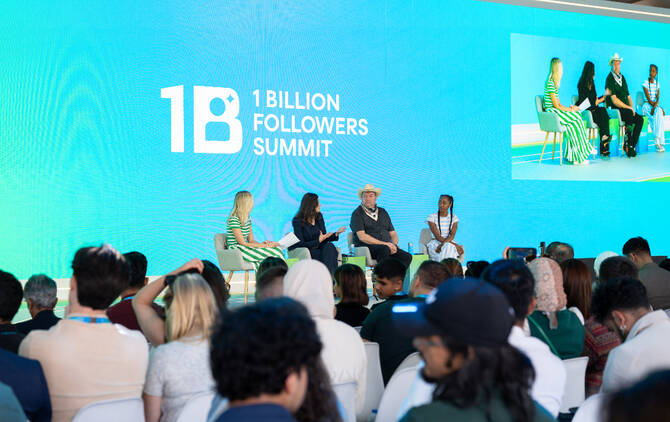
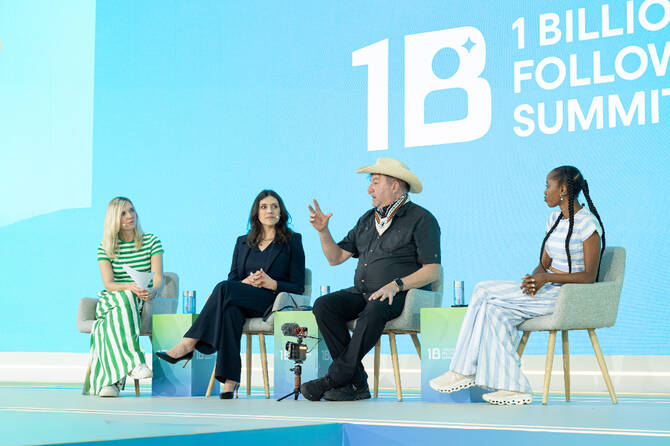

DUBAI: Media experts at the 1 Billion Followers Summit said on Friday that the rise of the creator economy was reshaping the media landscape, though the role of legacy outlets remained essential.
The 4th edition of the summit, held from Jan. 9 to 11 in Dubai, brought together more than 15,000 content creators and over 500 speakers from around the world to examine how the creator economy is transforming industries ranging from fashion and technology to sports, entertainment, AI, lifestyle and personal finance.
Held under the theme “Content for Good,” discussions on the opening day on Friday examined the latest trends of the creator economy, today worth $250 billion and projected to double by 2027, while urging creators and media outlets to use their influence in producing responsible and authentic content amid the rise of artificial intelligence.
The media industry was among the sectors witnessing significant transformation, as legacy outlets find themselves in competition with independent journalists and content creators who deliver information faster and with greater flexibility and direct outreach to the audiences, often outside traditional newsroom structures.
Another trend highlighted was the rise of niche media networks designed to cater to regional cultural diversity and local contexts — gaps often left unaddressed by global legacy media models.
Tara Palmeri, founder of FTMM LLC and The Red Letter, and host of The Tara Palmeri Show, said that the lack of audience engagement, transparency and accountability had contributed to declining public trust in the media.
“The blind spots (of media institutions) is that they think they are invaluable and they act like they are invaluable. You cannot be that way with people. They just are not going to buy it anymore,” said Palmeri, who practiced journalism for 15 years before creating her own content.
She urged media outlets to take accountability when things go wrong, share with the audience “the process of your journalism” and “be more willing to to meet your audience where they are, start a conversation and and actually engage.”
She said that independent journalism had garnered creators greater editorial control, closer connection with audiences and the ability to create communities rooted in trust.
Shift in TV consumption
Speakers stressed that the traditional news platforms and entertainment are not disappearing, but the way stories are told are fundamentally shifting.
Sharon Machira, CEO of Studio Unconventional, argued that in a fragmented online landscape, legacy media must focus on analysis and explanation.
While audiences may get breaking news first from social media, there remains strong demand for context and clear explanations of why events matter, especially for younger audiences.
“(Media institutions) must break down the news because I think there’s still space for legacy media,” said the former journalist, pointing to the expertise and credibility journalists bring to in-depth analysis.
Meanwhile, Saudi content creator Ayman Az argued that creator-led ecosystems redefined TV consumption and challenged traditional entertainment models, providing viewers with unfiltered, genuine content from people like themselves.
“Social media offers diverse content presented in a more natural and authentic manner away from the bureacractic and commercial restrictions of TV,” he said. “Viewers see YouTubers as people like them —closer, more real, and easier to relate to when delivering pieces of information.”
He said that new media had given audiences greater agency to choose what content they consumed, when and on which platforms. This shift had pushed TV networks to invest heavily in online shows and digital-first formats.
However, Moroccan YouTuber and director Reda El-Wahabi stressed that television continued to outperform social media in key areas such as live event coverage and sports broadcasting, even as the internet and livestreaming have expanded TV’s reach.
“People follow people nowadays, but they also follow trust and TV still leads in that with live events, especially as online spaces are filled with deep fakes and AI-generated content,” he said.
Another feature that distinguishes journalists is the professional training they received in newsgathering, fact-checking, research and information verification — values that must lead the news industry in the digital age.
Machira said that besides the rise of misinformation, harmful narratives could be amplified by algorithms, including stereotypes and rage-driven content that generated engagement but damaged public discourse.
“We need to be mindful that as journalists, we are trained to understand ethics, to understand balance, but content creators unfortunately do not get that training. So sometimes they speak about things that might be super-biased and it’s unfortunate because it is the rage content that seems to get the most clicks,” Machira told the summit’s audience.
Robb Montgomery, founder of Smart Film School, said that his journalistic background established his online credibility.
While his independent practice enabled him to experiment with new forms of technologies, the core principles of journalism were at the center of his work.
“The starting point for finding original stories is finding questions of things that you didn’t expect to find, and researching them to find that connection to the community.”
He added: “I find my stories literally from the streets; where I find the human interest connection and where I’m seeing something. I then chase it down with my phone or by doing 3D scanning and creating virtual models. Because I was trained as a photojournalist, I tend to view the world a little bit differently.”
Montgomery highlighted spaces for journalist-creator collaborations, giving successful examples where newsrooms trained YouTubers on the basic priniciples of journalism to build healthier online communities.
“(Content creators) bring a whole new energy. They do not have these rigid institutions thinking, but then that is not to say that journalism values go down with that,” he said.
Media experts also emphasized that algorithms, not editors, now determined content success. Saudi Arabia’s Az explained that unlike TV’s fixed formats, each social platform demanded a distinct storytelling approach aligned with its algorithm.
Success, he said, is driven by storytelling, consistency, and innovation, rather than approvals from legacy platforms.
Speakers, therefore, urged creators to feed the algorithms with responsible and meaningful content that inspires positive change among communities.
1 billion acts of kindness
As part of the three-day summit’s focus to encourage drafting “Content for Good,” MrBeast, one of the world’s most-followed YouTubers, announced that 20 content creators will travel with him to Ghana for a humanitarian project under the “1 Billion Acts of Kindness” campaign.
The campaign, supported by Mohammed bin Rashid Al-Maktoum Global Initiatives and the Varkey Foundation, aims to leverage MrBeast’s global reach to encourage people around the world to share one act of kindness, inspiring others to take part in positive social action.
The winning creators, selected from more than 170,000 submissions, will help to deliver clean water supplies, build schools, and support health and food initiatives in Ghana, while producing content designed to inspire wider participation in humanitarian work.
Winners were chosen based on the strength of their stories and their ability to inspire others. Submissions were required to demonstrate genuine acts of kindness or charitable work, engage audiences effectively, and convey a positive message capable of driving real-world change.


