

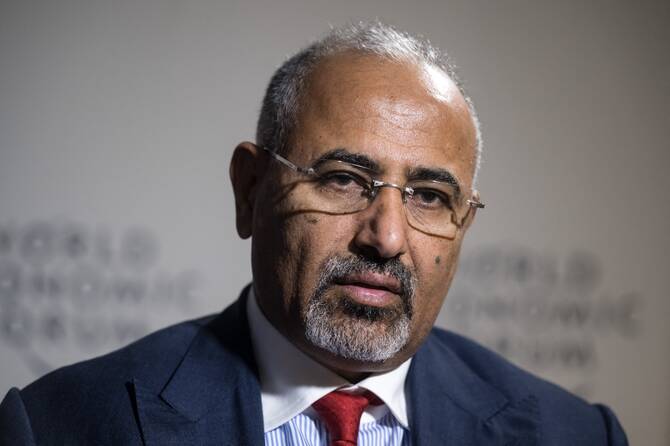
DAVOS: Sheikh Bandar bin Mohammed bin Saoud Al-Thani, Qatar Central Bank’s governor, has said a central bank should continue to be a cornerstone of financial stability as part of its role as a catalyst for change and supporter of the fintech industry.
“This is the job of the regulator to keep the financial sector safe and resilient,” Al-Thani said, speaking at a forum during the World Economic Forum in Davos, Switzerland, which discussed the digitization of banking systems and fintech, or technology-enabled financial services.
“We must not overlook the fact that with the recent development in technology, they are fundamentally transforming the financial sector. And if regulators fail to keep pace with these changes, then a structural gap will emerge in the system.”
Al-Thani said as a governor of a central bank he supported adapting a forward-looking approach for regulating the financial sector, by maintaining a safe market and also enabling innovation.
He noted how recent reports had shown that in more than 100 countries, over 100 central banks do not have a fast payment system.
But by playing the role of the “enabler” of market rules, Al-Thani said central banks were “making the market more efficient” by allowing the banking sector and fintech companies “to test their product in a very safe environment.”
He added: “A fast payment system is very important for any economy in order to make the economy efficient. Two years ago, in Qatar’s Central Bank, we announced our new payment system. One product, as a result of this new digital payment system, was an instant payment, where the sender and receiver can receive the funds within a second. And you don’t need to put in an IBAN (international bank account number), but rather you can choose your number, your nickname, email, whichever is easier for you.
“That will help to make the capital flow in the market much faster, and will make the market more efficient.”
Al-Thani said artificial intelligence could contribute to “increase the profitability” of banks, but it was not the only factor that could make banking more safe.
He said: “A lot of factors can make banks safe, not just AI. If regulators don’t issue a regulation that governs AI, there will be a risk. We issued last year a guideline to adopting AI in the financial sector. Those guidelines will govern how the banks in our market will adopt AI to make sure they protect customers’ data, customers’ information, and protect the bank from any emerging risk.”
He added that regulators and banks should work closely to avoid the risks of fraud by protecting data and privacy.
He said: “Regulators and banks need to work to mitigate the risk. The people’s behavior has changed. People now are relying more on using digitalization and technology.
“So that increases the risk (of fraud). One area that we must also take seriously is making an educational campaign to customers, as a regulator and also as banks. We urge banks to have new annual campaigns to educate their customers and to protect them. Also, as a regulator, we make campaigns regarding types of fraud in the market.
“We cannot eliminate fraud, but we can mitigate the risk by the right regulation and (putting) the right system in place.”