

Pakistan PM orders plan to boost farm exports, cut trade deficit

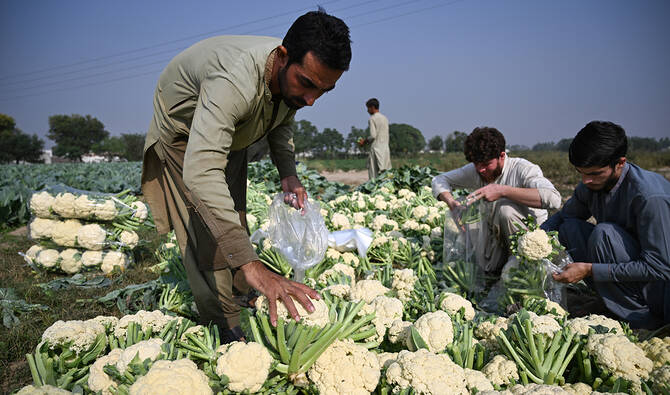
Farmers pack cauliflowers in bags after harvesting them in a field in Attock district, Punjab province on October 31, 2025. (AFP/ file)
Short Url
Updated 08 January 2026
Follow

Pakistan PM orders plan to boost farm exports, cut trade deficit

  • Shehbaz Sharif calls for institutional reforms to strengthen exports, warns against delaying tax refunds
  • Pakistan has been striving for export-led economic growth while upgrading its ports and logistics systems

ISLAMABAD: Prime Minister Shehbaz Sharif on Wednesday ordered officials to draw up a plan to increase agricultural exports and reduce the country’s trade deficit, highlighting the government’s push toward export-led growth as the economy shows signs of stabilization.

The directive comes amid Islamabad’s efforts to strengthen foreign exchange inflows, expand export destinations through economic diplomacy and shift growth away from consumption-led demand, following months of fiscal tightening and external financing pressures.

“Achieving export-based growth targets is our priority,” Sharif said while chairing a review meeting on export promotion, according to a statement from his office.

It added that the prime minister “directed authorities to draw up a plan to boost exports, especially agricultural exports, and cut the trade deficit.”

Sharif instructed authorities to fast-track institutional reforms aimed at improving facilitation for exporters and warned that any delays in processing tax refunds would be unacceptable.

He also directed officials to work with the Rice Exporters Association to develop a strategy to boost rice exports, with Islamabad holding talks with several countries on government-to-government agreements to expand overseas sales.

Officials briefed the meeting on plans to increase exports from high-value sectors such as engineering goods, pharmaceuticals, medical devices and processed foods, while upgrading ports and logistics systems to ease trade bottlenecks and integrate Pakistan more deeply into global value chains.


Pakistan consults banks on financial stability as Middle East conflict rattles global markets

Updated 5 sec ago
Follow

Pakistan consults banks on financial stability as Middle East conflict rattles global markets

  • Finance minister says government monitoring global supply chains, energy markets amid regional tensions
  • Banks pledge coordination with government and central bank to ensure uninterrupted financial services

KARACHI: Pakistan’s finance minister held consultations with the country’s banking sector on Wednesday to review potential economic risks from the escalating Middle East conflict and ensure financial stability, according to a government statement.

The virtual meeting between Finance Minister Muhammad Aurangzeb and senior representatives of the Pakistan Banks’ Association (PBA) came as tensions involving the United States, Israel and Iran have driven volatility in global oil and financial markets, raising concerns for import-dependent economies such as Pakistan.

Islamabad has already faced pressure from rising fuel prices and potential supply disruptions in energy markets, prompting officials to closely monitor global developments and assess possible impacts on inflation, external accounts and broader macroeconomic stability.

“The discussion focused on the evolving economic and financial situation in light of prevailing regional developments and the importance of close coordination between the government, the State Bank of Pakistan, and the banking sector to ensure financial stability and uninterrupted financial services,” the finance ministry said in a statement after the minister's meeting with PBA officials. 

Aurangzeb told banking leaders the government had established a high-level coordination mechanism involving key economic ministries and institutions to continuously review developments in global markets, particularly in supply chains and energy.

He said authorities were conducting regular scenario analysis to evaluate possible implications for inflation, external accounts and overall economic stability while ensuring the continuity of essential supplies.

“The government remains engaged with relevant stakeholders and international partners as part of its efforts to safeguard the country’s economic interests,” the minister said, according to the statement.

Aurangzeb also emphasized the importance of coordinated decision-making and operational resilience within the financial sector during periods of uncertainty, encouraging banks to continue supporting businesses and customers while maintaining responsible risk management.

PBA Chairman Zafar Masud briefed the finance minister on the banking sector’s internal consultations and preparedness measures in response to the evolving situation, the statement said. 

Masud said the banking industry had set up a coordination framework for timely consultation and information sharing among financial institutions, aimed at ensuring the smooth functioning of financial services and payment systems.

He added that banks would remain in close engagement with the State Bank of Pakistan and other stakeholders while maintaining regular consultations within the industry to monitor developments and support financial market stability.