

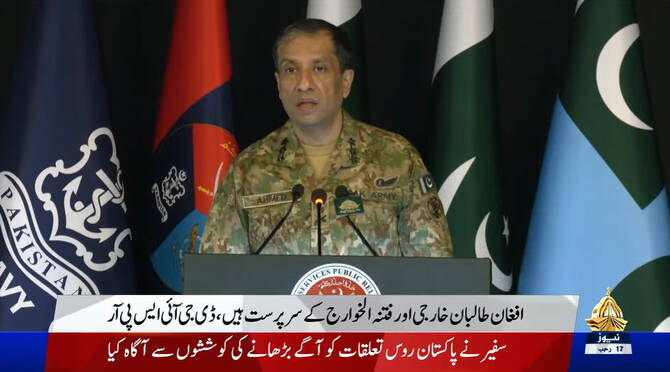

ISLAMABAD: Incidents of militant violence in Pakistan have notably decreased since October last year after Islamabad took punitive measures against neighboring Afghanistan, including border closures and strikes against suspected militant hideouts, the Pakistani military said on Tuesday.
Islamabad has frequently accused Afghanistan of allowing militant groups, including the Tehreek-e-Taliban Pakistan (TTP) and the Balochistan Liberation Army (BLA), to operate on its soil and India of backing them in attacks against Pakistan. Kabul and New Delhi deny the allegations.
The surge in militant violence in Pakistan triggered one of the worst skirmishes between Pakistan and Afghanistan in Oct. last year, after Islamabad hit what it called TTP targets inside Afghanistan. Pakistan has since suspended all trade with Afghanistan, despite a ceasefire reached between the neighbors in Doha on Oct. 19.
Speaking at a press conference, Pakistani military spokesman Lt. Gen. Ahmed Sharif Chaudhry highlighted Pakistan’s counter-terrorism efforts and said security forces had conducted 75,175 intelligence-based operations (IBOs) last year, killing 2,597 militants.
“There were 761 terrorism incidents reported across Pakistan in 2021, while the number went up to 5,397 in 2025,” he said. “Before Oct. 2025, there were 540 terror incidents occurring monthly, but the number has come down to 469 per month after Pakistan took strong measures.”
The military spokesman accused Kabul of violating a 2020 Doha agreement with the United States (US) that outlined a phased US troop withdrawal from Afghanistan in exchange for the Taliban’s security guarantees and commitments against militancy among other things.
Chaudhry said the incidents of militant violence in Pakistan had steadily increased since the Taliban took control of Kabul in 2021, adding that many militants involved in major incidents in Pakistan were of Afghan origins. Pakistan has also repatriated 1.96 million Afghan refugees in a drive against illegal foreigners that began in late 2023, he added.
“According to a UN report, about 20 terrorist groups are operating in Afghanistan,” Chaudhry said, adding that these groups were also targeting countries like China, Iran and Tajikistan.
Chaudhry also accused India of collaborating with Afghanistan-based militant groups to orchestrate attacks inside Pakistan, saying that Islamabad is fully prepared to defend itself against any aggression from either side. New Delhi did not immediately respond to the statement.
“Pakistan wants a verifiable mechanism from Afghanistan to ensure no terrorists cross into Pakistan,” he reiterated.
In response to the Pakistani military statement, Taliban spokesman Zabiullah Mujahid said Kabul condemns these “irresponsible and provocative” remarks and urges the relevant Pakistani institutions to refrain from “unfounded propaganda about Afghanistan.”
“Afghanistan is an independent and stable country with a strong security system and decisive leadership that exercises full sovereignty over all its territory,” Mujahid said on X.
“We emphasize that any statements or threatening language interfering in Afghanistan’s internal affairs are completely unacceptable to the Afghan nation.”
‘LANDMARK’ YEAR
Chaudhry described 2025 as a “landmark” year in the country’s long-running fight against militancy even as violence claimed the lives of 1,235 civilians and law-enforcement personnel.
According to military data presented at the briefing, Pakistan recorded 5,397 militant incidents nationwide during the year. The northwestern Khyber Pakhtunkhwa province accounted for 3,811 attacks, while 1,557 incidents were reported in the southwestern province of Balochistan.
Chaudhry said an “exceptionally high number” of counterterrorism missions were carried out in 2025, averaging more than 200 intelligence-based operations per day.
“The past year was a landmark and consequential one in the war against terrorism,” he said. “This year, complete alignment was achieved between the Pakistani state and the public on the issue of terrorism.”
He rejected allegations of civilian harm during counterterrorism operations, saying Pakistani forces had caused no “collateral damage” while carrying out actions against militants.
‘POLITICALLY CONDUCIVE ENVIRONMENT’
The military spokesman criticized the provincial government of Pakistan’s northwestern Khyber Pakhtunkhwa (KP) province, which is ruled by jailed former prime minister Imran Khan’s Pakistan Tehreek-e-Insaf (PTI) party.
“Out of total 5,397 terrorist incidents in 2025, 71 percent occurred in the Khyber Pakhtunkhwa province,” he said, attributing this number to what he called a “politically conducive environment” in the province.
Khan, who has waged an unprecedented campaign against Pakistan’s powerful military since his ouster in a no-trust vote in 2022, has repeatedly called for talks with militant groups instead of the use of force.
Chaudhry reaffirmed the military’s commitment to protecting Pakistan’s sovereignty and national integrity, saying security forces would continue their operations in KP under the federal government’s mandate despite Provincial Chief Minister Sohail Afridi’s opposition to military campaigns.
He praised the Balochistan government for taking steps to curb the root causes of militancy, sharing that a crackdown on smuggled Iranian oil has increased provincial revenues by 82 percent.


