

Pressure builds for answers over Swiss bar fire after victims identified

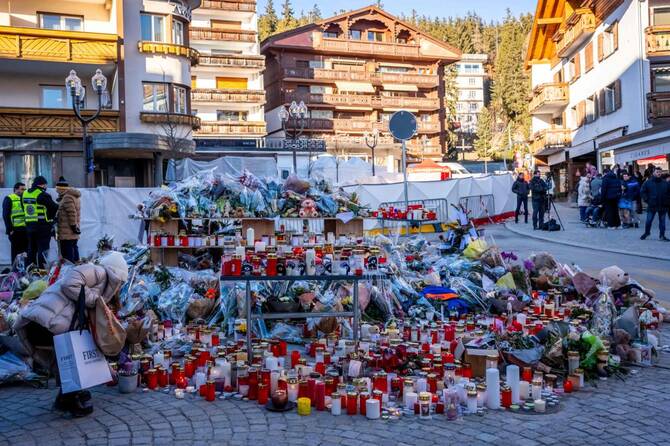
A mourner lays a flower bouquet at a makeshift memorial near the Constellation bar, on January 4, 2026, in Crans-Montana in honour of the victims of the fire that ripped through the venue in the luxury Alpine ski resort on New Year's Eve. (AFP)
Short Url
Updated 05 January 2026
Follow

Pressure builds for answers over Swiss bar fire after victims identified

  • All 40 victims of New Year fire now identified
  • Prosecutors say ‘fountain candles’ likely cause of blaze

CRANS-MONTANA, Switzerland: Pressure was building for answers on Monday from the investigation into a New Year bar fire in a Swiss ski resort that killed 40 people, after authorities said they had now identified all the victims, most of whom were teenagers.
The Alpine getaway of Crans-Montana in the canton of Valais united in mourning on Sunday with condolences coming in from leaders ranging from Pope Leo to Chinese President Xi Jinping.
Prosecutors said the fire that spread rapidly in the ‌early hours of January ‌1 was likely caused by sparkling candles igniting the ‌ceiling ⁠of ​the ‌bar’s basement.

CRIMINAL INVESTIGATION
Authorities are investigating the two people who ran the bar on suspicion of crimes including homicide by negligence. On Sunday, police said circumstances did not currently merit them being put under arrest and they did not see a flight risk.
On Monday morning, Swiss newspaper Blick said anger over the case was growing.
“Why are the couple running the bar free?” the paper said on its front page, pasted over ⁠a photo of mourners and media gathered around the huge pile of flowers left in front of the “Le ‌Constellation” bar.
The youngest victims of the blaze, which ‍also injured well over 100 people, ‍were only 14 years old, and the dead were from all around Europe, ‍including several from France and Italy. Swiss authorities have not named the victims.
Italian Deputy Prime Minister Matteo Salvini said in a social media post that “in civilized Switzerland, the prison gates will have to open for quite a few people.”
Salvini said there had been a ​failure to ensure the bar’s basement was safe, questioning the emergency systems and whether there had been enough inspections.

SILENT PROCESSION
Aika Chappaz, a local ⁠resident who took part in a silent procession through the town on Sunday, said justice must be done for the sake of future generations.
“It’s crucial that such a tragedy never happens again. And the investigation must be thorough, because it’s so unbelievable,” she said.
Tages-Anzeiger, another leading Swiss newspaper, said questions must be answered about the age checks at the bar, the soundproofing material used in the basement and the standards governing use of the so-called fountain candles.
One of the bar’s two operators, Jacques Moretti, told Swiss media that Le Constellation had been checked three times in 10 years and that everything was done according to the rules.
Valais authorities say investigators were checking ‌if the bar had undergone its annual building inspections, but that the town had not raised concerns or reported defects to the canton.


NATO wants ‘automated’ defenses along borders with Russia: German general

Updated 24 January 2026
Follow

NATO wants ‘automated’ defenses along borders with Russia: German general

  • That zone would act as a defensive buffer before any enemy forces advanced into “a sort of hot zone,” said Lowin
  • The AI-guided system would reinforce existing NATO weapons and deployed forces, the general said

FRANKFURT: NATO is moving to boost its defenses along European borders with Russia by creating an AI-assisted “automated zone” not reliant on human ground forces, a German general said in comments published Saturday.
That zone would act as a defensive buffer before any enemy forces advanced into “a sort of hot zone” where traditional combat could happen, said General Thomas Lowin, NATO’s deputy chief of staff for operations.
He was speaking to the German Sunday newspaper Welt am Sonntag.
The automated area would have sensors to detect enemy forces and activate defenses such as drones, semi-autonomous combat vehicles, land-based robots, as well as automatic air defenses and anti-missile systems, Lowin said.
He added, however, that any decision to use lethal weapons would “always be under human responsibility.”
The sensors — located “on the ground, in space, in cyberspace and in the air” — would cover an area of several thousand kilometers (miles) and detect enemy movements or deployment of weapons, and inform “all NATO countries in real time,” he said.
The AI-guided system would reinforce existing NATO weapons and deployed forces, the general said.
The German newspaper reported that there were test programs in Poland and Romania trying out the proposed capabilities, and all of NATO should be working to make the system operational by the end of 2027.
NATO’s European members are stepping up preparedness out of concern that Russia — whose economy is on a war footing because of its conflict in Ukraine — could seek to further expand, into EU territory.
Poland is about to sign a contract for “the biggest anti-drone system in Europe,” its defense minister, Wladyslaw Kosiniak-Kamysz, told the Gazeta Wyborcza daily.
Kosiniak-Kamysz did not say how much the deal, involving “different types of weaponry,” would cost, nor which consortium would ink the contract at the end of January.
He said it was being made to respond to “an urgent operational demand.”