

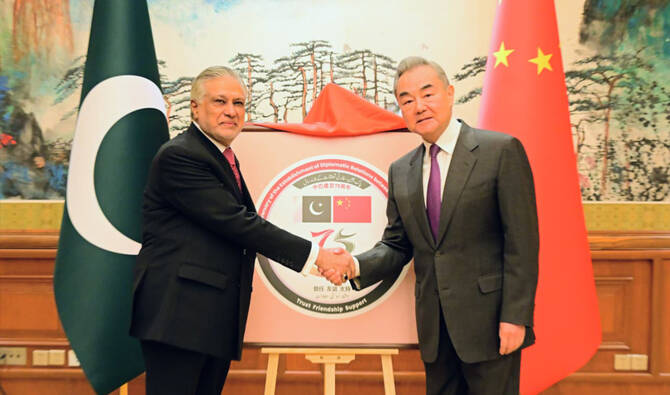


ISLAMABAD: China and Pakistan on Sunday described their bilateral partnership as “vital for peace and stability” in the region as top officials from both sides reviewed the full spectrum of ties and pledged to deepen cooperation, amid evolving regional and global challenges.
The remarks came during the latest round of the Pakistan–China Foreign Ministers’ Strategic Dialogue in Beijing, co-chaired by Pakistani Foreign Minister Ishaq Dar and his Chinese counterpart Wang Yi, at which the two sides discussed political, economic and security cooperation, and reaffirmed mutual support on core interests.
While Beijing maintains close defense, diplomatic and economic ties with Islamabad, it has a recurring border dispute with New Delhi, which Washington and allies have long viewed as a counterbalance to China. A rising military superpower, China hasn’t fought a major war in over four decades but has raced under President Xi Jinping to modernize its armed forces, develop sophisticated weaponry and cutting-edge technologies, extending that modernization drive to Pakistan.
During the 7th round of Pakistan–China Foreign Ministers’ Strategic Dialogue in Beijing, the two sides reviewed the entire spectrum of Pakistan–China relations and discussed key issues at the regional and global levels.
“Views were exchanged on CPEC [China-Pakistan Economic Corridor], trade, multilateral cooperation, and people-to-people exchanges,” the Pakistani foreign office said in a statement.
“Highlighting the salience of the All-Weather Strategic Cooperative Partnership, both leaders reaffirmed that the Pakistan–China friendship is vital for peace, stability, and prosperity in the region and for the two countries.”
The development comes months after Pakistan declared victory in a four-day military conflict with India, saying its air force used Chinese J-10C aircraft to shoot down six Indian fighter jets, including three French Rafales. Though Indian officials have acknowledged losses, they have not specified the number of jets downed by Pakistan in May.
Over the past five years, China has supplied 81 percent of Pakistan’s imported weapons, according to data from the Stockholm International Peace Research Institute (SIPRI). Those exports include advanced fighter jets, missiles, radars and air-defense systems. Some Pakistan-made weapons have also been co-developed with Chinese firms or built with Chinese technology and expertise.
Both foreign ministers agreed to enhance coordination at bilateral and multilateral fora as well as to befittingly celebrate the 75th anniversary of the establishment of Pakistan–China diplomatic relations.
China is Pakistan’s largest trading partner. According to China’s General Administration of Customs, its bilateral trade with Pakistan reached $23.06 billion in 2024, up by 11.1 percent on a year-on-year basis. Islamabad also views Beijing as a key investment partner which has funneled billions of dollars into the country under the CPEC energy and infrastructure project for over a decade.
The Foreign Ministers’ Strategic Dialogue is the highest consultative mechanism between Pakistan and China, providing a structured platform to review the entire spectrum of bilateral cooperation, as well as regional and international developments of mutual interest.
Earlier during his visit to Beijing, Dar met Liu Haixing, the Chinese Minister of the International Department of the Communist Party of China.
“The two sides expressed satisfaction with the steady and forward-looking trajectory of bilateral relations, while reviewing party-to-party exchanges, regional developments, and progress on various projects under CPEC,” the foreign office said in a statement.
The Pakistani deputy premier also met China’s Executive Vice Premier Ding Xuexiang, according to the statement. The Chinese official appreciated Pakistan’s consistent support to Beijing on issues of core interest.


