

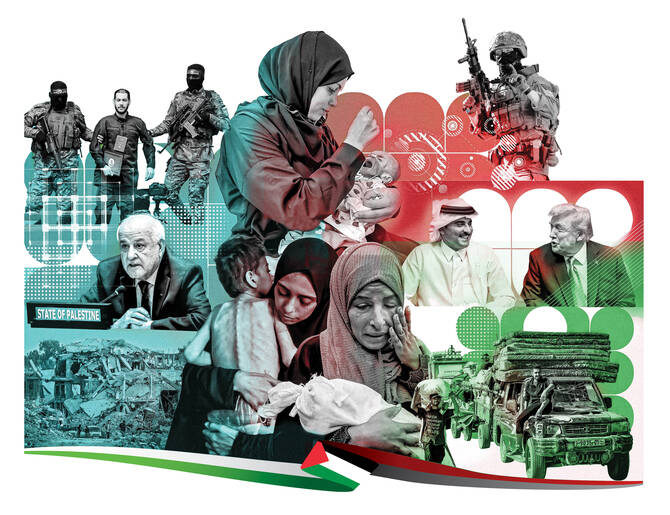

DUBAI: War-weary Gaza enters 2026 amid cold weather, flooded tents and bombed-out homes. Israel’s offensive has displaced hundreds of thousands and damaged or destroyed 80 percent of the enclave’s buildings. With shelters inadequate and supplies scarce, Palestinians’ suffering deepens as winter sets in.
But global attention is now gripped by crises elsewhere, including the US capture of Venezuela’s president, Israel’s recognition of Somaliland statehood, and conflict in southern Yemen. Against that backdrop, Israel’s continued violations in Gaza and the occupied West Bank, including East Jerusalem, have largely receded from view.
As the new year begins, Palestinians across the occupied territories face deep uncertainty over what 2026 may bring.
The US administration has signaled it will soon announce the next phase of its Gaza plan, which would include further Israeli withdrawals, an international stabilization force, and a new governing structure for Gaza with broad international participation.

Palestinians make their way to flee their homes, after the Israeli army issued evacuation orders for a number of neighborhoods, following heavy Israeli strikes, in Beit Hanoun in the northern Gaza Strip March 19, 2025. (Reuters/File)
But as officials debate the future of a population devastated by over two years of war, conditions on the ground continue to deteriorate. Severe cold, flooding and collapsing shelters caused by torrential rains have killed at least 18 people in recent weeks, according to local health authorities.
Amnesty International said in December the deaths were “utterly preventable,” blaming Israel’s ongoing restrictions on the entry of critical supplies needed to repair damaged infrastructure.
Unless aid is allowed to flow freely into Gaza, rights groups warn that the dire humanitarian situation under the fragile ceasefire will continue to worsen well into 2026.
UN agencies have warned that humanitarian conditions in Gaza will remain “catastrophic” this year. An estimated 1.9 million people still require urgent shelter support, water and sanitation systems remain badly damaged, and winter storms are compounding risks for those living in tents or ruined buildings.
Those conditions are expected to worsen further as Israel tightens restrictions on aid operations.

Riyad H. Mansour, Palestinian Permanent Observer to the United Nations, addresses delegates after the United Nations General Assembly. (Reuters/File)
New limits affecting 37 international NGOs, along with legislation targeting the UN relief agency for Palestinian refugees (UNRWA), are likely to disrupt humanitarian work if not reversed.
Aid groups warn the impact could be “fatal” for civilians who depend on outside assistance to survive.
In December, Israel said it will revoke the operating licenses of several aid groups, including Doctors Without Borders (MSF) and the Norwegian Refugee Council, accusing them of failing to meet security and transparency requirements. Those requirements include disclosing the identities and roles of Palestinian staff to “rule out any links to terrorism.”

MSF told the AFP news agency that it “would never knowingly employ people engaging in military activity,” adding that such individuals would “pose a danger to our staff and our patients.”
“If MSF is prevented from working in Gaza, it will deprive hundreds of thousands of people from accessing medical care,” the organization told Reuters, underscoring the stakes for civilians already struggling to obtain health services.
For its part, the Norwegian Refugee Council told Reuters that “at a time when needs in Gaza far exceed the available aid and services, Israel has and will continue to block life-saving aid from entering.”

Members of Israeli forces hold guns, during an Israeli raid in Ramallah, in the Israeli-occupied West Bank. (Reuters/File)
These restrictions come as food insecurity remains acute. The latest Integrated Food Security Phase Classification analysis projects that, despite modest improvements after the ceasefire, hundreds of thousands of people in Gaza will remain in “emergency” food insecurity and over 100,000 in “catastrophe/famine” conditions into 2026.
The analysis also estimates that by October 2026, at least 101,000 children between six and 59 months will suffer from acute malnutrition, and nearly 37,000 pregnant and breastfeeding women will require urgent nutritional support.
A separate conflict-risk forecast by the Peace Research Institute Oslo anticipates fewer conflict-related deaths in Palestine in 2026 than in 2025, largely due to the Gaza ceasefire. Still, it warns that renewed large-scale fighting cannot be ruled out.

Nemah Hamouda prepares food for her grandchildren using limited ingredients, amid a critical shortage of infant formula and widespread malnutrition, in Gaza City, July 29, 2025. (Reuters/File)
Israel’s campaign in Gaza, launched after a Hamas-led attack in southern Israel on Oct. 7, 2023, has killed more than 71,000 Palestinians, most of them civilians, according to local health authorities.
The US-brokered ceasefire that took effect Oct. 10 has not ended Israeli strikes. Since then, at least 414 Palestinians have been reportedly killed and more than 1,140 injured.
Israeli human rights organizations have described 2025 as the “deadliest and most destructive” year for Palestinians since 1967, citing a sharp escalation in killings and displacement across Gaza and the occupied West Bank.
A joint report released in early December by 12 Israeli rights groups said the death toll in Gaza surpassed 36,000 by March 2024 and rose to 67,173 by October 2025. More than 20,000 children and about 10,000 women were among the dead, while the number of wounded exceeded 170,000.
In the West Bank, conditions appear only marginally less dire. The situation is expected to remain highly volatile in 2026 as home demolitions, Israeli military operations, settler violence and movement restrictions continue to drive displacement and humanitarian need.

A Palestinian boy, Amjad Al-Kanoo, who suffers from malnutrition is held by his mother, Nada, as they wait to be transferred for treatment outside Gaza. (Reuters/File)
In the 2026 UNRWA Flash Appeal for the Occupied Palestinian Territory, UN humanitarian partners said they would prioritize coordinated assistance for families displaced by demolitions, forced evictions, military operations, and settler attacks across the West Bank.
The Norwegian Refugee Council has warned that the territory continues to experience its largest displacement crisis since 1967, with more than 35,000 Palestinians uprooted by Israeli operations, settler violence and demolitions.
Indeed, humanitarian agencies have described 2025 as one of the most dangerous years on record in the West Bank. UN data show that June 2025 saw the highest monthly number of Palestinians injured by settlers since record-keeping began in 2005.
Those attacks coincided with increasingly aggressive Israeli raids, including one in the town of Kafr Malik that killed several Palestinians and wounded others.
By July 21, at least 159 Palestinians had been killed by Israeli forces in the West Bank since the start of the year. By early December, UN figures put the 2025 death toll at more than 227, amid a sharp escalation in raids and settler violence.

General view of destroyed buildings in Gaza, as seen from the Israel-Gaza border, March 19, 2025. (Reuters/File)
The impact has been particularly visible in Tulkarem and Jenin, where Israeli raids, settler attacks and expanding no-go zones have further eroded Palestinian Authority control. Armed groups have moved into the resulting security vacuum, pushing parts of the territory beyond Ramallah’s administrative reach.
Despite the conflict remaining far from resolved, some diplomats point to a narrow opening toward de-escalation in 2026, driven by intense international pressure.
However, with Israel in the grip of political turmoil and hardline leadership, the PA still not reformed and questions over Hamas disarmament far from resolved, a lasting resolution of the Middle East conflict and Palestinian self-determination remain elusive.
For ordinary Palestinians, uncertainty is measured less in diplomatic plans than in daily survival. As 2026 begins, people in Gaza and the West Bank are entering the new year not with recovery, but with ongoing displacement, insecurity and a deepening sense of international abandonment.


