

West Bank communities come under attack from Israeli settlers

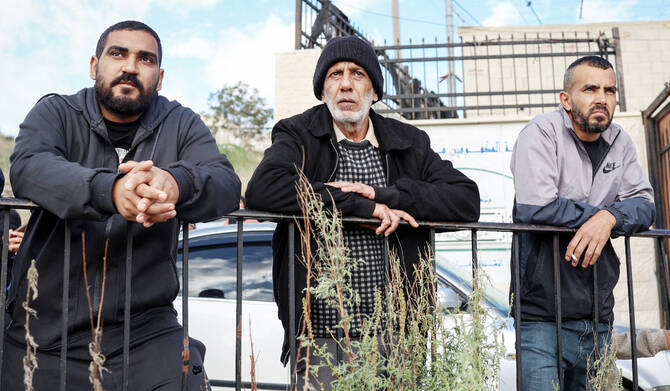
Residents of the Nur Shams Palestinian refugee camp watch their homes being demolished on New Year’s eve by an Israeli military excavator, east of Tulkarm. (AFP)
Short Url
Updated 02 January 2026
Follow

West Bank communities come under attack from Israeli settlers

  • Attacks on homes, land, religious sites supported by Israeli troops, witnesses say

RAMALLAH: Israeli settlers launched a series of attacks on Palestinian communities in the occupied West Bank on Friday, the Palestinian news agency WAFA reported.

The assaults targeted homes, a mosque and agricultural land and were frequently accompanied or protected by Israeli troops, local sources were cited as saying.
In Khalayel Al-Lawz, southeast of Bethlehem, settlers threw stones at people’s homes and surrounded the area. In some cases, trees were uprooted and farmers were prevented from accessing their land.
Israeli forces provided protection for the attackers and in some cases threw stun grenades and tear gas canisters into properties, the report said. The military also later sealed off the area. In a separate attack in Al-Jiftlik, north of Jericho in the eastern West Bank, several members of the Ka’abneh family were assaulted by settlers, the report said.
Hassan Salem and Mousa Odeh Ka’abneh were later detained by Israeli forces, Eid Barahmeh, director of the Palestinian Prisoners’ Society in Jericho, said.
Israeli authorities also issued demolition orders for several homes in the village, claiming their owners lacked the appropriate building permits.
In an incident in Deir Ballut, Salfit district, settlers stormed Al-Salam Mosque, damaging its contents, and caused disruption by blocking roads into the town.
The attack reflected a growing pattern of violence in the area, where settlers have increasingly been targeting religious sites, the report said.
In Turmus Ayya, north of Ramallah, Israeli forces bulldozed agricultural land near the home of the Abu Awwad family and uprooted dozens of ancient olive trees.
Witnesses said the attacks had been going on for three months and that about 4,000 olive trees had been pulled up and hundreds of acres of land plowed to make way for a new Israeli outpost west of the town.
Palestinian authorities, human rights groups and international observers, including the UN, have reported a sharp increase in violence against Palestinian communities by settlers, often supported by Israeli troops.


Tunisian police arrest member of parliament who mocked president

Updated 05 February 2026
Follow

Tunisian police arrest member of parliament who mocked president

  • Ahmed Saidani mocked the president in a Facebook post, describing him as the “supreme commander of sewage and rainwater drainage”

TUNIS: Tunisian police arrested lawmaker Ahmed Saidani on Wednesday, two of his colleagues ​said, in what appeared to be part of an escalating crackdown on critics of President Kais Saied.
Saidani has recently become known for his fierce criticism of Saied. On Tuesday, he mocked the president in a Facebook post, describing him as the “supreme commander of sewage and rainwater drainage,” blasting what he said ‌was the absence ‌of any achievements by Saied.
Saidani ‌was ⁠elected ​as ‌a lawmaker at the end of 2022 in a parliamentary election with very low voter turnout, following Saied’s dissolution of the previous parliament and dismissal of the government in 2021.
Saied has since ruled by decree, moves the opposition has described as a coup.
Most opposition leaders, ⁠some journalists and critics of Saied, have been imprisoned since he ‌seized control of most powers in 2021.
Activists ‍and human rights groups ‍say Saied has cemented his one-man rule and ‍turned Tunisia into an “open-air prison” in an effort to suppress his opponents. Saied denies being a dictator, saying he is enforcing the law and seeking to “cleanse” the country.
Once a supporter ​of Saied’s policies against political opponents, Saidani has become a vocal critic in recent months, accusing ⁠the president of seeking to monopolize all decision-making while avoiding responsibility, leaving others to bear the blame for problems.
Last week, Saidani also mocked the president for “taking up the hobby of taking photos with the poor and destitute,” sarcastically adding that Saied not only has solutions for Tunisia but claims to have global approaches capable of saving humanity.
Under Tunisian law, lawmakers enjoy parliamentary immunity and cannot be arrested for carrying out their ‌duties, although detention is allowed if they are caught committing a crime.