PTCL completes $400 million acquisition of Telenor Pakistan

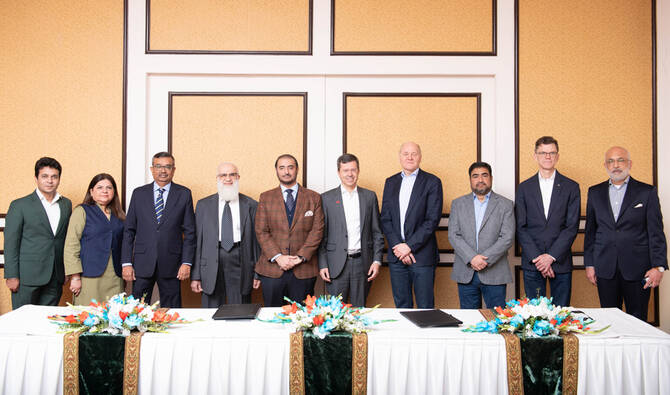
Officials from Pakistan Telecommunication Company Limited (PTCL) and Telenor Pakistan (Pvt) Ltd. pose for a group photo after signing an agreement in Islamabad, Pakistan, on December 14, 2023. (PTCL/File)
Short Url
Updated 31 December 2025
Follow

PTCL completes $400 million acquisition of Telenor Pakistan

  • Deal will see PTCL’s Ufone merge with Telenor Pakistan to create country’s second-largest mobile operator
  • PTCL has said acquisition will help improve customer experience, enhance network quality and coverage

KARACHI: The Pakistan Telecommunication Company Limited (PTCL) announced on Wednesday that it has acquired 100 percent shares of Telenor Pakistan (Private) Limited, with the move expected to reshape Pakistan’s telecom landscape. 

PTCL signed a share purchase agreement with Norway’s Telenor Group in December 2023 to acquire 100 percent stakes in Telenor Pakistan and Orion Towers (Private) Limited for $400 million. The acquisition will see PTCL’s mobile arm, Ufone, merge with Telenor Pakistan to create the country’s second-largest mobile operator.

“It is to notify that PTCL on December 31, 2025, has acquired 100 percent of the shareholding of Telenor Pakistan (Private) Limited and Orion Towers (Private) Limited, and shares have been duly transferred in the name of PTCL,” the company said in a stock filing to the Pakistan Stock Exchange (PSX).

PTCL has previously said the acquisition will help improve customer experience, enhance network quality and coverage, and enable the telecom sector to achieve greater efficiency by building resilient infrastructure and creating a more competitive landscape.

The deal is expected to boost Pakistan’s telecom landscape, which currently has four major operators but continues to face pressure from thin margins, high spectrum costs and heavy capital expenditure requirements.

The acquisition followed approvals from the Competition Commission of Pakistan and the Pakistan Telecommunication Authority earlier this year. 


Pakistan’s 120-year-old wooden mosque draws worshippers, visitors in Ramadan

Updated 10 sec ago
Follow

Pakistan’s 120-year-old wooden mosque draws worshippers, visitors in Ramadan

  • Baba Jee Mosque in northwest Pakistan fills nightly for Taraweeh prayers
  • Hand-carved timber structure reflects century-old Pashtun craftsmanship

LOWER DIR, Pakistan: As dusk settles over Timergara in northwest Pakistan, worshippers stream toward the 120-year-old Baba Jee Mosque, where the holy month of Ramadan brings nightly Taraweeh prayers beneath intricately carved wooden ceilings that have stood for generations.

During Ramadan, Muslims fast from dawn to sunset and gather in the evenings for extended congregational prayers. At Baba Jee Mosque, those gatherings swell, turning the historic structure into one of the region’s spiritual focal points.

The mosque, built in the 1890s by Mian Gul Muhayuddin, a religious figure from the prominent Pashtun Yousafzai tribe known locally as Baba Jee? has long served as a central place of worship for Dir Lower and surrounding districts.

Its significance intensifies during the fasting month when the mosque traditionally holds two Khatm-ul-Qur’an, or the full recitation of the Qur’an during Taraweeh prayers.

“Ten paras would be recited every day by two reciters. The two Khatams were completed in six days, three days each, and the mosque used to be full of worshippers,” said Naqeeb Ul Abrar, 62, the mosque’s custodian.

For decades, Baba Jee Mosque was the primary congregational mosque for the wider area, drawing worshippers from distant towns in a mountainous region near the Afghan border.

“In the past, mosques weren’t in such numbers as they are now. It was the only mosque where the Friday and Eid congregations were offered,” Abrar said. “People from far-flung areas like Medan, Rabat, Talash (Dir Lower), Arang (Bajaur), and Dir (Upper) would come for Friday and Eid prayers.”

For many locals, attending Baba Jee Mosque during Ramadan is a generational tradition.

“I have been coming to this mosque for the last 35-40 years,” said Burhan Uddin, 59. “Earlier, my grandfather would come here, and then my father would come, and this whole journey continues for 115-120 years. I am coming regularly now.”

“THE SOUL FEELS HAPPY HERE”

Beyond its Ramadan crowds, the mosque stands out for its remarkable preservation. 

Made of mud-plastered walls painted white, the structure is supported by large timber beams resting on ornately carved wooden columns. The heavy doors open inward with a distinct cracking sound, a reminder of its age.

Abrar said building the mosque in the late 19th century was an arduous task in the mountainous terrain, long before modern transport.

“This mosque was made with a lot of struggle. At that time, there was no transportation, so the wood was transported through the river Panjkoora,” he said. “They would drop all the large and big wood into the river water at Dir (Upper) and would collect it in Timergara.”

Craftsmen renowned for their skills were brought from Peshawar’s Tehkal area and Mardan’s Londkhwar to execute the detailed woodwork that still defines the interior.

“After completion, Baba Jee Sab [Mian Gul Muhayuddin] offered prayer for 12 years followed,” Abrar said. “The height of the mosque is 17 feet, and the width of the stone wall is 3.5 feet.”

The main hall accommodates around 500 worshippers inside and up to 800 more in the courtyard. While modern extensions using cement, tiles and marble have expanded capacity, the original wooden hall remains the mosque’s architectural and spiritual heart.

Many visitors are drawn by the craftsmanship that predates machinery.

“The wooden work here is done with detailed, hard work. At that time, it was done by hand with files, chisels, and screwdrivers,” Uddin said. 

“Now it is the time of machines, everything is done fast. This work has been done by hand, god knows how much time it would have taken. It is a kind of antique work, so many people come to see it too.”

Seventy-five-year-old Saeed ur Rahman said the mosque’s atmosphere remains unchanged despite modern development around it.

“People from Timergara and the surrounding areas come and offer their prayers here,” he said.

Recalling childhood memories, Rahman described how religious lessons and extended Qur’an recitations have long been part of the mosque’s Ramadan traditions.

“In the past, there used to be Darsi Qur’ani, and so it is now. The Khatm-ul-Qur’an (in Taraweeh) is done in Ramadan, and there are madrassa students, and I have been coming here to offer prayers for a very long time now.”

He said praying inside the wooden structure brings a particular sense of peace.

“Look, where stands the beauty of marble and where does the beauty of wood. In the wooden construction, the soul feels happy here. Look how beautiful its ornamentation is.”