

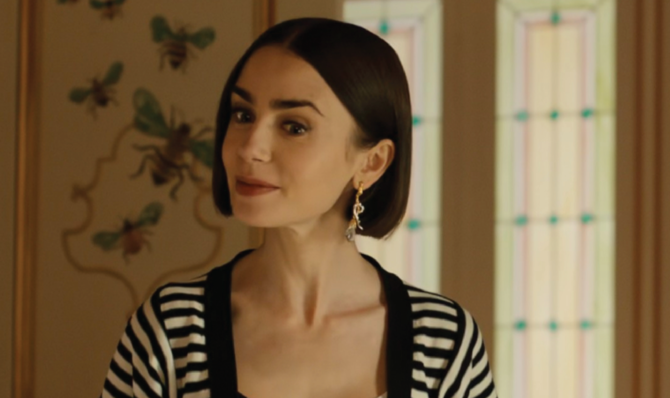
Lily Collins shows her appreciation for Arab designers

Her character in ‘Emily in Paris’ was seen wearing jewelry from Egyptian label Jude Benhalim. (Supplied)
Short Url
Updated 23 December 2025
Follow

Lily Collins shows her appreciation for Arab designers

DUBAI: Actress Lily Collins has made her appreciation for Arab designers very clear — both in her personal style and through her role as Emily Cooper in Netflix’s hit show “Emily in Paris.”

Over the years, she has worn creations by designers such as Georges Hobeika and Elie Saab, and that influence now extends to the show’s styling.

Since season five premiered, fans have spotted several jewelry pieces worn by Collins on screen from Egyptian label Jude Benhalim. Her character is seen wearing a mix of the brand’s designs, including the Mini Harmonia earrings alongside the Elara earrings.

The styling leans into playful layering, with the Mini Gemino and Gemino earrings worn together. The jewelry is finished with rings such as the Cassandra Mix ring, paired with the Riverstone Mix and Gemino Mix rings.

This is not the first time the actress has showed off jewelry from the Cairo-based label on the show.

Last year, the Ripple Ring in gold is seen on Collins in episode six of season four. Also in episode six, Camille’s mother, Louise, played by Camille Japy, shines in the Droplet Earrings in white.

Additionally, Mindy Chen, brought to life by Ashley Park, is spotted wearing the Elea Hoops in the same episode.

Benhalim, who is part-Libyan and part-Syrian, and grew up in Egypt, founded her eponymous brand in 2011 when she was just 17, and has since gone on to release a number of lines that each pay tribute to her heritage, finding fans in a handful of celebrities.

In a released statement, Benhalim said: “Seeing Jude Benhalim return to ‘Emily in Paris’ is incredibly meaningful. The show celebrates individuality, confidence and self-expression — values that are deeply rooted in our brand.

“Dressing Emily for a second season felt like a continuation of a story rather than a placement, where the jewelry becomes part of her identity,” she added.

“Emily in Paris” is a romantic dramedy about Cooper, an ambitious American marketing exec trying to juggle work, love and friendship while living abroad — first in Paris and now splitting her time between Paris and Rome. Season five debuted on Dec. 18, continuing Emily’s stylish (and often chaotic) European adventures.


At Jazan festival, Suad Al-Asiri paints memory, land and leadership

Updated 13 January 2026
Follow

At Jazan festival, Suad Al-Asiri paints memory, land and leadership

  • Local artist channels personal hardship into works that reflect Jazan’s identity, heritage
  • Jazan: A Nation and a Prince, places region at the heart of a composition featuring Prince Mohammed bin Abdulaziz and Prince Nasser bin Mohammed bin Abdullah bin Jalawi

RIYADH: At the Ahad Al-Masarihah pavilion at Jazan Festival 2026, Suad Al-Asiri’s paintings blend memory, place and personal history, offering visual narratives shaped by beauty and hardship. 

A novelist and visual artist, Al-Asiri has long used art as a storytelling tool. After a near-fatal car accident in March 2024, her work took on a new urgency. Bedridden for 11 months, cut off from the public world for more than a year, she describes that period as one of the most painful in her life — yet also transformative. 

“First of all, praise be to God for granting me life, as the accident was extremely severe,” she said. “By God’s grace, I was given a new life. All my thinking after the accident was about becoming an inspiration to others — about enduring pain and obstacles, and still leaving an impact.” 

Her return to public life came in 2025, when she participated in National Day celebrations with the ministry of interior. By the time she arrived at Jazan Festival, she was ready to channel that experience into her art. 

The centerpiece of her display, “Jazan: A Nation and a Prince,” places the region at the heart of a composition featuring Prince Mohammed bin Abdulaziz and Prince Nasser bin Mohammed bin Abdullah bin Jalawi, governor and deputy governor of Jazan respectively. 

Visitors linger over the details: the painting incorporates coffee beans, sesame and khudair — materials drawn from local products.

“I wanted people to recognize these products immediately,” she said. “They are part of Jazan’s daily life, and using them makes the work more tangible, more connected to everyday experience.” 

The painting sparks conversation. Visitors discuss leadership, identity, and the intimate relationship between people and their environment. 

Beyond the central piece, Al-Asiri presents individual portraits of the two princes, expanding the dialogue into a broader exploration of heritage and memory.  

Her journey into art is tied to her life as a storyteller. Early experiments with charcoal and pencil evolved into abstract art, drawn by its expressive freedom. 

From there, she explored realism, surrealism, and eventually modern art, particularly pop art, which has earned her wide recognition in artistic circles. Her novels and media work complement her visual practice, earning her the title “the comprehensive artist” from the governor.

Yet what stands out most in this exhibition is how Al-Asiri’s personal resilience flows through each piece. Her experience of surviving a devastating accident, enduring months of immobility, and returning to the public eye informs every brushstroke. 

Visitors sense not just her artistic skill, but her determination to turn life’s hardships into inspiration for others. 

Walking through the pavilion, one can see it in the way she blends heritage symbols, southern landscapes, and scenes of daily life. 

Each painting becomes both a document and a dialogue — a celebration of Jazan’s culture, a reflection on identity, and a testament to the power of human perseverance. 

At Jazan Festival 2026, Suad Al-Asiri’s art is a quiet, persistent inspiration for anyone who pauses long enough to listen.