

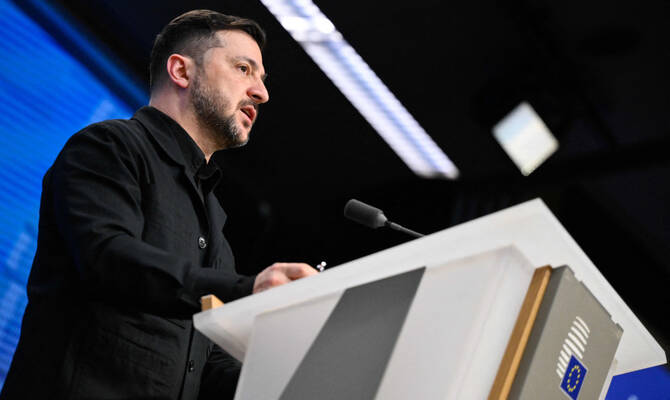

MIAMI: Ukrainian President Volodymyr Zelensky on Saturday called on the United States to put more pressure on Russia to end the war, as diplomats converged on Miami for fresh talks.
Zelensky also said that Washington had proposed the first face-to-face negotiations between Ukraine and Russia in half a year, but later expressed skepticism that would help.
Zelensky said that only the United States was capable of persuading Russia to end the war, and he called on Washington to increase pressure on Moscow to make that happen.
“America must clearly say: if not diplomacy, then there will be full pressure...Putin does not yet feel the kind of pressure that should exist,” he said, stressing the need for more arms supplies to Ukraine and sanctions on the entire Russian economy.
The Ukrainian leader’s comments in Kyiv came as Russian envoy Kirill Dmitriev arrived in Miami where Ukrainian and European teams have also gathered for the negotiations, mediated by US special envoy Steve Witkoff and President Donald Trump’s son-in-law Jared Kushner.
Russian envoy Dmitriev wrote in an X post that he was “on the way to Miami,” adding a peace dove emoji and attaching a short video of a morning sun shining through clouds on a beach with palms. A Russian source, speaking on condition of anonymity, later confirmed to AFP he had arrived in the Florida city.
Trump’s envoys have pushed a peace plan in which the United States would offer security guarantees to Ukraine, but Kyiv will likely be expected to surrender some territory, a prospect resented by many Ukrainians.
However, US Secretary of State Marco Rubio on Friday promised not to force Ukraine into any agreement, saying “there’s no peace deal unless Ukraine agrees to it.” He added that he may join Saturday’s talks in Miami, his hometown.
Earlier Saturday, Zelensky had revealed Washington had proposed negotiations that would include Ukraine, the United States and Russia. He added that Europeans could be present and it would be “logical to hold such a joint meeting.”
But he subsequently told journalists, “I am not sure that anything new could come of it.”
The last time Ukrainian and Russian envoys held official direct talks was in July in Istanbul, which led to prisoner swaps but little else in the way of concrete progress.
Russian and European involvement in Miami marks a step forward from before, when the Americans held separate negotiations with each side in different locations.
However, it is unlikely Dmitriev would hold direct talks with European negotiators as relations between the two sides remain extremely strained.
Moscow, which invaded Ukraine in February 2022, argues that Europe’s involvement in the talks only hinders the process.
Russia presses on
The Florida talks come after President Vladimir Putin vowed to press ahead with his military offensive in Ukraine, hailing Moscow’s battlefield gains nearly four years into his war in an annual news conference on Friday.
Russia announced on Saturday it had captured two villages in Ukraine’s Sumy and Donetsk regions, further grinding through the country’s east in costly battles.
Putin however suggested that Russia could pause its devastating strikes on the country to allow Ukraine to hold a presidential ballot — a prospect which Zelensky rejected.
Meanwhile, the death toll in Ukraine’s Black Sea Odesa region from an overnight Russian ballistic missile strike on port infrastructure rose to eight, with almost three dozen people wounded in the attack.
A civilian bus was struck in the attack, Ukrainian Prime Minister Yulia Svyrydenko said, adding the victims “were ordinary Ukrainians.”
A series of intensified Russian strikes has wrought havoc on the coastline region in recent weeks, hitting bridges and cutting electricity and heating for hundreds of thousands in freezing temperatures.
Moscow earlier said it would expand strikes on Ukrainian ports as retaliation for targeting its sanctions-busting oil tankers.
On Saturday, Ukraine claimed to have destroyed two Russian fighter jets at an airfield in occupied Crimea, according to the security service SBU. Kyiv’s army said it struck a Russian oil rig in the Caspian Sea as well as a patrol ship nearby.
Putin described Russia’s initial invasion as a “special military operation” to demilitarize the country and prevent the expansion of NATO.
Kyiv and its European allies say the war, the largest and deadliest on European soil since World War II, is an unprovoked and illegal land grab that has resulted in a tidal wave of violence and destruction.


