

Anti-fuel smuggling drive boosts Pakistan revenues 82%, PM office says

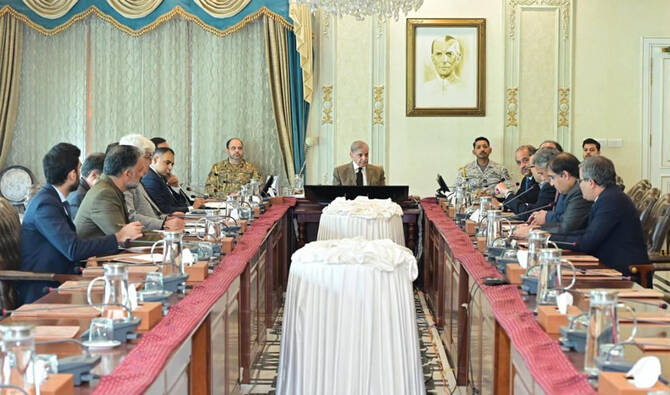
Prime Minister Shehbaz Sharif (center) chairs a weekly performance review meeting of the Federal Board of Revenue (FBR) in Islamabad, Pakistan, on December 19, 2025. (PID)
Short Url
Updated 19 December 2025
Follow

Anti-fuel smuggling drive boosts Pakistan revenues 82%, PM office says

  • Crackdown targets illegal petroleum trade using GPS tracking and pump registration
  • July–November gains cited as government intensifies tax, customs enforcement

ISLAMABAD: The Pakistani prime minister’s office said on Friday revenues from petroleum products rose 82% between July and November 2025 after a nationwide crackdown on fuel smuggling, as the government steps up enforcement to curb tax evasion and losses that have long strained public finances.

The increase was cited during a weekly performance review of the Federal Board of Revenue (FBR), where Prime Minister Shehbaz Sharif directed authorities to accelerate action against smuggling and tax evasion, according to a statement issued by the PM’s Office.

Fuel smuggling has been a persistent problem in Pakistan, where subsidised or untaxed petroleum products are often trafficked across borders or sold through unregistered pumps, depriving the state of revenue and distorting domestic energy markets. Successive governments have blamed the practice for billions of rupees in annual losses, while international lenders have repeatedly urged tighter enforcement as part of broader fiscal reforms.

“Every year the nation loses billions due to smuggling,” Sharif was quoted as saying in a statement, praising customs authorities for successful operations and noting that revenues from petroleum products increased by 82% from July to November 2025 compared with the same period last year.

The PM said stricter enforcement had brought several goods back into the formal economy, adding that there would be “no leniency” toward those involved in tax evasion or illegal trade.

Officials briefed the prime minister that Pakistan Customs has rolled out a nationwide enforcement framework, including GPS tracking of petroleum product transportation, registration of fuel stations through a digital monitoring system, and legal action against illegal machinery under updated petroleum laws.

The government has also instructed provincial administrations to cooperate fully with federal authorities in shutting down illegal petrol pumps, the statement said.

Sharif said enforcement efforts would continue until smuggling networks were dismantled and tax compliance improved, as the government seeks to strengthen revenues amid ongoing economic reforms.

Pakistan has struggled for years with weak tax collection and a narrow revenue base, forcing repeated bailouts from the International Monetary Fund. Smuggling of fuel, cigarettes, electronics and consumer goods has been identified by policymakers as a major obstacle to improving revenues and stabilising the economy.

Independent research shows that Pakistan loses an estimated Rs750 billion (about $2.7 billion) annually in tax revenue due to illicit trade and smuggling across sectors such as petroleum, tobacco and pharmaceuticals. Broader analyzes suggest total tax revenue losses linked to the informal economy and smuggling may reach as high as Rs3.4 trillion (around $12.1 billion) a year, roughly a quarter of the government’s annual tax targets.

Smuggled petroleum products alone are thought to cost the state about Rs270 billion (around $960 million) a year in lost revenue, underscoring why authorities have focused recent enforcement efforts on fuel tracking and pump registration.


Pakistan discovers new oil, gas reserves in push to cut costly imports

Updated 5 sec ago
Follow

Pakistan discovers new oil, gas reserves in push to cut costly imports

  • Exploration firm announces modest discovery of 225 barrels of oil, 1.01 MMSCFD of gas per day
  • Multiple discoveries together could boost domestic production and reduce reliance on imports

ISLAMABAD: Pakistan has announced a modest discovery of new oil and gas reserves in its northwestern Khyber Pakhtunkhwa (KP) province, state media reported on Friday, amid the country efforts to boost exploration to cut costly imports.

Pakistan faces a widening energy gap due to rising demand and limited domestic output, forcing reliance on costly fuel imports that expose the economy to global price swings. Its petroleum, oil, and lubricants import bill fell 4.39 percent to $9.046 billion in July 2025-January 2026.

The discovery was made at Lumshiwal Formation of Baragzai X-01 exploratory well. During Cased Hole Drill Stem Test (CHDST-04) conducted in the Hangu and Lumshiwal formations, the well produced 225 barrels of oil per day (BOPD) and 1.01 million standard cubic feet per day (MMSCFD) of gas through a 32/64’’ choke at a wellhead flowing pressure of 190 psig.

“Baragzai X-01 (Slant) was spudded on December 30, 2024, as an exploratory well to assess the hydrocarbon potential of multiple formations, including Lockhart, Hangu, Lumshiwal, Samana Suk, Shinawari, Datta and Kingriali.

The well was successfully drilled to a total depth of 5,170 meters into the Kingriali Formation,” the state-run APP news agency reported, citing the Oil and Gas Development Company (OGDC).

“Based on wireline log evaluations, three earlier cased hole drill stem tests were conducted in the Kingriali, Datta, and Samana Suk plus Shinawari formations, which also resulted in oil and gas discoveries. The latest test over Lumshiwal further confirms the commercial viability and hydrocarbon prospectivity of the block.”

The discovery was made under the Nashpa Exploration License. OGDC has a 65 percent working interest in the license, in partnership with Pakistan Petroleum Limited (30 percent) and Government Holdings Private Limited (5 percent).

“This discovery will strengthen Pakistan’s energy security by enhancing indigenous hydrocarbon production,” the exploration firm said. “It will add to the reserves base of OGDC and its joint venture partners while contributing toward narrowing the country’s energy supply-demand gap.”

Pakistan has reported several oil and gas discoveries recently. Although modest individually, their combined potential could boost domestic production and reduce reliance on imported energy.

In January, a discovery regarding an exploratory well, flowing at the rate of 4,100 barrels of oil per day (BOPD) and 10.5 million standard cubic feet per day (MMSCFD) of gas, was made in Kohat. In September 2025, Pakistan Petroleum Limited announced a discovery in Attock district, while Mari Energies reported a new gas find in North Waziristan.

Pakistan’s Sindh province dominates gas production with a 62 percent share and contributes 40 percent to oil output, while Khyber Pakhtunkhwa accounts for 41 percent of crude oil production. Punjab produces 18 percent of the nation’s oil, and Balochistan contributes just one percent, according to Topline Securities.