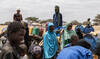
ATHENS: Greece’s Coast Guard rescued about 545 migrants from a fishing boat off Europe’s southernmost island of Gavdos on Friday, one of the biggest groups to reach the country in recent months.
The migrants were found during a Greek search operation some 16 nautical miles (29.6 km) off Gavdos, a Coast Guard statement said. They are all well and are being taken to the port of Agia Galini on the nearby island of Crete, it added.
Greece was on the front line of a 2015-16 migration crisis when more than a million people from the Middle East and Africa landed on its shores before moving on to other European countries, mainly Germany.
Flows have ebbed since then, but both Crete and Gavdos — the two Mediterranean islands nearest to the African coast — have seen a steep rise in migrant boats, mainly from Libya, reaching their shores over the past year and deadly accidents remain common along that route.
Greece, Cyprus, Spain and Italy will be eligible for help in dealing with migratory pressures under a new EU mechanism when the bloc’s pact on migration and asylum enters into force in mid-2026.
The center-right government of Prime Minister Kyriakos Mitsotakis has said deportation of rejected asylum seekers will be a priority.

Hundreds of migrants land in Greece after search operation at sea
https://arab.news/p6mf2
Hundreds of migrants land in Greece after search operation at sea
- Greece was on the front line of a 2015-16 migration crisis when more than a million people from the Middle East and Africa landed on its shores before moving on to other European countries
Single ‘digital nation-state’ is not a far-fetched notion, Melania Trump tells UN Security Council
- US first lady argues that AI and global connectivity could reshape education, help reduce conflict and empower children worldwide
- Societies rooted in knowledge foster innovation, tolerance and moral reasoning, while those shaped by ignorance risk disorder and conflict, she says
NEW YORK CITY: The idea of a single digital nation-state is “not so far-fetched,” US First Lady Melania Trump told the UN Security Council on Monday.
She argued that artificial intelligence and global connectivity could reshape education, help reduce conflict and empower children worldwide.
The US holds the rotating presidency of the council for March, and as she presided over its first meeting of the month Trump said technology was erasing borders and creating what she described as a shared intellectual future.
“Perhaps this idea isn’t so far-fetched,” she said, pointing to the rise of digital currencies, blockchain-based payment systems, and AI-driven databases she argued were already transforming media and financial markets.
Trump thanked the US’s fellow council members — the UK, France, Russia, China, Greece, the Democratic Republic of Congo, Denmark, Panama, Liberia, Somalia, Colombia, Pakistan, Bahrain and Latvia — for their role in efforts to maintain international security.
The responsibility for preventing conflict “must be applied evenly and should never be carried out lightly,” she said. Her remarks focused in particular on the role of education as the foundation of peace and stability.
“A nation that makes learning sacred protects its books, its language, its science and its mathematics. It protects its future,” Trump said, arguing that societies rooted in knowledge foster innovation, tolerance and moral reasoning, while those shaped by ignorance risk disorder and conflict.
Education is widely recognized as a fundamental human right, she added, yet many children and young adults around the world remain barred from the chance to attend high school or university. The losses arising from this squandered potential, from potential medical breakthroughs to possible advances in food security and technology, are borne not only by the individual countries involved but by humanity as a whole, she said.
Trump called for the expansion of global access to technology to help bridge the digital divide, noting that about 6 billion people, 70 percent of the world’s population, now use mobile devices and the internet.
“If our nations band together, we can close the technological divide,” she said, describing a world in which a farmer on a remote Greek island, a student in Somalia and a resident of New York City can all tap into centuries of accumulated human knowledge.
AI was democratizing access to information once confined to university libraries, she added, and redefining participation in the global “economy of ideas.”
She continued: “Conflict arises from ignorance. Knowledge creates understanding, replacing fear with peace and unity.”
Trump called on council members to safeguard learning and promote access to higher education, urging them to “build a future generation of leaders who embrace peace through education.”
She added: “The path to peace depends on us taking responsibility to empower our children through education and technology.”