

Pakistan, IFC review steps to unlock private investment, jobs

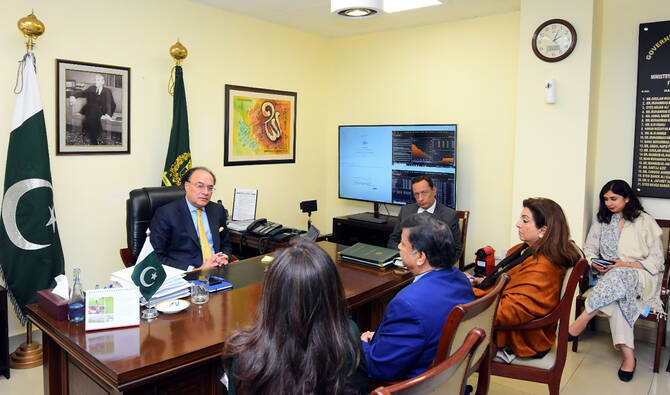
Finance Minister of Pakistan, Muhammad Aurangzeb (left) in conversation with a delegation of International Finance Corporation at the Finance Division in Islamabad, Pakistan, on December 18, 2025. (Government of Pakistan)
Short Url
Updated 18 December 2025
Follow

Pakistan, IFC review steps to unlock private investment, jobs

  • Talks focus on public-private partnerships, mobilizing private capital
  • Government flags IT, agriculture, mining, health care as priority sectors

KARACHI: Pakistan’s finance minister on Thursday reviewed ways to deepen cooperation with the International Finance Corporation (IFC) to mobilize private investment, expand public-private partnerships and support job creation, the finance ministry said in a statement.

Finance Minister Muhammad Aurangzeb met an IFC delegation led by Khawaja Aftab Ahmed, the lender’s director for the Middle East, Pakistan and Afghanistan, as Islamabad seeks to translate recent macroeconomic stabilization into sustained private-sector growth.

Pakistan has made progress under an International Monetary Fund–backed reform program, easing immediate default risks and restoring a measure of macroeconomic stability. But officials say the next phase hinges on reviving investment, expanding exports and creating jobs, particularly as fiscal space remains tight and development spending constrained.

“Both sides agreed on the need to align investment and advisory support with Pakistan’s medium-term development priorities, with a clear focus on job creation, sustainability, and export-oriented growth,” the finance ministry said.

According to the statement, the IFC briefed the minister on its expanding engagement in Pakistan across investment and advisory operations, including local-currency financing, private-sector investments and sustainability-oriented initiatives. Particular emphasis was placed on the IFC’s role in strengthening public-private partnership frameworks, including projects aimed at improving urban services, infrastructure performance and resource efficiency.

Aurangzeb outlined the government’s strategy of creating enabling ecosystems rather than direct state intervention, identifying priority areas such as the digital and information technology economy, agriculture and agri-value chains, minerals and mining, health care and skills-based human capital exports.

Both sides also discussed closer coordination within the World Bank Group to deploy advisory, financing and risk-mitigation instruments more effectively, while stressing the importance of timely execution of approved transactions to maintain investor confidence.

Pakistan’s engagement with the International Finance Corporation is part of a broader long-term partnership aimed at catalyzing private sector-led growth. Since its early involvement in the country, IFC has deployed a range of equity and loan investments across sectors including renewable energy, infrastructure, manufacturing and agribusiness, with cumulative investments reaching an estimated $13 billion over several decades. 

In recent years, IFC has boosted financing for strategic initiatives such as Pakistan’s first sustainable aviation fuel facility in Punjab, where it is providing up to $35 million in equity and debt capital to generate jobs, support exports and reduce carbon emissions.


Pakistan forms committee to negotiate financial advisory services for Islamabad airport privatization

Updated 18 February 2026
Follow

Pakistan forms committee to negotiate financial advisory services for Islamabad airport privatization

  • Committee to engage Asian Development Bank to negotiate terms of financial advisory services agreement, says privatization ministry
  • Inaugurated in 2018, Islamabad airport has faced criticism over construction delays, poor facilities and operational inefficiencies

ISLAMABAD: Pakistan’s Privatization Ministry announced on Wednesday that it has formed a committee to engage the Asian Development Bank (ADB) to negotiate a potential financial advisory services agreement for the privatization of Islamabad International Airport.

The Islamabad International Airport, inaugurated in 2018 at a cost of over $1 billion, has faced criticism over construction delays, poor facilities, and operational inefficiencies.

The Negotiation Committee formed by the Privatization Commission will engage with the ADB to negotiate the terms of a potential Financial Advisory Services Agreement (FASA) for the airport’s privatization, the ministry said. 

“The Negotiation Committee has been mandated to undertake negotiations and submit its recommendations to the Board for consideration and approval, in line with the applicable regulatory framework,” the Privatization Ministry said in a statement. 

The ministry said Islamabad airport operations will be outsourced under a concession model through an open and competitive process to enhance its operational efficiency and improve service delivery standards. 

Pakistan has recently sought to privatize or outsource management of several state-run enterprises under conditions agreed with the International Monetary Fund (IMF) as part of a $7 billion bailout approved in September last year.

Islamabad hopes outsourcing airport operations will bring operational expertise, enhance passenger experience and restore confidence in the aviation sector.

In December 2025, Pakistan’s government successfully privatized its national flag carrier Pakistan International Airlines (PIA), selling 75 percent of its stakes to a consortium led by the Arif Habib Group. 

The group secured a 75 percent stake in the PIA for Rs135 billion ($482 million) after several rounds of bidding, valuing the airline at Rs180 billion ($643 million).

Pakistan’s Finance Minister Muhammad Aurangzeb said this week the government has handed over 26 state-owned enterprises to the Privatization Commission.