

Deal signed to boost hospitality, heritage studies

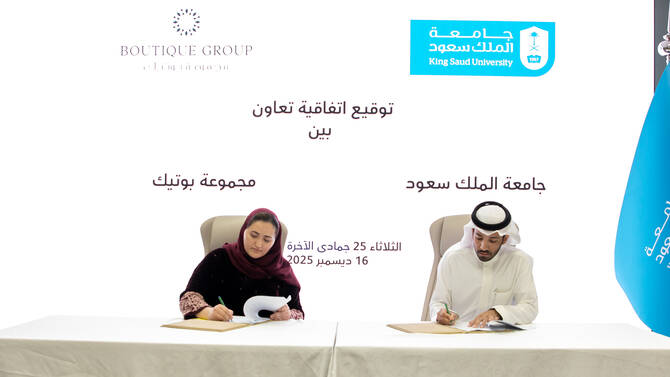
The MoU was signed by Boutique Group CEO Christophe Maris and Ali Al-Mismali, acting president of the King Saud University. (Supplied)
Short Url
Updated 17 December 2025
Follow

Deal signed to boost hospitality, heritage studies

Riyadh: Boutique Group, a hospitality company owned by the Public Investment Fund, has signed a memorandum of understanding with King Saud University in Riyadh to strengthen collaboration between the hospitality and academic sectors, promote heritage and cultural activities, and support scientific research.

The MoU was signed by Boutique Group CEO Christophe Maris and Ali Al-Mismali, acting president of the university, according to a press release.

Maris said the partnership supports the group’s vision of creating a Saudi model of luxury hospitality rooted in the Kingdom’s values and heritage.

“At Boutique Group, we are building a Saudi model of luxury hospitality that draws on the Kingdom’s values and heritage and presents them to the world at global standards,” he said.

“The palaces we revive are not just hospitality destinations; they are cultural masterpieces that preserve regional memory. This partnership empowers national talent and advances research and practical specializations that safeguard Saudi heritage while delivering refined, contemporary hospitality experiences.”

Salman Al-Otaibi, dean of the College of Tourism and Archeology, said the agreement aligns with the college’s strategy to build impactful partnerships.

“Collaboration with Boutique Group is a key pillar in advancing applied education and enhancing our students’ readiness for national and international markets,” he said.

“This partnership will strengthen the university’s role in preserving and revitalizing historical palaces, support Saudi Vision 2030, and reinforce the college’s leading position in developing the Kingdom’s heritage and hospitality sectors.”

Under the agreement, both parties will exchange expertise in preserving rare artifacts and developing academic competencies to safeguard national heritage and prepare future specialists.

The collaboration also includes architectural surveys and documentation of historical palaces in line with the highest scientific standards.

The MoU establishes a framework for cooperation across educational and professional tracks, including programs related to heritage, museums, crafts, and traditional industries, as well as cultural activities that enrich visitor experiences.

It also includes joint efforts to develop specialized training programs aligned with future market needs.


King Abdulaziz Camel Festival sees unprecedented demand

Updated 5 sec ago
Follow

King Abdulaziz Camel Festival sees unprecedented demand

  • Has become a major economic engine for the camel breeding industry in Saudi Arabia and the wider Gulf
  • Auctioneer Mubarak Al-Ghannami said that around 200 camels are entered into the daily auction

RIYADH: The 10th annual King Abdulaziz Camel Festival held in Al-Sayahid, north of Riyadh, has seen unprecedented demand this year, according to the Saudi Press Agency.

It has become a major economic engine for the camel breeding industry in Saudi Arabia and the wider Gulf, with prices reaching over SR100,000 ($27,000) at auction for the best specimens.

Auctioneer Mubarak Al-Ghannami told the SPA that around 200 camels are entered into the daily auction, with prices starting at around SR4,000.

The festival supports economic activity beyond just the auctions, however, with job opportunities in camel transportation and related auxiliary sectors.

Veteran transporter Abu Naif Al-Mutairi highlighted the potential for seasonal profit and encouraged young Saudis to engage in the industry.

Organizers Saudi Camel Club have set up a 500-meter corridor of tents and pens for breeders and buyers.

High-stakes sales take place on specialized auction platforms and main exhibition areas, drawing global attention to the quality of Saudi livestock.

Industry experts and participants have reported a significant shift in market dynamics, with attendee Dr. Daghash Al-Masradi noting that the festival attracts buyers now seeking the highest-quality camels.

He noted that the organized environment allows owners to operate with greater freedom and energy.

The festival is a key initiative of Saudi Vision 2030, aiming to promote cultural tourism and showcase Saudi heritage to an international audience.

Featuring traditional crafts and cuisine, visitors are offered a glimpse into the Kingdom’s culture.

It also serves as an important platform to highlight the significance of the camel in the history of Saudi Arabia.

This year’s festival began on Dec. 1 and runs until Jan. 3, with prices for admission starting at SR500.