

Pakistan moves to end week-long transport strike disrupting goods movement nationwide

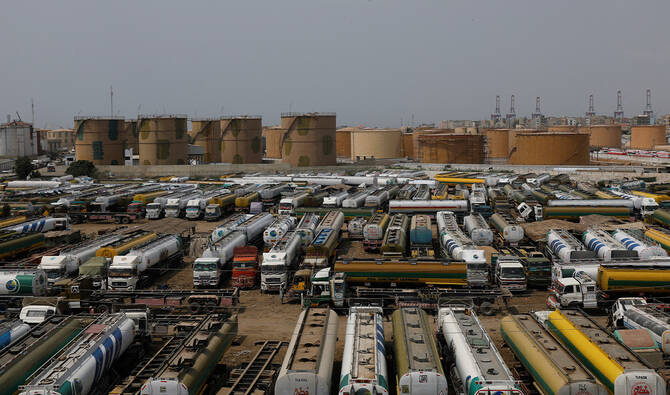
Oil tankers are seen parked, following the protest by the All Pakistan Oil Tankers Owners Association in Karachi, Pakistan, on September 19, 2023. (Reuters/File)
Short Url
Updated 16 December 2025
Follow

Pakistan moves to end week-long transport strike disrupting goods movement nationwide

  • Federal delegation sent to Karachi as talks intensify with transporters
  • Strike over axle loads and tolls has hit supply chains and economic activity

ISLAMABAD: Pakistan’s federal government on Monday stepped up efforts to end an over week-long strike by goods transporters that has disrupted the movement of cargo across the country, directing a high-level delegation to hold urgent negotiations with transport unions in Karachi, according to an information ministry statement.

The strike, now in its eighth day, has slowed the flow of goods between ports, industrial centers and markets, raising concerns over supply chains in an economy heavily reliant on road transport for domestic trade and exports. Trucking is the backbone of Pakistan’s logistics system, moving food, fuel, raw materials and manufactured goods, and prolonged disruptions can quickly translate into higher costs and shortages.

Transport unions have been protesting against stricter enforcement of axle-load limits — legal caps on how much weight trucks can carry — as well as increases in toll taxes and what they describe as heavy-handed policing on highways and motorways. 

The action comes at a sensitive time for Pakistan, which is trying to stabilize its economy under an International Monetary Fund-backed reform program that places emphasis on controlling inflation and improving fiscal discipline.

“Prolonged strikes cause losses to all stakeholders, particularly those associated with the transport sector,” Federal Minister for Communications Abdul Aleem Khan said while chairing a meeting with representatives of the Pakistan Goods Transport Alliance, according to the statement.

Transporters briefed the government on their concerns, including axle-load regulations, toll charges and enforcement practices.

The communications minister said the government was committed to resolving all legitimate issues “through dialogue and consultation” and confirmed that a five-member committee formed earlier had been tasked with finding a solution. He directed a senior delegation to immediately travel to Karachi to continue negotiations and seek a timely and amicable resolution.

The government also pledged to address issues related to driving licenses, road safety and accident prevention on a priority basis, while stressing that axle-load regulations were designed to protect national highways and improve long-term safety.

Representatives of the Pakistan Goods Transport Alliance expressed satisfaction over the progress of talks and assured the government of their cooperation, reaffirming their preference for constructive engagement, the statement said.

Authorities have warned that a prolonged transport shutdown could deepen economic disruptions, particularly by affecting port operations, industrial supply chains and the distribution of essential goods.


Pakistan reviews austerity measures amid Middle East crisis, urges strict nationwide implementation

Updated 11 March 2026
Follow

Pakistan reviews austerity measures amid Middle East crisis, urges strict nationwide implementation

  • Deputy Prime Minister Ishaq Dar chairs review meeting of austerity steps
  • Officials briefed on salary cuts, school closures, four‑day week, petrol conservation

ISLAMABAD: Pakistan’s government on Wednesday assessed progress on a sweeping set of austerity measures introduced to mitigate the country’s economic strain from sharply rising global oil prices and supply disruptions linked to the ongoing war in the Middle East.

Prime Minister Shehbaz Sharif this week announced a series of austerity steps, including a four‑day work week for government offices, requiring 50  percent of staff to work from home, cutting fuel allowances for official vehicles by half, grounding up to 60  percent of the government fleet and closing all schools for two weeks to conserve fuel amid the global oil crisis.

The measures were unveiled in response to global oil market volatility triggered by the conflict involving the United States, Israel and Iran, which has disrupted supply routes such as the Strait of Hormuz and pushed crude prices sharply higher, straining Pakistan’s heavily import‑dependent energy sector.

“The meeting stressed the importance of strict and transparent adherence to the austerity measures, promoting fiscal responsibility and prudent use of public resources,” Deputy Prime Minister and Foreign Minister Senator Mohammad Ishaq Dar said in a statement.

He was chairing a meeting of the Committee for Monitoring and Implementation of Conservation and Additional Austerity Measures, constituted under the directions of the PM, bringing together federal and provincial officials to review execution of the broad cost‑cutting plan. 

Dar emphasized the government’s commitment to enforcing the PM’s austerity steps nationwide. The committee’s review also covered reductions in departmental expenditure, deductions from salaries of senior officials earning over Rs. 300,000 ($1,120), and coordination with provincial administrations to ensure uniform implementation of the plan.

Participants at the meeting reiterated that all ministries and divisions must continue strict monitoring and reporting, with transparent oversight mechanisms, as Pakistan navigates the economic pressures from the prolonged Middle East crisis and its fallout on global energy and trade markets.
