

Jeddah’s King Abdulaziz International Airport reaches record 50 million passengers in 2025

1 / 3
Executives of the Jeddah Airports Company presented a commemorative gift to the lucky 50 millionth passenger. (SPA)
2 / 3
A view of Jeddah’s King Abdulaziz International Airport. (SPA)
3 / 3
The lucky 50 millionth passenger and a JEDCO executive pose with a commemorative symbol at KAIA in Jeddah on Sunday. (SPA)
Short Url
Updated 15 December 2025
Follow

Jeddah’s King Abdulaziz International Airport reaches record 50 million passengers in 2025

  • New milestone marks the highest number ever recorded by a Saudi airport 
  • Lucky 50-millionth passenger was a French national arriving from Paris on a Saudia flight

JEDDAH: King Abdulaziz International Airport in Jeddah recorded a new historic milestone on Sunday with the arrival of the 50-millionth passenger for year 2025.

The 50 million milestone marks the highest number ever recorded by a Saudi airport since the launch of civil aviation in the Kingdom, the Saudi Press Agency (SPA) reported. 

It also placed KAIA among the world’s mega airports in terms of passenger numbers. The figure represents a 1.83 percent growth from 49.1 million passenger arrival recorded in 2024.

“This achievement reflects the qualitative transformation at KAIA and its growing status as a regional hub and national gateway connecting the Kingdom to the world,” the report said.
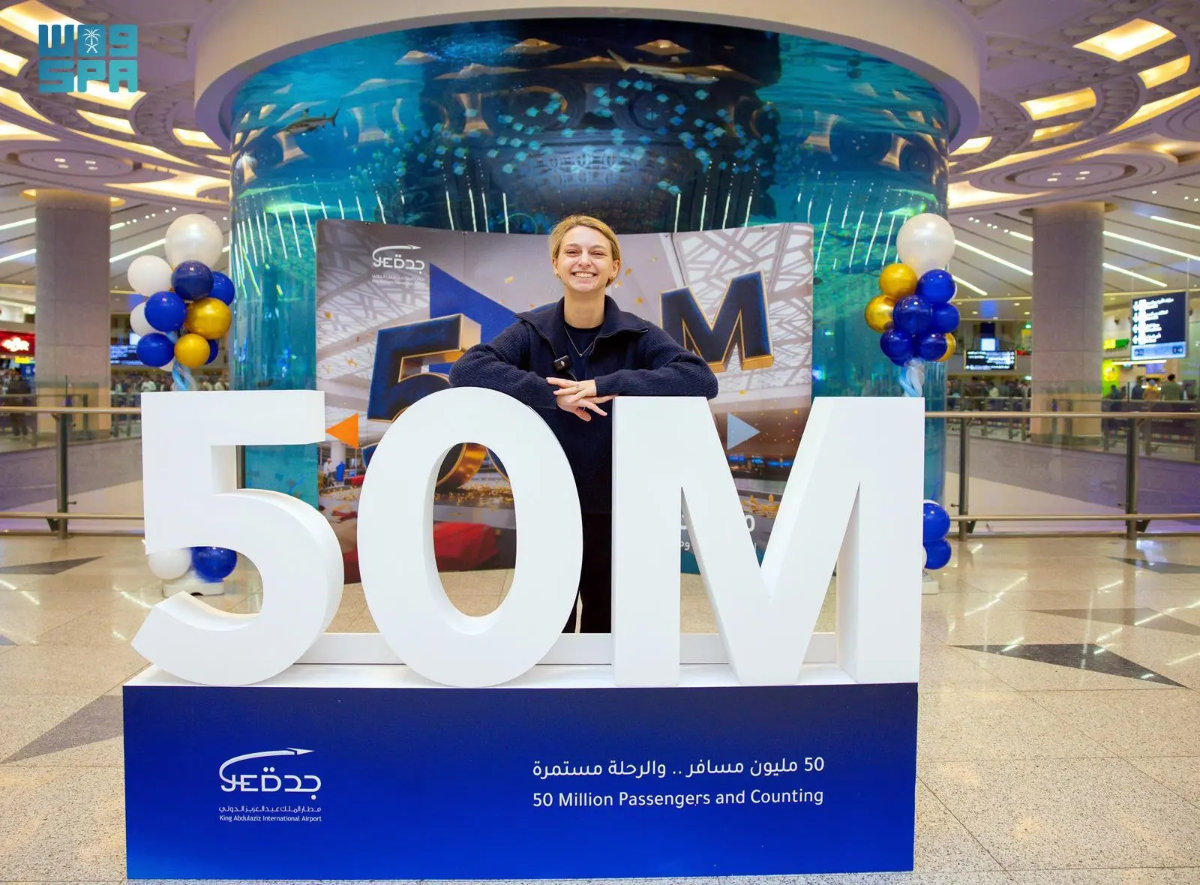


The lucky 50-millionth passenger was a French national arriving from Paris on a Saudia flight to participate in a sports tournament hosted in Jeddah. (SPA)

It also underscores the airport’s vital role in enhancing the Kingdom’s position as a global tourist destination and a gateway to the Two Holy Mosques by facilitating the movement of visitors, Umrah performers, and pilgrims.

KAIA serves as a gateway to the holy cities of Makkah and Madinah by facilitating the movement of visitors, Umrah performers, and pilgrims.

The lucky 50-millionth passenger was a French national arriving from Paris on a Saudia flight to participate in a sports tournament hosted in Jeddah.

She was welcomed by JEDCO’s leadership, who greeted her and presented a commemorative gift to mark the occasion.

JEDCO Chief Executive Officer Mazen Johar said that reaching 50 million passengers reflects the airport’s high operational readiness and marks a pivotal milestone in preparations to double this figure in the coming years.


Saudi Food and Drug Authority pioneering digital health safety

Updated 15 December 2025
Follow

Saudi Food and Drug Authority pioneering digital health safety

  • Digital foundation enabled the development of centralized dashboards that provide real-time analysis of adverse events
  • Major improvement has been the use of Robotic Process Automation (RPA) to ensure medication safety works smoothly

TOKYO: Saudi Arabia is establishing itself as a regional leader in digital health regulation by integrating advanced technologies into the Saudi Food and Drug Authority’s (SFDA) pharmacovigilance and cosmetic safety oversight.

In line with Vision 2030’s digital goals, these projects are creating new standards for using data to protect public health, according to the SFDA.

A report by the Oxford Business Group says the transformation began with modernising the National Pharmacovigilance Centre’s adverse reaction reporting system. Moving from paper-based submissions to the fully digital “Saudi Vigilance” platform marked a significant step forward.

The introduction of smart reporting forms with structured data fields and behavioural nudges grounded in psychological principles significantly improved reporting quality and completion rates.

This digital foundation enabled the development of centralised dashboards that provide real-time analysis of adverse events, enabling early identification of safety signals and under-reporting trends.

A major improvement has been the use of Robotic Process Automation (RPA) to ensure medication safety works smoothly. By letting computers handle repetitive tasks like sorting reports and checking data, the SFDA has become more efficient.

The new RPA system for identifying safety signals has also sped things up. These technology solutions have made work easier and happier employees by eliminating boring manual tasks.

The SFDA’s digital changes also help prevent risks by using new online learning tools. The aRMMs e-learning system, with training videos about high-risk medicines, has changed how health care workers learn. Adding digital safety steps directly into hospital computer systems has also made a big difference. This new approach puts safety alerts and learning materials directly into doctors’ daily work, ensuring important information reaches them when they need it.

Digital innovation has also helped prevent medication errors. Moving from the old Phonetic and Orthographic Computer Analysis system to the new Saudi Name Registration (SNR) platform has made it easier to spot potentially confusing drug names. With better computer programs that check both Arabic and English names, plus real-time alerts and automatic updates, the SNR system is a big step forward in ensuring the safety of medicines before they reach the market.

Looking ahead, the SFDA plans to use these digital changes to make cosmetic products safer as well.

Planned projects using artificial intelligence include computer systems that spot rule-breaking, automated ingredient checks, and tools that read customer feedback to identify early warning signs.

This digital strategy puts Saudi Arabia ahead in new ways of making rules. By using artificial intelligence, automation, and data analysis in its work, the SFDA is improving how it tracks medicine safety and preparing for further progress in keeping products safe for consumers.

All these efforts support Vision 2030’s goal of building a knowledge-based economy and keeping Saudi citizens as safe as possible.