

Pakistan, Iran leaders highlight mutual support after both engaged in short wars this year

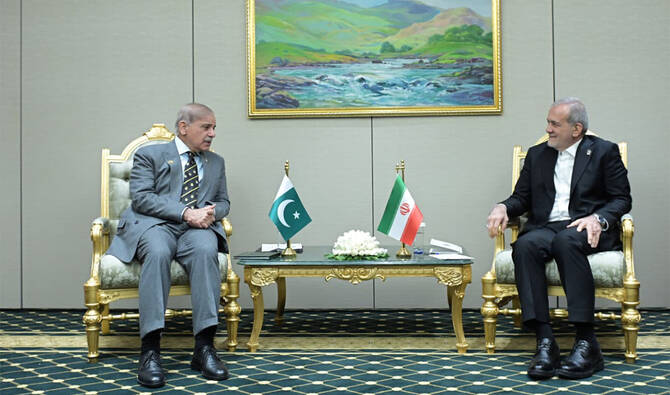
Prime Minister Shehbaz Sharif (left) meets Iranian President Masoud Pezeshkian in Tehran, Iran, on December 12, 2025. (Government of Pakistan)
Short Url
Updated 13 December 2025
Follow

Pakistan, Iran leaders highlight mutual support after both engaged in short wars this year

  • Prime Minister Sharif met Iranian President Pezeshkian in Ashgabat on the sidelines of an international forum
  • Pakistani PM also had an informal interaction with President Putin, discussed regional issue with President Erdogan

ISLAMABAD: Prime Minister Shehbaz Sharif and Iranian President Masoud Pezeshkian on Friday praised the support their countries offered one another during episodes of external aggression this year, according to the state media, as they met on the sidelines of an international peace forum in Turkmenistan.

Pakistan fought a four-day war with India in May, when New Delhi fired missiles at its cities and Islamabad responded with retaliatory strikes. Nearly a month after the conflict, Iran waged its own war with Israel after Tel Aviv carried out attacks inside Iranian territory, prompting Tehran to launch a series of missile and drone barrages in response.

The meeting in Turkmenistan came as Pakistan and Iran seek to steady ties after a period of strained security relations, while also attempting to expand economic cooperation and strengthen border management. The two leaders reviewed regional developments, including Pakistan’s concerns over militant attacks it says originate from Afghanistan, and ongoing diplomatic efforts related to Gaza.

“Both leaders appreciated the strong support that their countries had provided to each other when they had faced external aggression earlier this year,” the state-owned Associated Press of Pakistan (APP) said.

Sharif highlighted the outcome of the 22nd Pakistan–Iran Joint Economic Commission held this year and urged closer coordination to increase bilateral trade, operationalize border markets, reinforce border security and revive transport links, including the Islamabad-Tehran-Istanbul rail network.

Pezeshkian, according to the report, said Iran wished to further strengthen ties and thanked Sharif for a “useful and timely exchange of views.”

Sharif also pressed for “meaningful action” from the Afghan Taliban administration to address Pakistan’s security concerns, APP added.

Separately, the Pakistani prime minister met other global leaders attending the forum marking the International Year of Peace and Trust 2025 and Turkmenistan’s Neutrality Day.

He held informal interactions with Russian President Vladimir Putin and discussed regional issues with Turkish President Tayyip Erdogan, Tajik President Emomali Rahmon and Kyrgyz President Sadyr Zhaparov.


Pakistan, UAE review bilateral ties, economic and trade cooperation

Updated 7 sec ago
Follow

Pakistan, UAE review bilateral ties, economic and trade cooperation

  • UAE Ambassador Salem Mohammed Al Zaabi meets Pakistan’s deputy PM, ministers of defense, finance and IT
  • UAE is Pakistan’s third-largest trading partner after China and the US, and home to around 2 million Pakistani expats

ISLAMABAD: UAE Ambassador Salem Mohammed Al Zaabi met Deputy Prime Minister Ishaq Dar and other members of the Pakistani cabinet on Sunday to review bilateral ties and discuss trade and economic cooperation between the two countries, the UAE embassy said. 

Al Zaabi held separate meetings with Dar, Defense Minister Khawaja Muhammad Asif, Finance Minister Muhammad Aurangzeb, IT Minister Shaza Fatima Khawaja, Railways Minister Hanif Abbasi, Senate Chairman Yousaf Raza Gilani and National Assembly Speaker Ayaz Sadiq. 

“Views on the latest developments at the regional and international levels and matters of common interest between the two friendly countries were discussed and exchanged,” the UAE embassy in Islamabad wrote on social media platform X. 

Meanwhile, the embassy said Zaabi discussed bilateral relations and ways to enhance economic and trade cooperation in his meeting with Aurangzeb. 

Pakistan enjoys cordial ties with UAE rooted in shared values, faith, culture and economic relations. The Gulf nation is Pakistan’s third-largest trading partner after China and the US.

The UAE is also home to two million Pakistani expatriates, who make it the second-largest source of foreign remittances for cash-strapped Pakistan after Saudi Arabia. 

The UAE is also a major source of foreign investment in Pakistan, which have been valued at over $10 billion in the last 20 years, according to the Gulf state’s foreign ministry. 

Policymakers in Pakistan consider the UAE an optimal export destination due to its geographical proximity, which minimizes transportation and freight costs while facilitating commercial transactions.

Both nations have signed agreements worth billions of dollars recently as Pakistan eyes greater trade and economic ties with Gulf states. In January 2024, Pakistan and the UAE signed multiple agreements worth more than $3 billion for cooperation in railways, economic zones and infrastructure.