

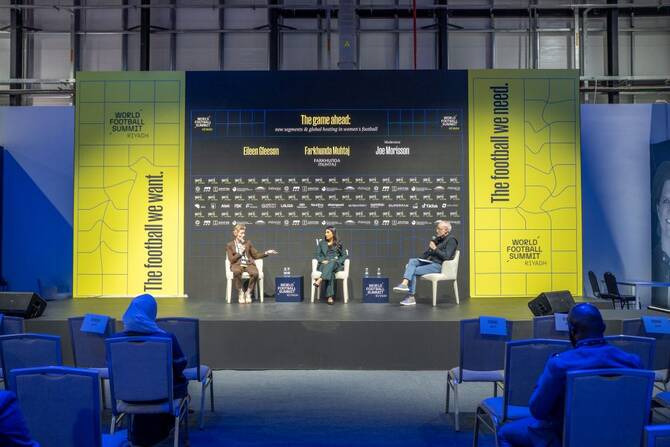
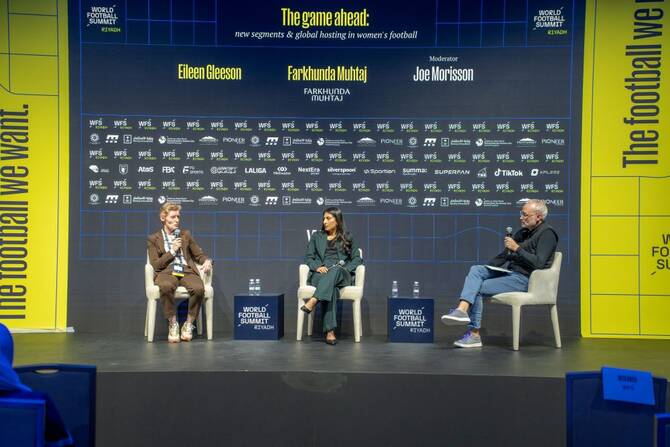
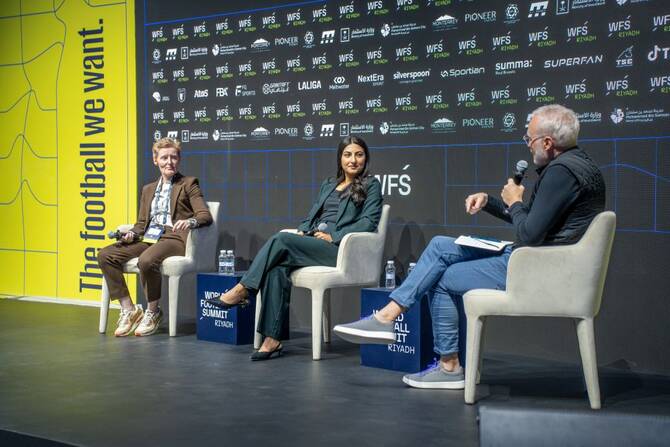

RIYADH: The World Football Summit which ended here on Thursday has once again placed women’s football at the center of its global agenda, highlighting initiatives, insights, and the achievements of trailblazers shaping the sport’s future.
One of the summit’s standout moments was the Female Leaders Awards that celebrated individuals and organizations driving progress, innovation, and equity in the women’s game.
Another anchor of the summit was the Female Leaders Gathering, which in its third year has become a vital platform for discussing leadership pathways and gender equity.
The gathering was led by Farkhunda Muhtaj, captain of the Afghanistan women’s national team, who said she hoped the initiative “continues empowering women to lead and influence the game at every level.”
Among the year’s award winners was Lina Al-Maeena, chairperson of Jeddah United Club, who expressed pride in the rapid transformation taking place within the Kingdom.
“We have come a long way in a very short time,” she said. “Our under-17 girls’ football team is now competing across the country under the Saudi Football Federation, and it shows how fast the sport is evolving.”
She added that “women are now participating in international events, something that felt impossible only a few years ago.”
Al-Maeena emphasized that equal opportunity was a cornerstone of Saudi Vision 2030. “The Ministry of Sports has opened doors for girls and boys across more than 100 federations and committees,” she said.
She highlighted the power of grassroots involvement. “It starts with the community,” she said. “That’s where you find the everyday champions who then rise to clubs and national teams.”
Across multiple sessions at the WFS, experts emphasized that women’s football was entering a new phase marked by global expansion and the rise of nontraditional markets.
The country had launched a professional women’s league, hosted international tournaments, expanded youth programs, and introduced the region’s first Women’s Champions League.
Eileen Gleeson, who has worked extensively in international women’s football, said that emerging markets like Saudi Arabia were “changing the map of where the women’s game can grow.”
She explained that the needs of these regions differed from those of established football nations. “The ambition is there,” she said, “but it’s not always matched with resources. You might want to win, but you can’t invest equally in every area. So the question becomes: where do you put that money?”
For Gleeson, long-term sustainability had to be the guiding principle. “Your starting point is different,” she said. “You’re introducing women’s football while also trying to professionalize it. For long-term growth, investment must go into the developing areas.”
She cited Saudi Arabia’s progress, noting that “in just four years, they’ve moved into professional structures with real commitment.” Still, she cautioned that nurturing homegrown players had to remain a priority.
“You have to protect your domestic league,” she said. “You can’t let it become an international league for its own sake.”
Muhtaj echoed this point, offering her perspective as a player who grew up without a domestic league in Canada. “Many Canadian players had to go abroad,” she said.
“But when you go abroad, you’re not always given the best opportunities because domestic players take precedence.”
She argued that investment should focus on markets with high talent but limited infrastructure. “There is so much talent in Asia and Africa,” she said. “The only thing missing is opportunity.”
She also emphasized how investment could stretch further in developing regions.
She said $400 million in Canada’s National Women’s Soccer League “might get you two or three franchises. But that same amount in developing regions could build an entire league with strong infrastructure.”
Muhtaj pointed to Saudi Arabia as “an example of how quickly opportunity can transform the environment for women players.”


