

Pakistan’s top military commander hails Saudi defense pact as ‘historic’ at scholars’ conference

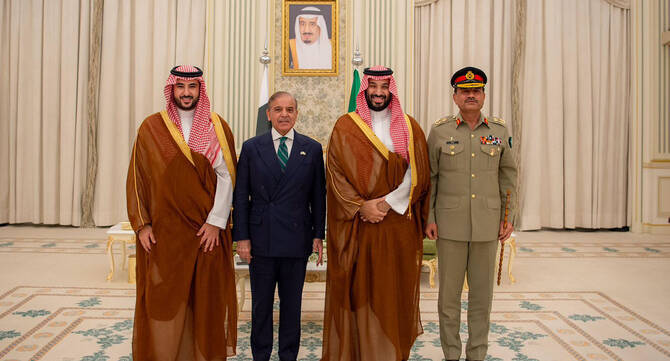
Pakistan army chief Field Marshal Syed Asim Munir (right), Saudi Crown Prince Mohammed bin Salman (2nd right), Prime Minister of Pakistan Shehbaz Sharif (2nd left) and the Saudi Minister of Defense pictured after signing of landmark defense pact in Riyadh on September 17, 2025. (PMO)
Short Url
Updated 10 December 2025
Follow

Pakistan’s top military commander hails Saudi defense pact as ‘historic’ at scholars’ conference

  • Asim Munir says Pakistan has a unique bond with the Kingdom, citing the ‘honor’ of helping safeguard the holy sites
  • He says only the state can declare jihad, urging religious scholars to counter extremist narratives and promote unity

ISLAMABAD: Chief of Defense Staff Field Marshal Asim Munir on Wednesday described the country’s joint security pact with Saudi Arabia as a “historic” milestone, telling a gathering of religious scholars that Pakistan and the kingdom share a deep strategic relationship.

Signed in September, the Strategic Mutual Defense Agreement has solidified decades of Saudi–Pakistan defense cooperation, covering intelligence-sharing, counterterrorism and regional stability.

The two nations have long coordinated on defense matters, with Pakistani military personnel deployed in the Kingdom.

“The defense agreement [with Saudi Arabia] is historic,” he said in an address to the conference in the federal capital.

The top military commander said Pakistan regarded its connection with the Kingdom as unique.

“Among all Muslim countries, Allah has given Pakistan the honor of helping safeguard the Haramain,” he continued, referring to the two holiest sites of Islam in Makkah and Madinah.

Munir used his speech to warn against extremism, saying that under the Islamic framework, only the state could declare jihad, a pointed reference to groups such as the Tehreek-e-Taliban Pakistan (TTP), which claims to act in the name of religion while carrying out attacks on civilians and security forces.

“When nations abandon knowledge and the pen, disorder takes hold,” he said, urging the religious scholars to help keep society unified and to “broaden the nation’s vision.”

Munir also criticized India, describing “terrorism” as “India’s habit, not Pakistan’s.”

His remarks came months after a four-day military confrontation in May, during which the two nuclear-armed neighbors exchanged artillery and missile fire and deployed drones and fighter jets.

India blamed Pakistan for a militant attack in Indian-administered Kashmir before launching a missile attack. Islamabad denied involvement and called for an international probe.

Pakistan claimed it had shot down six Indian fighter jets before a US-brokered ceasefire took effect.

“We do not hide when confronting the enemy,” Munir said. “We challenge openly.”


Pakistan seeks wider access to Canadian market as both sides want deeper agricultural cooperation

Updated 50 min 21 sec ago
Follow

Pakistan seeks wider access to Canadian market as both sides want deeper agricultural cooperation

  • Islamabad urges faster certification for canola and halal products in a bid to expand agricultural exports
  • Canada pledges collaboration on pest management, invites Pakistan to the Canada Crops Convention

ISLAMABAD: Pakistan on Wednesday pressed for improved access to Canadian agricultural markets and faster certification procedures for key exports as Islamabad looks to modernize its climate-strained farm sector and resolve long-standing barriers to trade, according to an official statement.

The push comes as Pakistan, a largely agricultural economy, faces mounting challenges from erratic weather patterns, including floods, droughts and heatwaves, which have hurt crop yields and raised food security concerns. Islamabad has increasingly sought foreign partnerships and training to upgrade farm technology, while pursuing export-oriented growth to diversify markets for mangoes, rice, kinnow, dates and halal meat.

Federal Minister for National Food Security Rana Tanveer Hussain and Canadian High Commissioner Tarik Ali Khan met to discuss “strengthening bilateral collaboration in agriculture, enhancing market access for key commodities, and advancing ongoing phytosanitary and technical cooperation,” according to the statement.

“Minister Rana Tanveer Hussain stressed the importance of resolving market access challenges to ensure uninterrupted trade in priority commodities, particularly canola, which constitutes Pakistan’s major agricultural import from Canada," it continued. "He highlighted that Pakistan seeks robust and timely certification and registration processes to facilitate predictable canola imports."

"The Minister emphasized that Pakistan is eager to strengthen its halal export footprint in Canada and sought CFIA’s [Canadian Food Inspection Agency’s] support in accelerating certification procedures for halal gelatin, casings, and value-added poultry," it added.

High Commissioner Khan  acknowledged Pakistan’s concerns, the statement said, and assured Hussain of Ottawa’s readiness to deepen technical collaboration.

He also briefed the minister on Canada’s pest management systems and grain supply chain controls, adding that his country looked forward to facilitating Pakistan’s plant protection team during an upcoming systems-verification visit.

Khan also invited Pakistani officials to the Canada Crops Convention in April 2026 and confirmed participation in the Pakistan Edible Oil Conference, reaffirming that “Canada views Pakistan as a priority partner in the region.”

Hussain proposed forming a joint working group to maintain momentum on technical discussions and regulatory issues as both officials agreed to strengthen agricultural cooperation.