

Israeli army takes journalists into a tunnel in a Gaza city it seized and largely flattened

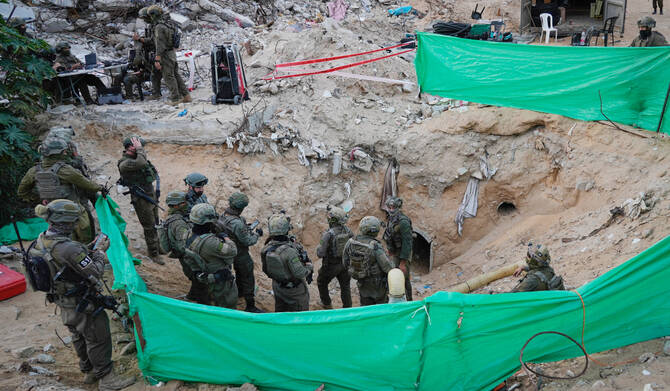
Israeli soldiers stand at the entrance of a tunnel where the army says the body of soldier Hadar Goldin was held in Rafah, Gaza Strip, Monday, Dec. 8, 2025. (AP)
Short Url
Updated 10 December 2025
Follow

Israeli army takes journalists into a tunnel in a Gaza city it seized and largely flattened

  • Israel and Hamas are on the cusp of finishing the first phase of the truce, which mandated the return of all hostages, living and dead, in exchange for Palestinians held by Israel
  • Hamas has said communication with its remaining units in Rafah has been cut off for months and that it was not responsible for any incidents occurring in those areas

RAFAH, Gaza Strip: One by one, the soldiers squeezed through a narrow entrance to a tunnel in southern Gaza. Inside a dark hallway, some bowed their heads to avoid hitting the low ceiling, while watching their step as they walked over or around jagged concrete, crushed plastic bottles and tattered mattresses.
On Monday, Israel’s military took journalists into Rafah — the city at Gaza’s southernmost point that troops seized last year and largely flattened — as the 2-month-old Israel-Hamas ceasefire reaches a critical point. Israel has banned international journalists from entering Gaza since the war began more than two years ago, except for rare, brief visits supervised by the military, such as this one.
Soldiers escorted journalists inside a tunnel, which they said was one of Hamas’ most significant and complex underground routes, connecting cities in the embattled territory and used by top Hamas commanders. Israel said Hamas had kept the body of a hostage in the underground passage: Hadar Goldin, a 23-year-old soldier who was killed in Gaza more than a decade ago and whose remains had been held there.
Hamas returned Goldin’s body last month as part of a US-brokered ceasefire in the war triggered by the militants’ Oct. 7, 2023, attack on southern Israel in which 1,200 people were killed and hundreds taken hostage. Israel’s retaliatory offensive has killed more than 70,000 Palestinians, according to Gaza’s Health Ministry, which operates under the Hamas-run government. The ministry does not differentiate between civilians and combatants, but says roughly half the dead have been women and children.
Israel and Hamas are on the cusp of finishing the first phase of the truce, which mandated the return of all hostages, living and dead, in exchange for Palestinians held by Israel. The body of just one more hostage remains to be returned.
Mediators warn the second phase will be far more challenging since it includes thornier issues, such as disarming Hamas and Israel’s withdrawal from the strip. Israel currently controls more than half of Gaza.
Israeli Prime Minister Benjamin Netanyahu is set to travel to Washington this month to discuss those next steps with US President Donald Trump.
Piles of rubble line Rafah’s roads
Last year, Israel launched a major operation in Rafah, where many Palestinians had sought refuge from offensives elsewhere. Heavy fighting left much of the city in ruins and displaced nearly one million Palestinians. This year, when the military largely had control of the city, it systematically demolished most of the buildings that remained standing, according to satellite photos.
Troops also took control of and shut the vital Rafah crossing, Gaza’s only gateway to the outside world that was not controlled by Israel.
Israel said Rafah was Hamas’ last major stronghold and key to dismantling the group’s military capabilities, a major war aim.
On the drive around Rafah on Monday, towers of mangled concrete, wires and twisted metal lined the roads, with few buildings still standing and none unscathed. Remnants of people’s lives were scattered the ground: a foam mattress, towels and a book explaining the Qur’an.
Last week, Israel said it was ready to reopen the Rafah crossing but only for people to leave the strip. Egypt and many Palestinians fear that once people leave, they won’t be allowed to return. They say Israel is obligated to open the crossing in both directions.
Israel has said that entry into Gaza would not be permitted until Israel receives all hostages remaining in the strip.
Inside the tunnel
The tunnel that journalists were escorted through runs beneath what was once a densely populated residential neighborhood, under a United Nations compound and mosques. Today, Rafah is a ghost town. Underground, journalists picked their way around dangling cables and uneven concrete slabs covered in sand.
The army says the tunnel is more than 7 kilometers (4 miles) long and up to 25 meters (82 feet) deep and was used for storing weapons as well as long-term stays. It said top Hamas commanders were there during the war, including Mohammed Sinwar — who was believed to have run Hamas’ armed wing and was the younger brother of Yahya Sinwar, the Hamas leader who helped mastermind the Oct. 7 attack. Israel has said it has killed both of them.
“What we see right here is a perfect example of what Hamas did with all the money and the equipment that was brought into Gaza throughout the years,” said Lt. Col. Nadav Shoshani. “Hamas took it and built an incredible city underground for the purposes of terror and holding bodies of hostages.”
Israel has long accused Hamas of siphoning off money for military purposes. While Hamas says the Palestinians are an occupied people and have a right to resist, the group also has a civilian arm and ran a government that provided services such as health care, a police force and education.
The army hasn’t decided what to do with the tunnel. It could seal it with concrete, explode it or hold it for intelligence purposes among other options.
Since the ceasefire began, three soldiers have been killed in clashes with about 200 Hamas militants that Israeli and Egyptian officials say remain underground in Israeli-held territory.
Hamas has said communication with its remaining units in Rafah has been cut off for months and that it was not responsible for any incidents occurring in those areas.
Both Israel and Hamas have accused each other of repeated violations of the deal during the first phase. Israel has accused Hamas of dragging out the hostage returns, while Palestinian health officials say over 370 Palestinians have been killed in continued Israeli strikes since the ceasefire took effect.


Could Israel’s Palestinians-only death penalty entrench impunity in the West Bank?

Updated 7 sec ago
Follow

Could Israel’s Palestinians-only death penalty entrench impunity in the West Bank?

  • The Knesset has advanced a bill mandating the death penalty exclusively for Palestinians convicted of terrorism
  • Rights experts say the law change would formalize patterns of lethal force already seen in West Bank operations

LONDON: The footage, secretly filmed by an onlooker and released by Reuters with a “graphic content” warning, is shocking.

On Nov. 27, Israeli border police raiding a building in the West Bank camp of Jenin summarily executed two men who had surrendered. The Palestinian health ministry later named the dead men as Montasir Abdullah, 26, and Yusuf Asasa, 37.

Summary executions of Palestinians by Israeli security forces are nothing new, as a spokesman for the UN Human Rights Office pointed out in a statement after the Jenin killings.

“We are appalled by the brazen killing by Israeli border police yesterday of two Palestinian men in Jenin in the occupied West Bank, in yet another apparent summary execution,” he said.

“Killings of Palestinians by Israeli security forces and settlers in the occupied West Bank have been surging without any accountability, even in the rare case when investigations are announced.”

Israel launched Operation Iron Fist in Jenin in January, later expanding it in February to include the Tulkarem and Nur Shams camps. The military says it is targeting Iran-backed armed groups that had grown stronger in the camps and were launching attacks against Israelis.

What began as a series of targeted raids to neutralize Palestinian armed groups and protect Israeli settlements has since become a sustained military campaign, in which the Israel Defense Forces have been accused of extreme violence.

Far from addressing this behavior, Israeli politicians are instead trying to push through a new law that would make execution mandatory for Palestinians — not for Jewish Israelis — convicted of terrorist killings.

The Penal Bill (Amendment No. 159) (Death Penalty for Terrorists) stipulates that “a person who caused the death of an Israeli citizen deliberately or through indifference, from a motive of racism or hostility against a population, and with the aim of harming the State of Israel and the national revival of the Jewish people in its land, shall be sentenced to death.”

The amendment adds that “in military courts in the Judea and Samaria region (the Israeli term for the West Bank) it will be possible to impose a death penalty by a regular majority of the judges in the panel, and a death penalty that was imposed cannot be commuted.”

The military courts have a conviction rate close to 99 percent.

Having passed its first reading in the Knesset on Nov. 11, the bill has now been returned to Israel’s National Security Committee for deliberation. It must then pass two more readings in the Knesset to become law.

Israel’s penal law already provides for the death penalty, but it has only been sought, and carried out, once since 1948.

In December 1961, Adolf Eichmann, the former head of Nazi Germany’s Department for Jewish Affairs, was found guilty in an Israeli court of having played “a central and decisive part” in the killing of 6 million European Jews.

On June 1, 1962, Eichmann, who had been captured in Argentina by Israeli agents, was hanged at Ramla Prison near Tel Aviv.

The amendment to the new law has been proposed by Israel’s far-right Jewish Power party, whose leader is Itamar Ben-Gvir, the national security minister. When the bill passed its first reading last month, Ben-Gvir celebrated by handing out sweets to members of the Knesset.

“After the law is finally passed,” he said, “terrorists will only be released to hell.”

During the debate on the vote, a scuffle broke out in the Knesset between Ben-Gvir and Ayman Odeh, chairman of Hadash-Ta’al.

In his speech, Odeh told Ben-Gvir: “You wanted to carry out a transfer, and you failed — therefore you are in an ideological crisis. You will be gone, and the Palestinian people will remain.”

In a statement after the vote, Odeh said: “The death penalty law for terrorists is the ultimate proof that this coalition has failed miserably and has failed to remove the Palestinian issue from the agenda. And it will never succeed. This law is the swan song of the occupation.”

Just over two weeks later, Ben-Gvir not only defended but celebrated the two summary executions carried out in Jenin. He gave his “full backing to border police members and IDF fighters who shot at wanted terrorists who came out of a building in Jenin.”

He added: “The fighters acted exactly as expected of them — terrorists must die.” Three days after the shootings, Ben-Gvir promoted the commander of the unit that had carried out the killings.

The proposed introduction of the death penalty has been condemned by human rights groups inside Israel and around the world, not least because of the undemocratic nature of the vote that saw the amendment pass its first reading.

There are 120 members of the Knesset, of whom just 39 voted in favor of the bill and 16 against.

“So the bill was passed when they didn’t even have 50 percent of the Knesset to vote for a bill actually asking to kill more Palestinians,” said Mutahir Ahmed, head of legal for the UK-based International Centre of Justice for Palestinians.

“That shows how tainted the system of democracy is in Israel.”

There was, said Amnesty International’s advocacy director, Erika Guevara Rosas, in a statement, “no sugarcoating this; a majority of 39 Israeli Knesset members approved in a first reading a bill that effectively mandates courts to impose the death penalty exclusively against Palestinians … and would include those who committed the punishable offences before the law is passed.”

Yair Dvir, spokesperson for B’Tselem, the Israeli Information Center for Human Rights in the Occupied Territories, told Arab News the proposed amendment was “a continuation of the deep demonization process that the Palestinians have undergone for years, and under this current government and in the past two years of genocide even more so.

“They are making a very clear distinction in this law, which is just intended for Palestinians. The death penalty would not be used in the case of any Jewish terrorism, because of course at the same time as they are about to create a death penalty for Palestinians, they are supporting Jewish terrorists, they are backing them politically, funding them, giving them weapons, and creating full immunity for settlers who kill Palestinians.”

The proposed amendment, he added, was “another step in Ben-Gvir’s war against Palestinian prisoners, which we have seen for a long time.

“Prisoners have already been killed in Israeli prisons, so actually the killing of Palestinian prisoners has already started. But now they want to make it legal.”

In a report published last month, Israeli non-profit Physicians for Human Rights said the past two years of detention had already proved to be “a death sentence” for almost 100 Palestinians.

The report revealed that between the Oct. 7, 2023, Hamas-led attack on southern Israel that triggered the Gaza war and August this year, at least 94 Palestinians had died in Israeli detention facilities.

The victims, killed by “the systemic denial of medical care and the torture of Palestinians in Israeli custody,” have included “the young and elderly, the healthy and the sick alike.”

The report added that “the fate of hundreds of Palestinians from Gaza detained by the Israeli military remains unknown to this day, suggesting that the true number of deaths is likely significantly higher than those documented here.”

As part of their campaign to introduce the death penalty, Ben-Gvir and his supporters have taken to wearing noose-shaped pins on their lapels.

Ben-Gvir, said Yair Dvir, “has been talking about this for years. But now, after the hostages have been released and he doesn’t have to think what Hamas might do, it’s an opportunity before elections to show the public just how far he wants to go in this fight against Palestinians in general, and specifically against prisoners.”

Ahmed said the proposed amendment was “a racist bill which violates international human rights law.”

It also violates European law. “Any country that wants to be part of the EU has to sign the European Convention on Human Rights, according to which the death penalty is against human rights and is not acceptable,” he said.

Israel is not in Europe. But controversially, it is in the Eurovision Song Contest, which is due to be held in Vienna next May. Several nations are now boycotting the competition, including Iceland, Spain, the Netherlands and Ireland, over Israel’s conduct in Gaza.

“This is a racist law that extends the apartheid legal system that Israel has been operating for many decades,” said Ahmed.

Palestinians are subject to trials in military courts, in which the conviction rate is about 99 percent, “and if this amendment becomes law, they will face the death penalty.”

He added: “What this amendment also intends is that there should be no provision for appeal or reduction of sentence. That means that if there is a miscarriage of justice, which is perfectly possible in any judicial system, it could not be rectified, even if new evidence comes to light.”

Even in the best justice systems in the world, mistakes are made, he said. “Our British judicial system is considered one of the best, but even here we have serious miscarriages of justice.”

It is not clear when the bill will undergo its second reading. But a leaked message between members of the National Security Committee reviewing the amendment revealed they were considering inserting a clause mandating that executions should be carried out by lethal injection within 90 days of conviction, to prevent “any possibility of avoiding carrying out the sentence.”