

Pakistan, Indonesia sign seven accords to expand cooperation as Subianto concludes Islamabad visit

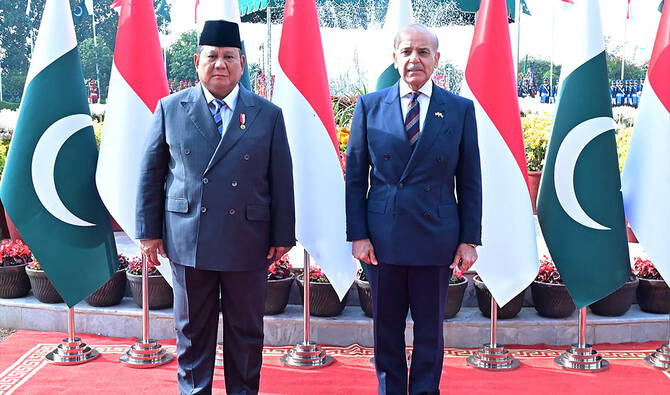
In this handout photograph released by Pakistan's Prime Minister Office on December 9, 2025, Pakistan's Prime Minister Shehbaz Sharif (R) and Indonesia's President Prabowo Subianto arrive for the guard of honour ceremony at the Prime Minister House in Islamabad. (AFP)
Short Url
Updated 09 December 2025
Follow

Pakistan, Indonesia sign seven accords to expand cooperation as Subianto concludes Islamabad visit

  • New MoUs include cooperation in higher education, halal certification, health and narcotics control
  • Army chief Asim Munir, Subianto discuss defense collaboration, training, counter-terrorism cooperation

ISLAMABAD: Pakistan and Indonesia signed seven memoranda of understanding on Tuesday to deepen cooperation in trade, higher education, halal certification and health, as Prime Minister Shehbaz Sharif said Islamabad is seeking to improve export access in a bilateral trade volume of about $4.5 billion.

The agreements were concluded during Indonesian President Prabowo Subianto’s two-day visit to Islamabad, his first to Pakistan since taking office and the first by an Indonesian president in seven years. The visit coincided with the 75th anniversary of diplomatic ties between the two nations.

According to state broadcaster Radio Pakistan, the MoUs include cooperation in higher education, an Indonesian state scholarship grant program, SME-business facilitation, collaboration between national archives, narcotics control and anti-drug trafficking, halal trade and certification, and health-sector partnership.

At a joint media address, Sharif said Pakistan wanted to adjust the structure of trade, which is currently dominated by palm oil imports from Indonesia. 

“Our bilateral trade stands at $4.5 billion, more than 90 percent represents imports from our brotherly country, Indonesia, that is palm oil,” Sharif said.

“We have discussed how to take corrective measures to balance this balance of trade through agri-exports from Pakistan, through exports of our IT-led initiatives, and of course in many other areas where we can really do to fill this gap.”

Sharif also said Pakistan was also ready to supply medical professionals to support Indonesia’s expanding health sector needs:

“I want to assure you that whatever is possible for us in this behalf, we will do it without any delay and with great pleasure and most willingly.”

Subianto thanked Pakistan for the reception he received and said the MoUs represented expansion across multiple fields including trade, agriculture, education and science and technology. He noted that Islamabad’s support in the health sector was “strategic and critical”.

Separately, Field Marshal Syed Asim Munir, who is the Chief of Army Staff and Chief of Defense Forces, met Subianto to discuss regional security, counter-terrorism, capacity-building and defense cooperation, the military’s media wing said. Both sides reaffirmed their intent to expand military training and professional exchanges.


Pakistan says responding to Afghan ‘offensive operations’ after border fire as tensions escalate

Updated 5 sec ago
Follow

Pakistan says responding to Afghan ‘offensive operations’ after border fire as tensions escalate

  • Afghan Taliban spokesperson says “large-scale offensive operations” launched against Pakistani military bases
  • Pakistan says Afghan forces opened “unprovoked” fire across multiple sectors along shared border

ISLAMABAD: Afghanistan’s Taliban authorities said on Thursday they had launched “large-scale offensive operations” against Pakistani military bases and installations, prompting Pakistan to say its forces were responding to what it described as unprovoked fire along the shared border.

The escalation follows Islamabad’s weekend airstrikes targeting what it said were Tehreek-e-Taliban Pakistan (TTP) and Daesh militant camps inside Afghanistan in response to a wave of recent bombings and attacks in Pakistan. Islamabad said the strikes killed over 100 militants, while Kabul said dozens of civilians were killed and condemned the attacks as a violation of its sovereignty.

In a post on social media platform X, Afghan government spokesperson Zabihullah Mujahid said Afghanistan had launched “large-scale offensive operations” in response to repeated violations by the Pakistani military.

Pakistan’s Ministry of Information said Afghan forces had initiated hostilities along multiple points of the frontier.

“Afghan Taliban regime unprovoked action along the Pakistan–Afghanistan border given an immediate, and effective response,” the ministry said in a statement.

The statement said Pakistani forces were targeting Taliban positions in the Chitral, Khyber, Mohmand, Kurram and Bajaur sectors, claiming heavy Afghan casualties and the destruction of multiple posts and equipment. It added that Pakistan would take all necessary measures to safeguard its territorial integrity and the security of its citizens.

Separately, security officials said Pakistani forces had carried out counterattacks in several border sectors.

“Pakistan’s security forces are giving a befitting reply to the unprovoked Afghan aggression with full force,” a security official said, declining to be named. 

“The Pakistani security forces’ counter-attack destroyed Taliban’s hideouts and the Khawarij fled,” they added, referring to TTP militants. 

The claims from both sides could not be independently verified.

Cross-border violence has intensified in recent weeks, with Pakistan blaming a surge in suicide bombings and militant attacks on militants it says are based in Afghanistan. Kabul denies providing safe havens to anti-Pakistan militant groups.

The clashes mark the third major escalation between the neighbors in less than a year. Similar Pakistani strikes last year triggered weeklong clashes before Qatar, Türkiye and other regional actors mediated a ceasefire in October.

The 2,600-kilometer (1,600-mile) frontier, a key trade and transit corridor linking Pakistan to landlocked Afghanistan and onward to Central Asia, has faced repeated closures amid tensions, disrupting commerce and humanitarian movement. Trade between the two nations has remained closed since October 2025.