

Pakistan to sell excess gas in international markets from Jan.1— petroleum minister

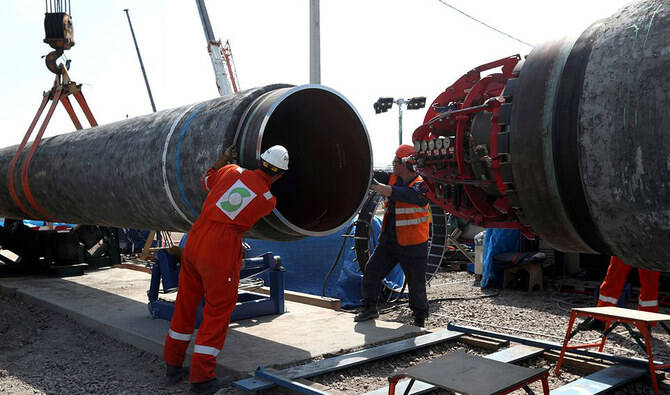
Workers are seen at the construction site of the Nord Stream 2 gas pipeline, near the town of Kingisepp, Leningrad region, Russia, on June 5, 2019. (REUTERS/File)
Short Url
Updated 08 December 2025
Follow

Pakistan to sell excess gas in international markets from Jan.1— petroleum minister

  • Pakistan was reportedly exploring ways to reduce $378 million in annual losses from supply glut caused by excess fuel imports 
  • Move to sell excess LNG in international markets will limit $3.56 billion losses caused since 2018-19, says petroleum minister

ISLAMABAD: Pakistan will sell its excess liquefied natural gas (LNG) in international markets from Jan. 1, Petroleum Minister Ali Pervaiz Malik said, revealing the move would limit losses caused from a years-long supply glut. 

Local and international media outlets had reported in July that Pakistan was exploring ways to sell excess LNG cargoes amid a gas supply glut that government officials said was costing domestic producers $378 million in annual losses. News reports had said Pakistan had at least three LNG cargoes in excess that it imported from Qatar and has no immediate use for.

Speaking to reporters during a press conference on Sunday, Malik said there was an excess of imported gas in Pakistan as the use of this fuel for power generation had reduced in the country during the past few months. He said Islamabad had been forced to sell the gas to local consumers, due to which the circular debt in the gas sector from 2018 till now had ballooned to around Rs1,000 billion [$3.56 billion]. 

“From Jan. 1 we will sell this excess fuel in international markets to reduce our burden and limit our losses of this Rs1,000 billion [$3.56 billion],” Malik said. 

He said this move would also allow Pakistan’s state-owned enterprises in the sector to operate on their full capacity and generate profits and employment. 

Malik also spoke of foreign oil companies that were ready to invest millions in the country in the near future. 

The minister cited the recent visit of Turkish energy minister to Pakistan which had resulted in the state-owned Turkish Petroleum signing deals to carry out onshore and offshore drilling activities in Pakistan. 

“Turkish Petroleum will also open its office in Islamabad, where 10 to 15 Turkish nationals will be working,” Malik said. 

He also said that a delegation of the State Oil Company of Azerbaijan Republic (SOCAR) visit Pakistan this week, adding that it was also expected to collaborate with local companies for oil and gas exploration.

The minister said SOCAR was also opening its office in Pakistan. 

“It will also invest millions of dollars in the construction of an oil pipeline from Machike to Thalian in collaboration with the PSO (Pakistan State Oil) and FWO (Frontier Works Organization),” Malik said. 


Fears of fuel shortage in Pakistan as tankers wait to fill up

Updated 5 sec ago
Follow

Fears of fuel shortage in Pakistan as tankers wait to fill up

  • US-Israeli war with Iran has disrupted shipping, damaged oil and gas facilities in Middle East
  • Pakistan, which depends on oil and gas from the Gulf, raised fuel prices by 20 percent last week

Sheikhupura, Pakistan: Tanker drivers in Pakistan said they were facing long waits at depots due to a shortage of fuel, as the government played down fears of another rise in prices.

The US-Israeli war with Iran has disrupted shipping and damaged oil and gas facilities in the Middle East, raising global oil prices as countries scramble to deal with concerns over supply.

Dozens of tankers, which supply fuel across Pakistan, were seen parked at the side of the road on Tuesday at depots near Lahore, the capital of Punjab, the country’s most populous province.

“There is no petrol at the depot for the past four days,” said one tanker driver, Abdul Shakoor.

“Iran has closed the border from their side. The depot is lying empty,” he told AFP.

Pakistan depends on oil and gas from the Gulf, and vessels transporting fuel were given naval escorts this week to ensure continuity of supplies during the Middle East crisis.

Last week, the government in Islamabad hiked prices by about 20 percent, triggering long lines and panic buying at filling stations across the country.

Petroleum Minister Ali Pervaiz Malik said in an interview broadcast late on Tuesday that there will be “no immediate significant changes” in the cost of fuel.

Prime Minister Shehbaz Sharif on Monday announced an austerity plan designed to save fuel, including slashing the working week for government employees to four days and shutting schools.

But Mazhar Mahmood, a tanker driver’s assistant, said: “The drivers went to the depot today as well, but the depot staff said there is no fuel available.”

He said he was told that fuel will be available in the next five to six days.

“The situation in the country is not good. There is no petrol in the country, which is why the vehicles are parked here.”