

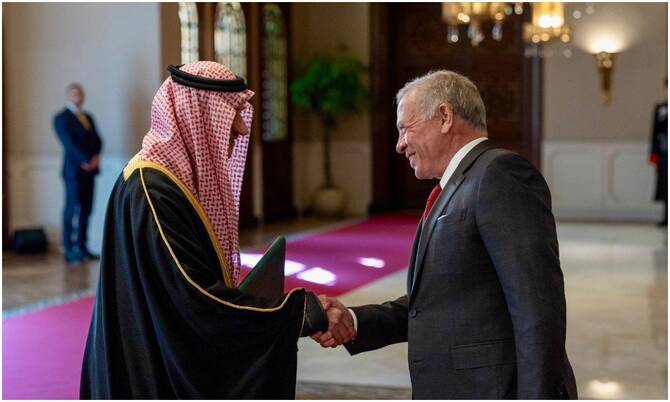
Jordanian king receives credentials of Saudi ambassador in Amman

1 / 2
King Abdullah II of Jordan received the credentials of the Saudi ambassador, Prince Mansour bin Khalid bin Farhan. (SPA)
2 / 2
The Saudi ambassador, Prince Mansour bin Khalid bin Farhan, arrives at Basman Palace in Amman. (SPA)
Short Url
Updated 07 December 2025
Follow

Jordanian king receives credentials of Saudi ambassador in Amman

  • King Abdullah recognizes strong ties between two nations

LONDON: King Abdullah II of Jordan received the credentials of the Saudi ambassador, Prince Mansour bin Khalid bin Farhan, during a ceremony at Basman Palace in Amman on Sunday.

The prince’s official title will be “ambassador extraordinary and plenipotentiary of the Kingdom of Saudi Arabia” to Jordan, the Saudi Press Agency reported.

King Abdullah recognized the strong ties between the two nations and wished the ambassador success in enhancing them.

The monarch also accepted the credentials of several other ambassadors, namely, Khaled El Abyad from Egypt, Brigitte Tawk from Lebanon, Louis-Martin Aumais from Canada, Paula Ganly from Australia, James Holtsnider from the US, Guo Wei from China and Shahin Shakir Abdullayev from Azerbaijan.

Yousef Issawi, chief of Jordan’s Royal Hashemite Court, and Ayman Safadi, the nation’s foreign minister, also attended the ceremony, the Petra news agency reported.


SDAIA president says Saudi Arabia is building an integrated AI ecosystem

Updated 20 February 2026
Follow

SDAIA president says Saudi Arabia is building an integrated AI ecosystem

RIYADH: Saudi Data and Artificial Intelligence Authority President Abdullah Al-Ghamdi says that Saudi Arabia is moving steadily to establish artificial intelligence as a trusted national capability, the Saudi Press Agency reported.

Guided by the objectives of Saudi Vision 2030, Al-Ghamdi said the goal is to use AI to help develop government services, enhance competitiveness, build human capacity and improve quality of life through a comprehensive strategy based on three main pillars that unlock the potential of this technology and achieve sustainable developmental impact.

“The first pillar focuses on building human capacity and enhancing readiness to engage with AI technologies,” he said.

The second pillar is building an integrated national AI ecosystem that drives expansion and innovation by developing advanced digital infrastructure that enables various sectors to adopt AI applications efficiently, consistently and with effective governance, Al-Ghamdi said.

The third pillar, he said, is governance that ensures responsible and measurable AI through a national framework aligned with international standards.

This came during Al-Ghamdi’s speech at a high-level ministerial session held on Thursday on the sidelines of the AI Impact Summit 2026 in New Delhi.

He is heading the Saudi delegation, and the session saw broad participation from heads of state, decision-makers and technology leaders from around the world.

Al-Ghamdi also had a meeting with Indian Prime Minister Narendra Modi on Thursday evening, discussed AI cooperation and expressed his gratitude for hosting the summit and for the hospitality extended to the participants.