Nobel Prize winner discusses art of writing at Ithra

Jon Fosse, who won the 2023 Nobel Prize in Literature, appeared on stage with moderator Tariq Khawaji, Ithra’s cultural consultant. (Supplied)
Short Url
Updated 06 December 2025
Follow

Nobel Prize winner discusses art of writing at Ithra

  • Jon Fosse offers insights into storytelling at the 10th iRead celebration

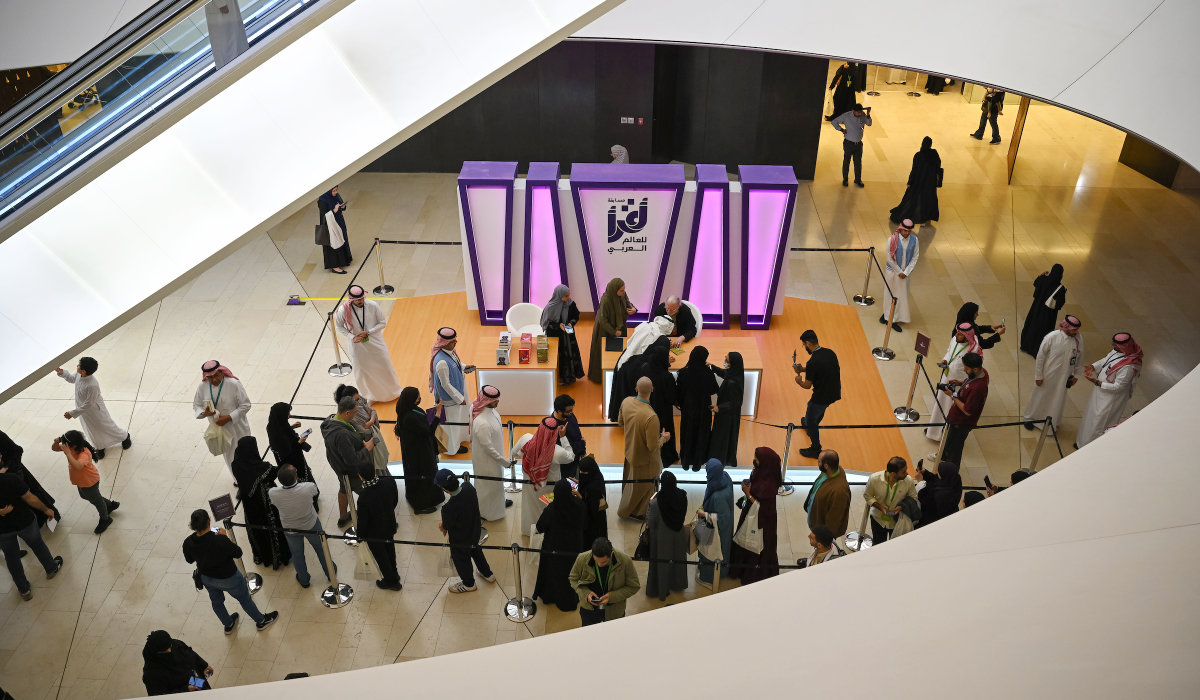
DHAHRAN: Nobel Prize-winning Norwegian author and playwright Jon Fosse drew a full house to Ithra on Friday, as he discussed art, writing, and the human experience during a session entitled “Nobel Minds” at the 10th edition of the institution’s iRead program.

Fosse, who won the 2023 Nobel Prize in Literature, appeared on stage with moderator Tariq Khawaji, Ithra’s cultural consultant.


Jon Fosse, who won the 2023 Nobel Prize in Literature, appeared on stage with moderator Tariq Khawaji, Ithra’s cultural consultant. (Supplied)

Outside, the landmark Ithra building, designed by Norwegian firm Snohetta, was lit in purple to mark the celebration. 

Fosse, whose work includes more than 70 novels, plays, poems, essays, and children’s books, and has been translated into more than 50 languages, including Arabic, is known for his minimalist, introspective style. His unconventional syntax and pared-down prose have significantly influenced postdramatic theater and contemporary experimental fiction. 

HIGHLIGHTS

• The landmark Ithra building, designed by Norwegian firm Snohetta, was lit in purple to mark the 10th anniversary of the institution’s iRead program.

• During the ‘Nobel Minds’ session, Jon Fosse discussed his writing process, sources of inspiration, and how writers might develop their own signature styles.

• Tariq Khawaji told Arab News that bringing Fosse to Saudi Arabia was especially meaningful as Arabic translations of his work remain relatively new to many readers. 

Khawaji told Arab News that bringing Fosse to Saudi Arabia was especially meaningful as Arabic translations of his work remain relatively new to many readers. 


Jon Fosse, who won the 2023 Nobel Prize in Literature, appeared on stage with moderator Tariq Khawaji, Ithra’s cultural consultant. (Supplied)

At a book signing following the session, he noted that Fosse’s pared-back lyrical language is a boon to both translators and new audiences. 

“I think one of Fosse’s strengths is his extremely simple language, he always uses the simplest phrasing and avoids inflated vocabulary or difficult expressions. This is why translators often find his writing both lyrical and clear,” Khawaji said. 

If I’m writing well, I have to bring something new to the book for me, and hopefully also for other people; something that didn’t exist before.

Jon Fosse, Norwegian Nobel laureate

“I think he speaks to the world through the problem of the individual — this tendency toward the quiet, the stripped-down. And I believe the Norwegian landscape, especially the western region, plays a very strong role in shaping him. His characters often feel like they come from a place with vast silence and depth. Even outside the session, you could sense many layers in how he spoke — something almost carved by that landscape,” he continued.


On the topic of artificial intelligence, Fosse said that while it can mimic a writer’s voice, it cannot replicate the essence behind it. (Supplied)

After noting Fosse’s 18 major awards, Khawaji added: “I think his Arabic readership is still small — though his plays have been translated and performed. I believe introducing him to the Arab world will increase his readership significantly, and I think the reception will change. Readers will discover a unique, unfamiliar voice. It was important to have him here.”

During his hour-long English-language conversation with Khawaji before the book signing, Fosse discussed his writing process, sources of inspiration, and how writers might develop their own signature styles.

“I think you can say all literature, in a certain sense, comes from literature. So the more you read — and the better literature you read — the cleverer you most likely will be,” he said.

“If I’m writing well, I have to bring something new to the book for me, and hopefully also for other people; something that didn’t exist before. And to get to that, you have to leave yourself (somehow). If you don’t leave yourself, you know exactly what you knew before,” he added.

On the topic of artificial intelligence, Fosse said that while it can mimic a writer’s voice, it cannot replicate the essence behind it.

“I’ve done it myself. I asked the computer to write something (in my style) and it was like a kind of parody, but still there were some very interesting sides to it. And there were some great metaphors that happened that I couldn’t have figured out myself,” he said. 

“Perhaps it is a childish idea but I think that art has so much to do with this universal individuality of the artist. It cannot possibly be replaced by a machine,” Fosse concluded.


Saudi Arabia has told Iran not to attack it, warns of possible retaliation, sources say

Updated 8 sec ago
Follow

Saudi Arabia has told Iran not to attack it, warns of possible retaliation, sources say

Saudi Arabia has told Tehran that while it favors a diplomatic settlement to Iran’s conflict with the United States, continued attacks on the kingdom and ​its energy sector could push Riyadh to respond in kind, four sources familiar with the matter told Reuters.

The message was conveyed before a speech on ‌Saturday in which Iranian President Masoud Pezeshkian apologized to neighboring Gulf states for Tehran’s actions – an apparent attempt to defuse regional anger over Iranian strikes that hit civilian targets.

Two days earlier, Saudi Foreign Minister Prince Faisal bin Farhan spoke to Iranian Foreign Minister Abbas Araghchi and set out Riyadh’s position with clarity, the sources said.

Saudi Arabia is open to any form of mediation aimed at de‑escalation and a negotiated settlement, the sources quoted ​the minister as saying, underlining that neither Riyadh nor other Gulf states had let the US use their airspace or territory to launch airstrikes on Iran.

But Prince ​Faisal was also quoted by the sources as saying that if Iranian attacks persisted against Saudi territory or energy infrastructure, Saudi Arabia would ⁠be forced to permit US forces to use their bases there for military operations. Riyadh would retaliate if attacks on the kingdom’s critical energy facilities continued, he said.

The sources said ​the kingdom had remained in regular contact with Tehran through its ambassador since the US and Israeli military campaign against Iran began on February 28 following the collapse of talks on ​Iran’s nuclear program.

The Saudi and Iranian foreign ministries did not respond to requests for comment.

Drone and missile attacks on Gulf states

The United Arab Emirates, Kuwait, Qatar, Bahrain and Saudi Arabia have all come under heavy drone and missile fire from Iran over the past week.

Iran’s Supreme Leader, Ayatollah Ali Khamenei, was killed on the first day of the war. Tehran responded by hitting Israel and Gulf Arab states hosting US military installations, ​and Israel has attacked Lebanon’s Iran-backed Hezbollah armed group.

Araghchi said in an interview on Saturday that he remained in constant contact with his Saudi counterpart and other Saudi officials, adding ​that Riyadh had assured Tehran it was fully committed to not allowing its territory, waters or airspace to be used for attacks against Iran.

Pezeshkian said Iran’s temporary leadership council had approved suspending attacks on ‌nearby countries – unless ⁠an attack on Iran came from those nations.

“I personally apologize to neighboring countries that were affected by Iran’s actions,” he said.

To what extent Pezeshkian’s remarks signal a change is unclear. There were further reports of strikes directed at Gulf states on Saturday.

Also, in a sign of possible divisions within Iran’s leadership, Khatam Al-Anbiya Central Headquarters – the unified combatant command of the Iranian armed forces – said in a statement afterwards that US and Israeli bases and interests across the region would remain targets.

The command said Iran’s armed forces respected the sovereignty and interests of ​neighboring states and had not taken action against ​them so far. But it said US ⁠and Israeli military bases and assets on land, at sea and in the air across the region would be treated as primary targets and face “powerful and heavy” strikes by Iran’s forces.

US President Donald Trump said in a social media post that Iran had “apologized and surrendered to its Middle ​East neighbors, and promised that it will not shoot at them anymore. This promise was only made because of the relentless US ​and Israeli attack.”

Two Iranian ⁠sources confirmed that a call had taken place in which Riyadh warned Tehran to halt attacks on Saudi Arabia and neighboring Gulf states. Iran, they said, reiterated its position that the strikes were not aimed at Gulf countries themselves but at US interests and military bases hosted on their territory.

One Iranian source said that Tehran had in response demanded that US bases in the region be ⁠closed and ​some Gulf states stop sharing intelligence with Washington that Iran believes is being used to carry out attacks against it.

Another ​Iranian source said some military commanders were pressing to continue the strikes, accusing the US of using bases in Gulf states and these countries’ airspace to conduct operations against Iran.

Iran had in recent years mended fences with its ​Gulf neighbors, including former regional archrival Saudi Arabia. The diplomatic campaign imploded in the blitz of drones and missiles launched by Iran’s Revolutionary Guards in the past week.