

Afghanistan ties reopening of Pakistan trade routes with guarantees against future closures

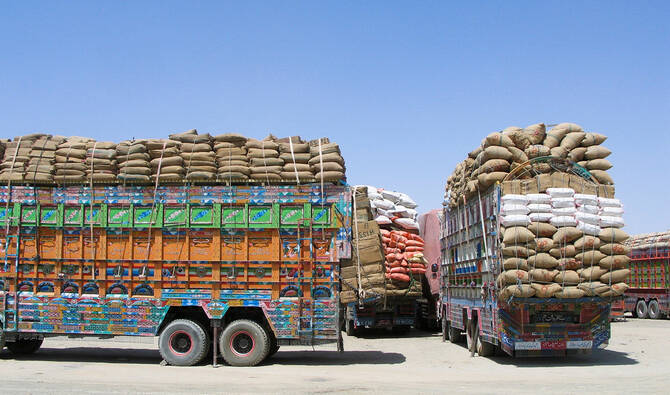
Trucks loaded with supplies wait to cross into Afghanistan at the Friendship Gate crossing point, in the Pakistan-Afghanistan border town of Chaman, Pakistan August 19, 2021. (Reuters/File)
Short Url
Updated 04 December 2025
Follow

Afghanistan ties reopening of Pakistan trade routes with guarantees against future closures

  • Pakistan closed land trading routes with Afghanistan in October after deadly clashes between the two neighbors
  • Afghanistan demands guarantees Islamabad will not close routes in future to exert “political pressure,” “coerce people“

PESHAWAR: Afghanistan government spokesperson Zabihullah Mujahid said on Thursday that Kabul would reopen its trade routes with Pakistan only after it receives “strong assurances” from Islamabad that they would not be closed in future to exert “political pressure” on it, as tensions persist between the two countries. 

The development takes place days after Pakistan’s Commerce Ministry issued a letter saying it has authorized the movement of United Nations humanitarian cargo into Afghanistan through the Torkham and Chaman border crossings after nearly 50 days of disruption. 

Pakistan closed its border crossings with landlocked Afghanistan after armed clashes between Pakistani and Afghan forces in October, which stalled the movement of people and goods, including relief shipments. Afghanistan’s reliance on Pakistani ports has long given Islamabad leverage to press Kabul over Pakistani militants it alleges shelter across the border, which Kabul denies. 

“The trade routes will be reopened only when strong assurances are received from the Government of Pakistan,” Mujahid wrote on social media platform X. 

“So that in the future these routes are not closed for political pressure, unlawful use or to coerce the people, and so that the rights of traders and citizens of both countries remain protected,” he added. 

The Afghan government spokesperson accused Pakistan of illegally closing its land border routes with Afghanistan, alleging Islamabad used them as a “tool of political and economic pressure” that caused harm to people on both sides. 

As the border crossings between the two neighbors remain closed, Afghanistan has increasingly started to make use of Iran’s concessions to shift freight to its Indian-backed port of Chabahar, bypassing Pakistan and avoiding recurring border and transit disruptions.

Abdul Salam Jawad Akhundzada, a spokesperson for Afghanistan’s commerce ministry, told Reuters in November that his country’s trade with Iran has reached $1.6 billion in the last six months. He said this was higher than the $1.1 billion of Afghanistan’s trade with Pakistan.
Afghanistan has boosted shipments through Turkmenistan, Uzbekistan and Tajikistan, routes it says are growing faster than Pakistan’s.
However, Pakistan still remains the fastest route to the sea, with trucks reaching its southern port of Karachi in three days. Its exports to Afghanistan neared $1.5 billion in 2024.

‘Good sense’ hailed as blockbuster Pakistan-India match to go ahead

Updated 11 sec ago
Follow

‘Good sense’ hailed as blockbuster Pakistan-India match to go ahead

  • Pakistan ends week-long standoff after ICC and regional boards intervene over boycott threat
  • India-Pakistan clash seen as financial linchpin for tournament, with cancelation hurting all members

MUMBAI: Pakistan’s decision to U-turn and go ahead with their blockbuster Group A match against India at the T20 World Cup on February 15 was hailed Tuesday as an outbreak of “good sense” and “good for cricket.”

The Pakistan government in Islamabad late on Monday night ended a week-long stand-off by rescinding its order for the cricket team to boycott the match in Colombo.

The biggest and most lucrative clash in world cricket was revived after a frantic weekend of negotiations.

It culminated in International Cricket Council (ICC) and Bangladesh Cricket Board (BCB) chiefs flying to Lahore on Sunday for talks with the Pakistan Cricket Board (PCB).

The governments of Bangladesh and Sri Lanka both wrote to the Islamabad government on Monday urging it to change its stance and allow the game to go ahead, and just before midnight they got their wish.

After “multilateral discussions, as well as the request of friendly countries, the Government of Pakistan hereby directs the Pakistan National Cricket Team to take the field on February 15,” the Islamabad government said on its official X account late Monday night.

The decision had been taken with the aim of “protecting the spirit of cricket,” it added.

Former India cricketer Madan Lal told AFP on Tuesday: “Pakistan did shake up the ICC by repeatedly saying they would not play.

“Eventually, the ICC had to send officials to Pakistan to sort out the issue” and that was “good for cricket.”

“We want strong teams to play so that the charm of the World Cup is not lost,” he added.

‘LOSS-LOSS SITUATION’

Sri Lanka, who will host the match which generates multi-millions of dollars in advertising, broadcast rights, sponsorship and tourism, also hailed the decision.

Sri Lankan President Anura Kumara Dissanayake thanked Pakistan’s Prime Minister Shehbaz Sharif for “ensuring the game we all love goes on.”

“Delighted that the eagerly awaited India and Pakistan match at the ongoing T20 Cricket World Cup in Colombo will proceed as planned,” Dissanayake said in a social media post.

Veteran Indian journalist Pradeep Magazine told AFP “good sense has prevailed on all sides.”

Financial considerations would have been taken into account, he added.

“India-Pakistan is not just about cricket revenue — it also means wider commercial revenue,” he said.

“Everyone realized that losing the revenue from an India-Pakistan match would have been a loss-loss situation for all ICC member nations.”

Bitter political rivals Pakistan and India have not played bilateral cricket for more than a decade and meet only at global or regional tournament events, and only on neutral territory.

The 20-team tournament had been overshadowed by an acrimonious political build-up.

Bangladesh, who refused to play in India citing security concerns, were replaced by Scotland.

As a protest, the Pakistan government ordered the team not to face co-hosts India in the Group A fixture.

Pakistan, who edged out Netherlands in the tournament opener on Saturday, would have conceded two points if they had forfeited the match, which could have put their chances of progressing in the tournament in jeopardy.

They play the USA in their second group match in Colombo later Tuesday.

India captain Suryakumar Yadav said on Friday that his team would travel to Colombo for the clash, whether the game was on or not.

“We haven’t said no to playing them,” Suryakumar said. “Our flights are booked and we are going to Colombo.”