UK, Norway to jointly hunt Russian submarines under new pact

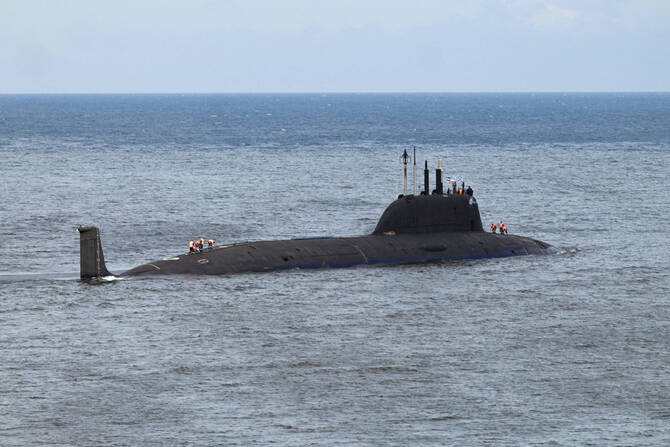
The Russian nuclear-powered submarine Kazan, part of the Russian naval detachment visiting Cuba, leaves Havana Harbour on June 17, 2024. (AFP file photo)
Short Url
Updated 04 December 2025
Follow

UK, Norway to jointly hunt Russian submarines under new pact

  • Pact aims to protect critical undersea infrastructure, such as cables, that Western officials say are increasingly under threat from Moscow
  • Russia is thought to be orchestrating a hybrid war against Western countries, most of which support Ukraine in resisting Russian invasion 

LONDON: A defense pact announced by Britain and Norway on Thursday will see their navies jointly operate a warship fleet to “hunt Russian submarines” in the North Atlantic, the UK government said.
The agreement aims to protect critical undersea infrastructure, such as cables, that Western officials say are increasingly under threat from Moscow.
It comes as Britain’s Ministry of Defense (MoD) reports that sightings of Russian vessels in UK waters have increased 30 percent in the past two years.
Norway announced in September the purchase of at least five Type-26 frigates from Britain for £10 billion ($13 billion).
The latest announcement coincides with a visit by UK Prime Minister Keir Starmer and his Norwegian counterpart Jonas Gahr Store to a Royal Air Force base in northern Scotland.
Under the pact, the two countries will operate a fleet of 13 British-built frigates on an “interchangeable” basis.
They will monitor Russian naval activity in the waters between Greenland, Iceland and the UK, “defending critical infrastructure such as underwater cables and pipelines, which carry vital communications, electricity and gas,” the MoD said in a statement.
“At this time of profound global instability, as more Russian ships are being detected in our waters, we must work with international partners to protect our national security,” said Starmer.
Last month, UK Defense Minister John Healey warned Russia after saying that its military ship Yantar had entered British waters for the second time this year.
He said that it had directed lasers at British air force pilots in a “deeply dangerous” move.
Britain and NATO allies have expressed growing concern about the risk Moscow poses to offshore infrastructure following the suspected sabotage in recent months of several undersea telecom and power cables.
Experts and politicians have accused Moscow of orchestrating a hybrid war against Western countries, most of which support Ukraine following Russia’s full-scale invasion of the country in 2022.


UK’s Starmer urges ‘sleeping giant’ Europe to curb dependence on US

Updated 2 sec ago
Follow

UK’s Starmer urges ‘sleeping giant’ Europe to curb dependence on US

MUNICH, Germany: British leader Keir Starmer will tell the Munich Security Conference that Europe is “a sleeping giant” and must rely less on the United States for its defense, his office said Friday.
In a speech on Saturday at the summit, the UK prime minister will argue that the continent must shift from overdependence on the United States toward a more European NATO.
“I’m talking about a vision of European security and greater European autonomy that does not herald US withdrawal but answers the call for more burden sharing in full and remakes the ties that have served us so well,” Starmer is expected to say.
The gathering comes as European leaders remain concerned that a United States led by President Donald Trump can no longer be relied upon to be the guarantor of their security.
Since returning to the White House last year, Trump has frequently criticized European countries for not sharing enough of the burden on common defense, and raised questions about the future of NATO.
European members of the transatlantic military alliance are rushing to build up their defenses in the face of an increasingly belligerent Moscow, whose war in Ukraine is set to enter its fifth year this month.
“As I see it — Europe is a sleeping giant. Our economies dwarf Russia’s, 10 times over,” Starmer will tell allies, according to excerpts released ahead of his address.
“We have huge defense capabilities. Yet, too often, all of this has added up to less than the sum of its parts,” he was to say, citing fragmented planning and procurement problems.
Late last year, talks on Britain joining the bloc’s new 150-billion-euro (£130 billion) rearmament fund broke down, reportedly because London baulked at the price for entry.
Downing Street said Starmer would use his speech to call for closer UK-EU defense cooperation.
“There is no British security without Europe, and no European security without Britain. That is the lesson of history — and it is today’s reality too,” Starmer was to say.
The UK government announced on Friday that Britain will spend more than £400 million this financial year on hypersonic and long-range weapons, including through joint projects with France, Germany and Italy.
Starmer, whose center-left Labour party is being squeezed on opposite ends of the political spectrum by the anti-immigrant Reform UK group and the more leftwing Greens, was to say leaders “must level with the public” about the defense costs they face.
He was due to hit out at “peddlers of easy answers on the extreme left and the extreme right,” according to the excerpts.
“The future they offer is one of division and then capitulation. The lamps would go out across Europe once again. But we will not let that happen,” Starmer was expected to say.