

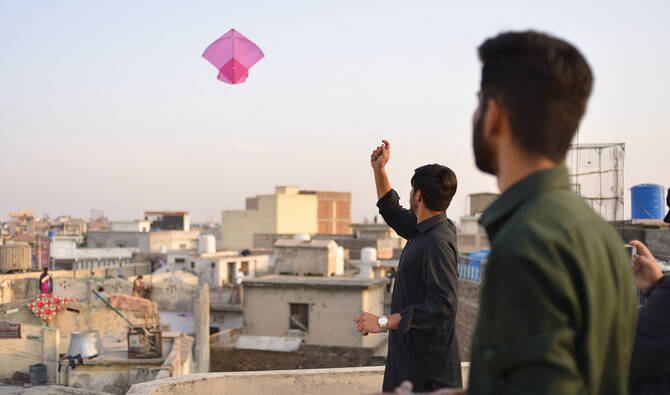

ISLAMABAD: The Pakistani province of Punjab has lifted its long-running ban on Basant, an iconic spring kite-flying festival, after issuing the Punjab Kite Flying Ordinance 2025, Chief Minister Maryam Nawaz Sharif announced on Wednesday.
The ordinance marks a cautious comeback for a festival that once symbolized the arrival of spring in South Asia but was banned due to fatal kite-string accidents.
Basant, one of Punjab’s most celebrated cultural festivals, would draw thousands to rooftops across Lahore and other cities in the province but was repeatedly banned from 2005 onward after dozens of people were killed or injured by dangerous metal- and chemically-coated kite strings that slashed motorcyclists, pedestrians and even children. Courts and provincial administrations upheld the prohibitions for years, making the revival of Basant one of Punjab’s most politically sensitive cultural decisions.
Its return marks a major policy shift for the province, but one that comes with strict new rules intended to prevent the safety crises that prompted the original ban.
“The Punjab Kite Flying Ordinance 2025 has been issued,” the chief minister said in a statement on her Facebook page, laying out new regulatory requirements to govern the event.
As part of the new rules, the government has made registration compulsory for anyone making or selling kites, and each kite will carry a QR code that links back to the seller’s identity.
The new rules impose a complete prohibition on kite flying for minors.
“Children under 18 will not be allowed to fly kites, and in case of violation the parent or guardian will be held responsible,” Sharif’s statement said.
Fines for minors include Rs50,000 ($179) for a first offense and Rs100,000 ($358) for a second.
Kite flying will only be permitted with formal authorization.
“Kite flying in Punjab will be subject to permission from the Deputy Commissioners,” the statement added, noting that kites may only be purchased from registered vendors linked to QR codes.
The ordinance introduces strict penalties for adults, including three to five years in prison and a fine of Rs2 million, about $7,160, for violating the law.
The government has said the new regulatory framework is intended to revive Basant in a controlled, safe manner, balancing public demand for the festival with longstanding concerns over fatal injuries from unsafe kite string.
Officials say the ordinance also aims to formalize the small but extensive economy built around Basant, which includes kite manufacturing, string production, dyes, paper suppliers, bamboo cutters, wholesalers and thousands of seasonal vendors.
For decades, this entire value chain has operated informally, meaning no licensing, safety regulation or tax registration, and earning little direct revenue for the provincial government.
By bringing manufacturers and sellers into a documented system through mandatory registration and QR-coded products, officials argue the government could expand its tax base, ensure safer production standards and create predictable business opportunities for cottage-industry workshops that rely on Basant season for income.
Senior Punjab Minister Marriyum Aurangzeb said the decision to revive Basant was taken only after authorities concluded that the festival could be made significantly safer under strict regulation. She noted that an entire generation had missed out on the event since it was banned due to fatal incidents linked to dangerous kite string.
“Bringing back this festival [of Basant] was a very big decision. It was banned because of the dangers involved,” she said, describing Basant as a landmark cultural event that once “made Lahore stand out on the world map.”
Aurangzeb stressed that while the regulatory framework had been put in place, public cooperation would ultimately determine whether Basant could be celebrated safely.
“The biggest responsibility lies with the citizens of Lahore,” she said, adding that without responsible behavior, it would be difficult to sustain the festival’s return.
She said the ordinance clearly spelled out the standard operating procedures “starting right from the grassroots level,” and urged residents to follow them to ensure the festival’s long-term revival.


