

Pakistan calls for reset in South Asia as dialogue with India hits 11-year freeze

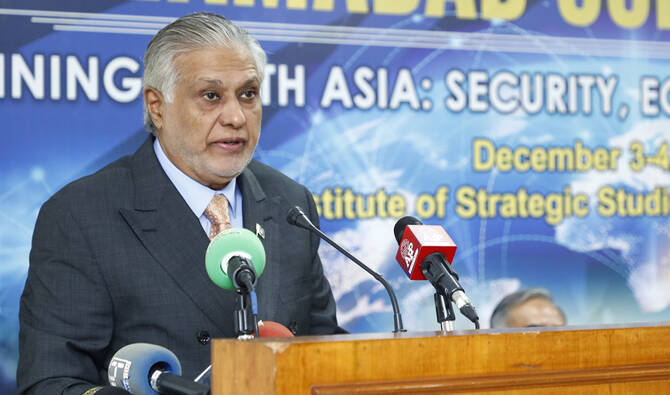
Pakistan’s Deputy Prime Minister Ishaq Dar addresses the “Islamabad Conclave 2025” at the Institute of Strategic Studies in Islamabad, Pakistan, on December 3, 2025. (ISSI)
Short Url
Updated 03 December 2025
Follow

Pakistan calls for reset in South Asia as dialogue with India hits 11-year freeze

  • Deputy PM criticizes SAARC’s paralysis, says rising climate pressures require renewed regional cooperation
  • Ishaq Dar speaks in favor of multilateralism, warns that states are using force in disregard of international law

ISLAMABAD: Pakistan’s Deputy Prime Minister Ishaq Dar on Wednesday urged a “reimagining” of South Asia’s fractured regional architecture, saying an 11-year freeze in dialogue with India was undermining prospects for long-term stability and peace in one of the world’s most volatile regions.

India and Pakistan fought a brief but intense military clash in May this year in which both nuclear-armed neighbors exchanged missiles, artillery fire and deployed fighter jets. The standoff lasted about four days before the United States brokered a ceasefire, saying the two sides had agreed to talk.

While Pakistan continued to call for a “composite dialogue” to resolve all outstanding disputes, India declined to proceed with negotiations.

Dar made the remarks while addressing the Islamabad Conclave 2025, a two-day gathering focused on security, economy, climate and connectivity in South Asia.

“The end of Cold War largely bypassed South Asia, leaving the region with few peace dividends,” Dar said while addressing the gathering. “We, the South Asians, need to think really hard. Are we doomed to remain mired in confrontation and conflict while other regions progress and prosper? The answer should be a clear no.”

He noted the region had weak conflict management and dispute resolution institutions, pointing out that “structured dialogue process between India and Pakistan remains stalled for over 11 years.”

Dar said South Asia’s fragmented political landscape, economic vulnerabilities and climate pressures had made cooperation increasingly urgent, warning that rising temperatures, extreme weather events and glacial melt were threatening water security, agriculture and livelihoods across the region.

He said the cumulative challenges of security, economic fragility and climate change were “too grave to disregard” and could not be effectively tackled without a more functional regional architecture.

He also criticized the paralysis of the South Asian Association for Regional Cooperation (SAARC) which has remained largely inactive for more than a decade, saying “artificial obstacles” must be removed to allow the organization to resume its role as a platform for economic cooperation.

Dar pointed to new trilateral initiatives, including one between Pakistan, China and Bangladesh, as examples of how smaller regional groupings could advance connectivity and collaboration where broader institutions had stalled.

Calling for South Asia to move beyond “zero-sum mindsets,” the deputy prime minister said the region needed dialogue, peaceful coexistence and economic interdependence, adding that open and inclusive regionalism remained essential for sustainable peace.

He maintained Pakistan envisioned a South Asia “where connectivity replaces divisions” and where disputes were resolved in accordance with international legitimacy.

Dar said the region would only realize its economic and political potential if all countries committed to cooperation.

He also spoke in favor of multilateralism, saying the world was witnessing growing military conflicts as states increasingly resorted to the use of force to settle disputes, showing disregard for international law and the principles of the UN Charter.


IMF board to meet tomorrow to consider $1.2 billion disbursement for Pakistan

Updated 11 sec ago
Follow

IMF board to meet tomorrow to consider $1.2 billion disbursement for Pakistan

  • Pakistan, IMF reached a Staff-Level Agreement for second review of $7 billion loan program 
  • Economists view disbursement crucial for cash-strapped Pakistan as it tackles economic crisis

ISLAMABAD: The International Monetary Fund’s (IMF) Executive Board will meet tomorrow, Monday, to consider and approve a $1.2 billion disbursement for Pakistan, according to the global lender’s official schedule. 

The meeting takes place nearly two months after the Fund reached a Staff-Level Agreement (SLA) with Pakistan for the second review of its $7 billion Extended Fund Facility (EFF) and the first review of its $1.4 billion Resilience and Sustainability Facility (RSF). 

The SLA followed a mission led by IMF’s Iva Petrova, who held discussions with Pakistani authorities during a Sept. 24–Oct. 8 visit to Karachi, Islamabad and Washington, DC.

“The International Monetary Fund’s (IMF) Executive Board will convene on Dec. 8 to consider Pakistan’s request for a $1.2 billion disbursement under the Extended Fund Facility (EFF) and the Resilience and Sustainability Facility (RSF), according to the Fund’s updated schedule,” the state-run Pakistan TV reported on Sunday.

Economists view IMF’s bailout packages as crucial for cash-strapped Pakistan, which has relied heavily on financing from bilateral partners such as Saudi Arabia, China and the United Arab Emirates, as well as multilateral lenders including the IMF, World Bank, Asian Development Bank and Islamic Development Bank. 

The South Asian country has been grappling with a prolonged macroeconomic crisis that has drained its financial resources and triggered a balance of payments crisis. Islamabad, however, has recorded some financial gains since 2022, which include recording a surplus in its current account and bringing inflation down considerably. 

Speaking to Arab News last month, Pakistan’s former finance adviser Khaqan Najeeb said the $1.2 billion disbursement will further stabilize Pakistan’s near-term external position and unlock additional official inflows. 

“Continued engagement also reinforces macro stability, as reflected in recent improvements in inflation, the current account, and reserve buffers,” Najeeb said. 

Pakistan came close to sovereign default in mid-2023, when foreign exchange reserves fell below three weeks of import cover, inflation surged to a record 38 percent in May, and the country struggled to secure external financing after delays in its IMF program. Fuel shortages, import restrictions, and a rapidly depreciating rupee added to the pressure, while ratings agencies downgraded Pakistan’s debt and warned of heightened default risk.

The crisis eased only after Pakistan reached a last-minute Stand-By Arrangement with the IMF in June 2023, unlocking emergency support and preventing an immediate default.