

Pakistan signs D-8 dispute mechanism in Egypt, calls for activating preferential trade deal

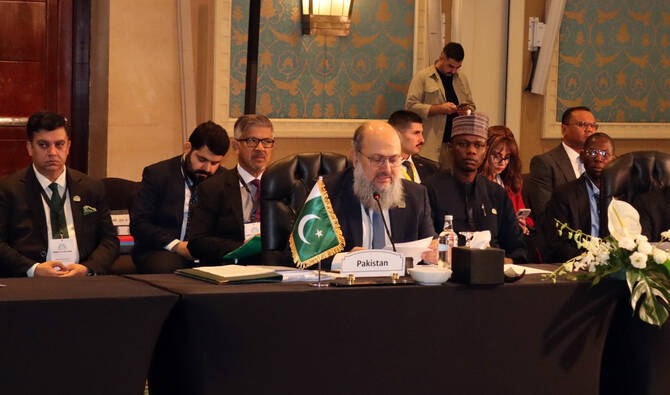
Pakistan’s Federal Minister for Commerce, Jam Kamal Khan, addresses the Fourth D-8 Trade Ministers Council in Cairo, Egypt, on December 8, 2025. (Commerce Ministry)
Short Url
Updated 03 December 2025
Follow

Pakistan signs D-8 dispute mechanism in Egypt, calls for activating preferential trade deal

  • Pakistan urges D-8 members to expand digital trade, logistics connectivity and private-sector partnerships
  • Jam Kamal Khan says the bloc must respond collectively to supply-chain disruptions, climate-related shocks

KARACHI: Pakistan has signed the Developing-8 (D-8) dispute settlement mechanism, an official statement said on Wednesday, as its commerce minister urged member states to operationalize the bloc’s preferential trade agreement (PTA) and expand cooperation in digital trade to boost regional economic integration.

The eight-nation grouping, founded in 1997 by Indonesia, Malaysia, Bangladesh, Pakistan, Iran, Türkiye, Egypt and Nigeria, aims to promote economic cooperation among large Muslim-majority developing states, though progress has often been uneven.

Commerce Minister Jam Kamal Khan made the remarks at the Fourth D-8 Trade Ministers Council in Cairo, where delegations met to review trade commitments and discuss the PTA’s implementation.

“The signing of the protocol — together with the operationalization of the PTA among D-8 member states — is expected to further enhance trade, facilitate smoother economic engagement and support the long-term vision of a more integrated D-8 economic bloc,” the commerce ministry said.

“Jam Kamal Khan stressed the urgency for regional platforms like the D-8 to respond collectively to rising protectionism, supply chain disruptions, climate-related shocks and commodity market volatility,” it added. “Strengthened cooperation, he noted, is essential to maintain resilience, sustain trade flows and foster market confidence.”

Khan also welcomed Azerbaijan’s accession as the grouping’s ninth member, calling its inclusion a boost to the bloc’s economic potential.

He emphasized the need to make the PTA fully functional, saying Pakistan was committed to harmonizing procedures, resolving operational hurdles and streamlining documentation to expand intra-D-8 trade.

The minister called for stronger institutional linkages in customs cooperation, standardization, mutual recognition and logistics connectivity to unlock regional trade.

He added that efficient transport corridors, predictable transit systems and deeper digital integration were critical for competitiveness.

Khan also urged member states to strengthen private-sector collaboration through joint ventures, technology partnerships and sector-specific cooperation.

He identified food security, textiles, agriculture, energy and technological innovation as priority areas for joint work aligned with sustainable development goals.

“Together,” he said according to the statement, “with the right policies and a strong spirit of partnership, we can transform the D-8 region into a dynamic center of trade, development, and opportunity for all our peoples.”


Imran Khan not a ‘national security threat,’ ex-PM’s party responds to Pakistan military

Updated 06 December 2025
Follow

Imran Khan not a ‘national security threat,’ ex-PM’s party responds to Pakistan military

  • Pakistan’s military spokesperson on Friday described Khan’s anti-army narrative as a “national security threat”
  • PTI Chairman Gohar Ali Khan says words used by military spokesperson for Khan were “not appropriate”

ISLAMABAD: Former prime minister Imran Khan’s Pakistan Tehreek-e-Insaf (PTI) party on Saturday responded to allegations by Pakistan military spokesperson Lt. Gen. Ahmed Sharif Chaudhry from a day earlier, saying that he was not a “national security threat.”

Chaudhry, who heads the military’s media wing as director general of the Inter-Services Public Relations (ISPR), spoke to journalists on Friday, in which he referred to Khan as a “mentally ill” person several times during the press interaction. Chaudhry described Khan’s anti-army narrative as a “national security threat.”

The military spokesperson was responding to Khan’s social media post this week in which he accused Chief of Defense Forces Field Marshal Asim Munir of being responsible for “the complete collapse of the constitution and rule of law in Pakistan.” 

“The people of Pakistan stand with Imran Khan, they stand with PTI,” the party’s secretary-general, Salman Akram Raja, told reporters during a news conference. 

“Imran Khan is not a national security threat. Imran Khan has kept the people of this country united.”

Raja said there were several narratives in the country, including those that created tensions along ethnic and sectarian lines, but Khan had rejected all of them and stood with one that the people of Pakistan supported. 

PTI Chairman Gohar Ali Khan, flanked by Raja, criticized the military spokesperson as well, saying his press talk on Thursday had “severely disappointed” him. 

“The words that were used [by the military spokesperson] were not appropriate,” Gohar said. “Those words were wrong.”

NATURAL OUTCOME’

Speaking to reporters earlier on Saturday, Pakistan’s Defense Minister Khawaja Asif defended the military spokesperson’s remarks against Khan.

“When this kind of language is used for individuals as well as for institutions, then a reaction is a natural outcome,” he said. 

“The same thing is happening on the Twitter accounts being run in his [Khan’s] name. If the DG ISPR has given any reaction to it, then I believe it was a very measured reaction.”

Khan, who was ousted after a parliamentary vote of confidence in April 2022, blames the country’s powerful military for removing him from power by colluding with his political opponents. Both deny the allegations. 

The former prime minister, who has been in prison since August 2023 on a slew of charges he says are politically motivated, also alleges his party was denied victory by the army and his political rivals in the 2024 general election through rigging. 

The army and the government both deny his allegations.