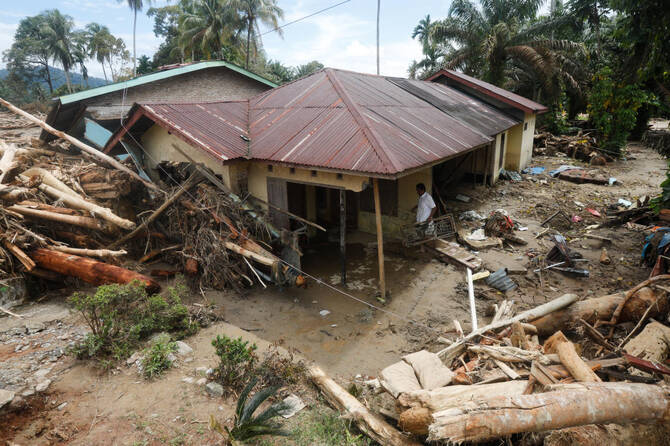
Frustration in Indonesia as flood survivors await aid

Officials in Indonesia and Sri Lanka battled Wednesday to reach survivors of deadly flooding in remote, cut-off regions as the toll in the disaster that hit four countries topped 1,300. (AP)
Short Url
Updated 03 December 2025
Follow

Frustration in Indonesia as flood survivors await aid

  • Officials in Indonesia and Sri Lanka battled Wednesday to reach survivors of deadly flooding in remote, cut-off regions as the toll in the disaster that hit four countries topped 1,300

TUKKA: Officials in Indonesia and Sri Lanka battled Wednesday to reach survivors of deadly flooding in remote, cut-off regions as the toll in the disaster that hit four countries topped 1,300.
In Indonesia, there is growing frustration among survivors of catastrophic flooding and landslides over the pace of the rescue effort and aid delivery.
Humanitarian groups said the scale of the challenge was almost unprecedented even for a country that has faced no shortage of natural disasters.
Monsoon rains paired with two rare tropical storm systems, sometimes known in the region as cyclones, dumped record deluges across Sri Lanka, and parts of Indonesia’s Sumatra, southern Thailand and northern Malaysia last week.
In Indonesia, the toll hit 753 on Wednesday, but the number of missing also increased to 650.
The rising figures reflect information that is only trickling in as many regions remain either physically cut off by flood damage or isolated by electricity and communications failures, or both.
“It’s very challenging logistically to respond,” said Ade Soekadis, executive director of Mercy Corps Indonesia, an aid group.
“The extent of the damage and the size of the affected area is really huge.”
The group is hoping to send hygiene equipment and water both from Jakarta and locally.
He said reports of food and water shortages were already “very concerning” and the situation will be “more problematic as time goes by.”
‘Like an earthquake’

At an evacuation center in Padan, 52-year-old Reinaro Waruwu told AFP he was “disappointed” in the government’s immediate response and the slow arrival of aid.
“Some waited a day and night before receiving help, so they couldn’t be saved,” he said, surrounded by evacuees sitting on mats on the floor in the hall-turned-shelter.
“I am frustrated, it doesn’t need to be said twice. The response was not quick,” he added.
Like many, he described the arrival of floodwaters and landslides as a disaster without precedent.
“It came like an earthquake.. I thought ‘Well,‘Like an earthquake’ if I am going to die, then so be it,’” he said, beginning to sob heavily.
He managed to escape the rising waters, but his neighbors were buried alive in debris.
Traumatized, he could not even eat on arrival, and since then food has been patchily available, though vegetables arriving on Tuesday offered a “semblance of hope,” he said.
Nearby, Hamida Telaumbaunua, 37, described watching her entire kitchen swept away by floodwaters.
“My heart... this was the first time I experienced such a flood,” she said.
Her home was lost entirely, along with everything but the few possessions she took when she left.
“It’s hard to think about what lies ahead. Maybe as long as we’re still here, it’s okay, but later... I don’t know what will happen.”
The weather system that hit Indonesia also brought heavy rains to Thailand, killing at least 176 people, and Malaysia, where two people were killed.
Sri Lanka ‘open’ for tourists
Though floods are common in Asia during monsoon season, climate change is making heavy rain events more frequent because a warmer atmosphere holds more moisture.
Warmer oceans can also turbocharge storm systems.
A separate weather system, Cyclone Ditwah, brought torrential rain and deadly floods and landslides to much of Sri Lanka last week.
At least 465 people were killed, and authorities have estimated the disaster’s cost at up to $7 billion.
“Our initial estimate is that we will need about six to seven billion dollars for the reconstruction,” said Prabath Chandrakeerthi, the Commissioner-General of Essential Services.
Another 366 people are unaccounted for, including in some of the hardest-hit regions that remain largely inaccessible.
Chandrakeerthi said existing laws that allow a person to be declared dead only after being missing for six months could be shortened to expedite the issuance of death certificates.
The government has said it will offer 25,000 rupees ($83) to families to help clean their homes. Those who lost homes will receive up to $8,000.
Over 1.5 million people have been affected, with over 200,000 in state-run shelters.
Despite the disaster, the tourism-reliant country welcomed a luxury cruiseliner to Colombo port on Tuesday, authorities said.
The arrival sends “a clear message to the world: Sri Lanka is safe, open, and ready to embrace visitors once again,” the country’s tourist board said.


Women suicide bombers, new weapons give boost to insurgents in Pakistan

Updated 5 sec ago
Follow

Women suicide bombers, new weapons give boost to insurgents in Pakistan

  • Insurgents put images of women adherents on social media
  • Women recruits ‌fuel group’s propaganda, analysts say
ISLAMABAD: Wearing military fatigues with rifles slung over their shoulders, Yasma Baloch and her husband Waseem smile into the camera for a picture released by Pakistani insurgents after their final mission: detonating suicide bombs.
“They shared a marriage before they shared a final stand,” the Baloch Liberation Army (BLA) said in a statement accompanying the heavily-edited photograph sent to journalists and distributed on social media.
It was among half-a-dozen pictures and biographies that Reuters was unable to immediately verify, but which analysts see as part of a propaganda effort by insurgents in the resource-rich southwestern province to showcase their movement’s appeal.
Insurgent attacks in Pakistan’s largest yet poorest province hit a record last year, fanning risks to huge investments planned in the region, including Chinese and US interests.
Wider ethnic appeal
The growing numbers of women help to boost recruitment, said junior interior minister Talal Chaudhry, in the insurgents’ decades-long battle for greater autonomy and a bigger share of regional resources and critical minerals.
“It gives them popularity and reach, and it impresses on their community that the fight has entered their homes,” Chaudhry told Reuters.
Pakistan has taken up the issue of insurgent recruitment online with numerous social media platforms, ‌he added.
A spokesperson ‌for the BLA did not respond to a request for comment.
Three suicide bombers were among six ‌women ⁠who participated in the ⁠group’s largest wave of attacks in January that killed 58 and nearly brought the province to a standstill, said Hamza Shafaat, a top government official.
Before those attacks, records show a total of five women BLA suicide bombers, including the first such attack in 2022, while three more would-be bombers were captured in counter-terrorism operations in the last some months.
While authorities know of only a small number of women who have joined the ranks of the BLA, analysts say the recruitments point to the group’s widening appeal among ethnic Baloch residents.
“The … insurgency’s broader appeal … has now gone beyond male-dominated tribal and feudal chiefs to include a wider cross-section of society,” said Pearl Pandya, a senior South Asia analyst at conflict monitor ACLED.
‘Most lethal insurgent group’
The participation of women amplifies a ⁠movement that Pakistan’s military says has boosted its firepower with access to a massive cache of US weapons ‌left behind in Afghanistan after Washington pulled out of the neighboring country in 2021.
“In South ‌Asia today, the BLA is the most organized and lethal insurgent group,” said Abdul Basit, a researcher in insurgencies and militancy at Nanyang Technological University in Singapore.
He ‌cited the group’s use of drones to identify troop deployments and vulnerabilities, adding that it used satellite communication during a February 2025 hijack ‌of a train with more than 400 aboard.
Pakistan recovered 272 US made rifles and 33 night vision devices by June last year, its military says, apart from the weapons seized in the most recent Balochistan attacks.
The armed forces “keep on seeing these weapons in the hands of the terrorists operating inside Pakistan,” their spokesperson, Lt. General Ahmed Sharif Chaudhry, told Reuters before January’s attacks.
The Pentagon did not respond to a request for comment.
In reply to a request for comment, White House ‌spokeswoman Anna Kelly said, “As President Trump has said, Joe Biden’s botched Afghanistan withdrawal was the most embarrassing day in our country’s history, which tragically resulted in the deaths of 13 US service members and lost ⁠equipment to the Taliban.”
She added, “We do ⁠not discuss private conversations with foreign governments.”
During more than a dozen coordinated attacks in January, the insurgents stormed hospitals, government buildings, and markets, set off bombs and fired into crowds, killing 58 civilians and security officials.
‘Dangerous evolution in tactics’
Afterwards, from the 216 militants that security forces said were killed in nearly a week of fighting, they seized items ranging from grenade launchers to more than a dozen M16 and M4 rifles.
Reuters was unable to verify whether the sophisticated weapons used in the BLA attacks were made in the United States or came from elsewhere.
Among the $7 billion worth of equipment left in Afghanistan, the US defense department has said, Afghan forces had received more than 300,000 of a total of 427,300 weapons.
That was in addition to more than 42,000 items such as night vision goggles and surveillance devices, it said.
And the insurgents hope propaganda about women recruits will boost their impact.
“They are using women strategically in high-profile attacks for visibility,” Basit added.
The women hail from various socio-economic backgrounds, with some having university education, Pakistan’s counter terrorism department said in a December report seen by Reuters.
“The shift represents a dangerous evolution in terrorist tactics,” it said, about women’s growing participation.
The change was driven by psychological manipulation, online radicalization and strategic exploitation of vulnerable individuals, it added.
“The insurgency’s foot soldiers and leaders both now come from the middle class,” said Pandya, the ACLED analyst.