

Minnesota officials defend Somali community against Trump’s attacks

Short Url
Updated 03 December 2025
Follow

Minnesota officials defend Somali community against Trump’s attacks

  • Local officials oppose Trump’s anti-Somali rhetoric and support community
  • Trump’s rhetoric ramped up during Tuesday Cabinet meeting

Officials in Minneapolis on Tuesday said they were not aware of imminent federal immigration raids targeting the area’s Somali community, which has come under blistering attacks from US President Donald Trump in recent days.
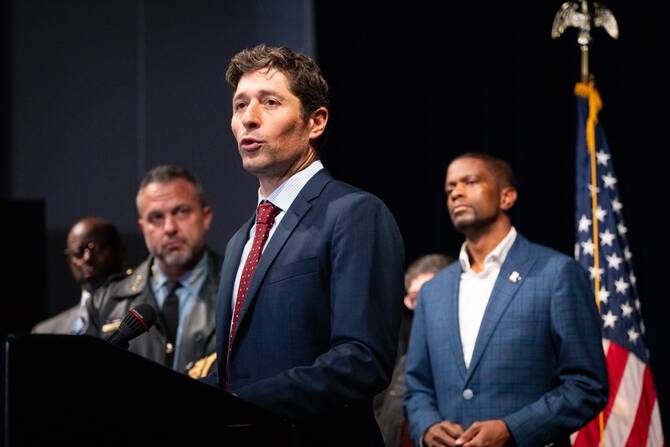
Minneapolis Mayor Jacob Frey, responding to a report in the New York Times that upward of 100 federal immigration agents were poised to descend on his city and neighboring St. Paul to target undocumented Somali residents, said regardless of whether raids were coming, the Somali community would be supported in every way possible by local authorities.
Frey, a Democrat, said local police would not work with federal agents on any immigration matters, and he strongly criticized Trump’s recent attacks on the Somali community, including on Tuesday when the president called them “garbage” and said “we don’t want them in our country.” The president has increased his attacks on Somalis in the US since last week’s shooting of two National Guard troops in Washington, a shooting that killed on of the troops and for which an Afghan national has been charged.
“To villainize an entire group is ridiculous under any circumstances,” Frey said.
Anti-immigration rhetoric was a major part of Trump’s campaign and since taking office in January he has overseen an aggressive campaign by masked federal agents across the country that has instilled fear in immigrant communities and prompted protests and backlashes in the cities targeted.
Tricia McLaughlin, a spokeswoman for the Department of Homeland Security, did not confirm raids were imminent in Minneapolis, but said agents were enforcing immigration laws across the country every day.
About 80,000 Somalis live in Minnesota, mostly in the Twin Cities metro region. Frey said the community had been an economic and cultural boon to the area and had been living in the US for several decades. The vast majority of Somalis in the US, Frey said, are American citizens, and he said he’s convinced any immigration action would ensnare people in the country legally.

Trump last month said he was immediately terminating temporary deportation protections for Somalis living in Minnesota, saying “Somali gangs” were terrorizing the state, without offering evidence or details. Local officials said Trump’s portrayal is untrue. In all, 705 Somalis are in the country with TPS status, according to government records. During a cabinet meeting on Tuesday, Trump ratcheted up his inflammatory rhetoric about Somalis, saying they had contributed nothing to the US
“I don’t want them in our country, I’ll be honest with you,” Trump said. “Their country is no good for a reason. Their country stinks.”
White House spokeswoman Abigail Jackson said the president was “absolutely right to highlight the problems caused by the radical Somali migrants that the Democrats let invade our country and steal from American taxpayers.” Trump has long used incendiary rhetoric, as well as racist and sexist language, saying on several occasions that immigrants in the US illegally are “poisoning the blood of our country.”
St. Paul Mayor Melvin Carter, the first Black mayor of his Twin City which is also home to many Somalis, said Trump’s attacks on that community were “racist” and “xenophobic.”
Citing the opening words to the preamble of the US Constitution — “We the People” — as the phrase that launched the American experience, Carter said “the sacred moments in American history are the moments we’ve had to decide who the ‘we’ is, who is included.’
“Who  is attacking aren’t just Somalis — they are Somali-Americans,” Carter said. “Who he attacked is Americans.”


Putin says there are points he can’t agree to in the US proposal to end Russia’s war in Ukraine

Updated 7 sec ago
Follow

Putin says there are points he can’t agree to in the US proposal to end Russia’s war in Ukraine

Russian President Vladimir Putin says some proposals in a US plan to end the war in Ukraine are unacceptable to the Kremlin, indicating in comments published Thursday that any deal is still some ways off.
US President Donald Trump has set in motion the most intense diplomatic push to stop the fighting since Russia launched the full-scale invasion of its neighbor nearly four years ago. But the effort has once again run into demands that are hard to reconcile, especially over whether Ukraine must give up land to Russia and how it can be kept safe from any future aggression by Moscow.
Trump’s special envoy, Steve Witkoff, and son-in-law Jared Kushner planned to meet later Thursday with the Ukrainian delegation led by Rustem Umerov following the Americans’ discussions with Putin at the Kremlin, but there was no immediate confirmation whether that meeting took place.
The meeting at the Shell Bay Club, a golf property developed by Witkoff in Hallandale Beach, was tentatively set to begin at 5 p.m. EST, according to an official familiar with the logistics. The official was not authorized to discuss the matter publicly because the meeting has not yet been formally announced and spoke on condition of anonymity.
Putin said his five-hour talks Tuesday with Witkoff and Kushner were “necessary” and “useful,” but also “difficult work,” and some proposals were unacceptable.
Speaking to the India Today television channel before he landed Thursday in New Delhi for a state visit, Putin said the American proposals discussed at the Kremlin meeting were based on earlier discussions between Russia and the US, including his meeting with Trump in Alaska in August, but also included new elements.
“We had to go through practically every point, which is why it took so much time,” he said. “It was a meaningful, highly specific and substantive conversation. Sometimes we said, ‘Yes, we can discuss this, but with that one we cannot agree.’“
Trump said Wednesday that Witkoff and Kushner came away from the marathon session confident that Putin wants to find an end to the war. “Their impression was very strongly that he’d like to make a deal,” he added.
Putin said the initial US 28-point peace proposal was trimmed to 27 points and split into four packages. He refused to elaborate on what Russia could accept or reject, and none of the other officials involved offered details of the talks.
The Russian leader praised Trump’s peace efforts, noting that “achieving consensus among conflicting parties is no easy task.”
“To say now what exactly doesn’t suit us or where we could possibly agree seems premature, since it might disrupt the very mode of operation that President Trump is trying to establish,” Putin said.
He emphasized that Russia will fulfill the goals it set and take all of the eastern Donetsk region. “All this boils down to one thing: Either we take back these territories by force, or eventually Ukrainian troops withdraw,” he said.
European leaders, left on the sidelines by Washington as US officials engage directly with Moscow and Kyiv, have accused Putin of feigning interest in Trump’s peace drive.
French President Emmanuel Macron met in Beijing with Chinese leader Xi Jinping, seeking to involve him in pressuring Russia toward a ceasefire. Xi, whose country has provided strong diplomatic support for Putin, did not say respond to France’s call, but said that “China supports all efforts that work toward peace.”
Russian barrages of civilian areas of Ukraine continued overnight into Thursday. A missile struck Kryvyi Rih on Wednesday night, wounding six people, including a 3-year-old girl, according to city administration head Oleksandr Vilkul.
The attack on Ukrainian President Volodymyr Zelensky’s hometown damaged more than 40 residential buildings, a school and domestic gas pipes, Vilkul said.
A 6-year-old girl died in the southern city of Kherson after Russian artillery shelling wounded her the previous day, regional military administration chief Oleksandr Prokudin wrote on Telegram.
The Kherson Thermal Power Plant, which provides heat for over 40,000 residents, shut down Thursday after Russia pounded it with drones and artillery for several days, he said.
Authorities planned emergency meetings to find alternate sources of heating, he said. Until then, tents were erected across the city where residents could warm up and charge electronic devices.
Russia also struck Odesa with drones, wounding six people, while civilian and energy infrastructure was damaged, said Oleh Kiper, head of the regional military administration.
Overall, Russia fired two ballistic missiles and 138 drones at Ukraine overnight, officials said.
Meanwhile, in the Russia-occupied part of the Kherson region, two men were killed by a Ukrainian drone strike on their vehicle Thursday, Moscow-installed regional leader Vladimir Saldo said. A 68-year-old woman was also wounded in the attack, he said.