

Nigeria’s defense minister resigns amid security crisis

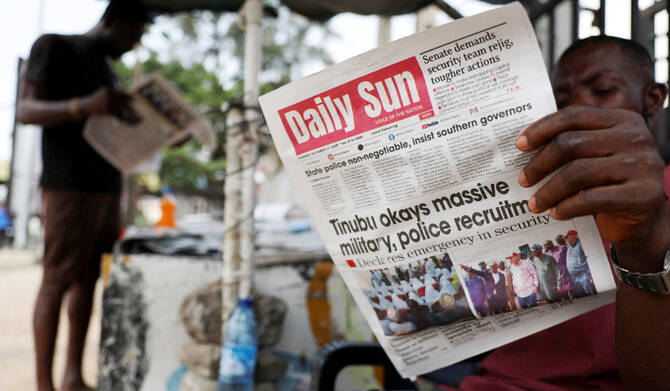
People read newspapers at a roadside newspaper stand in Ikoyi Lagos, Nigeria, November 27, 2025. (REUTERS)
Short Url
Updated 02 December 2025
Follow

Nigeria’s defense minister resigns amid security crisis

  • Africa’s most populous country has long experienced insecurity but the spate of abductions recently has left it scrambling

ABUJA: Nigeria’s defense minister has resigned, the presidency said, as the country reeled from a security crisis including mass kidnappings of schoolchildren.
The departure of Mohammed Badaru Abubakar came after President Bola Tinubu declared a “nationwide security emergency” last week as the country scrambled to respond to a wave of mass kidnappings that have seen hundreds of people, mostly schoolchildren, captured within days last month.
Tinubu’s spokesman, Bayo Onanuga, said in a statement that Abubakar, 63, was quitting with immediate effect, on health grounds.
“His resignation comes amid President Tinubu’s declaration of a national security emergency, with plans to elaborate on its scope in due course,” the spokesman said.
Africa’s most populous country has long experienced insecurity but the spate of abductions recently has left it scrambling.
US President Donald Trump in late October named Nigeria a Country of Particular Concern — a State Department designation for religious freedom violations — over what he called killing of Christians. He subsequently threatened to intervene militarily.
Washington’s rhetoric — rejected by the Nigerian government and independent security analysts — has placed the country’s security crisis under the spotlight.
Armed gangs seized more than 300 teachers and staff at St. Mary’s co-education school in north-central Nigeria on November 21. Fifty escaped but the rest are still in captivity.
“The children are fine and will be back soon,” national security adviser Nuhu Ribadu, was quoted as saying during a high-profile visit with school officials in the town of Kontagora, in central Niger state.
Since Boko Haram militants kidnapped nearly 300 schoolgirls from the northeastern town of Chibok in an infamous raid more than a decade ago, Nigeria has struggled to contain mass kidnappings.
In addition to kidnappings, which are frequent in Nigeria and are mostly carried out by criminal gangs seeking quick ransom payments, Africa’s most populous country has been battling a deadly militant insurgency in its northwestern regions, since 2009.
In the wake of the kidnappings, the country’s president declared emergency, and ordered mass recruitment of police and military personnel.
Recent raids have resulted in kidnappings of schoolchildren and teachers, worshippers and priests, a bride and her bridemaids, farmers, women and children as well as farmers across various parts of the country.


26 Doctors without Borders workers remain unaccounted for in South Sudan a month after attacks

Updated 4 sec ago
Follow

26 Doctors without Borders workers remain unaccounted for in South Sudan a month after attacks

  • A hospital in the town of Lankien was bombed by government forces, MSF said
  • “We have lost contact with them amid ongoing insecurity”

NAIROBI: More than two dozen Doctors Without Borders workers remain unaccounted for a month after attacks in South Sudan, the medical charity said.
Two facilities belonging to the group, known by French acronym MSF, were attacked on Feb. 3 in Jonglei State, northeast of the capital, Juba, where violence has displaced an estimated 280,000 people since December.
A hospital in the town of Lankien was bombed by government forces, MSF said, while another medical facility in the town of Pieri was raided by “unknown assailants.” Both were located in opposition-held areas.
Staff working at the two facilities fled alongside much of the local population into deeply rural areas where armed clashes and aerial bombardments were ongoing.
MSF said in a statement on Monday that “26 of 291 of our colleagues working in Lankien and Pieri remain unaccounted for.
“We have lost contact with them amid ongoing insecurity,” it said.
The lack of communication with its staff could be linked to the limited network connectivity in much of the state. Staff members who had been contacted described “destruction, violence and extreme hardships.”
Fighting escalated sharply in December, when opposition forces captured a string of government outposts in north central Jonglei. In January, the government responded with a counteroffensive that recaptured most of the area it had lost.
Displaced people in Akobo, an opposition-held town near the Ethiopian border, described horrific violence by government fighters. Many described not being able to find food or water as they walked for days to reach safety.
The attacks on MSF facilities in Lankien and Pieri are part of an uptick in violence on humanitarian staff, supplies and infrastructure, aid groups say. MSF facilities have been attacked 10 times in the last 12 months.
“This violence has taken an unbearable toll not only on health care services, but on the very people who kept them running,” said Yashovardhan, MSF head of mission in South Sudan, who only uses one name.
“Medical workers must never be targets,” he said. “We are deeply concerned about what has happened to our colleagues and the communities we serve.”