

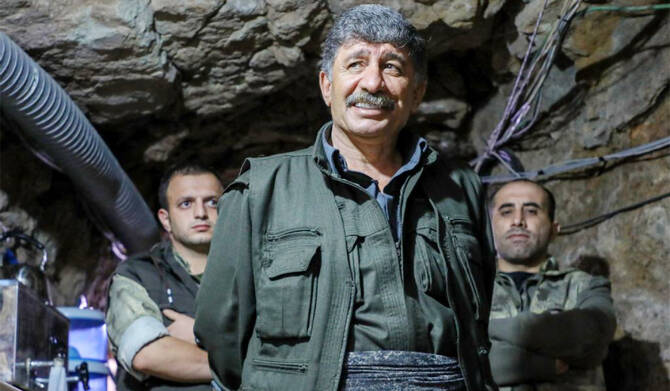

QANDIL MOUNTAINS, Iraq: A Kurdish militant picks his way along a switchback road in Iraq’s mountains before pulling over to alert his comrades in a nearby hidden bunker that they are about to have company.
After calling from a phone dangling from a tree, he leads a team of journalists into a bunker under the Qandil mountains, where they have been granted rare access to the Kurdistan Workers’ Party (PKK) rear base in northern Iraq.
“A peace process doesn’t mean leaving the mountains,” says Serda Mazlum Gabar, a 47-year-old commander with her long, rust-colored hair and unfailing smile.
HIGHLIGHT
Iraq’s mountains have recently welcomed new arrivals — fighters who withdrew from Turkiye to show the group’s commitment to the peace process.
“Even if we leave, we will live the same way,” she added. “Nature doesn’t scare me, but I wouldn’t feel safe walking around a city, with its cars, smoke and traffic.”
Answering a call from the group’s imprisoned founder Abdullah Ocalan, the PKK has taken historic steps in recent months toward ending its decades-old fight against Turkiye that has claimed around 50,000 lives.
The group formally renounced its armed struggle. Thirty of its fighters even burned their weapons in a symbolic move, although many fighters based in Qandil carried rifles during the journalists’ visit.
For decades, the PKK has found sanctuary in mountains in northern Iraq and southeastern Turkiye.
Even if fighting has stopped, the guerrilla lifestyle won’t end. It will rather adapt to new “peaceful” ways, the commander said.
“We were not forced into this life. We chose it,” she added.At the entrance, a large fan is attached to a duct that runs into a concealed passage, ventilating fresh air to the hidden bunker.
The tunnel then opens into a broader corridor where PKK members and commanders dressed in their traditional military dress — olive green fatigues or a dusty-colored sirwal and vest — line up to greet visitors.
The corridor branches out to several rooms, each serving a purpose. One, its entrance decorated with fresh plants and strings of lights, is quarters designated for women fighters.
Iraq’s mountains have recently welcomed new arrivals — fighters who withdrew from Turkiye to show the group’s commitment to the peace process.
Among them is Vejin Dersim who joined the PKK at only 23 and had spent most of her time in southeastern Turkiye.
Now 34, she has withdrawn to Iraq’s mountains.
“Leaving was very emotional. It is a very special place there, especially because we were closer to leader Apo,” she said, referring to Ocalan, who has been held in solitary confinement on Turkiye’s Imrali island since 1999.
Her comrade Devrim Palu, 47, joined the movement in 1999 and has recently returned to Iraq.
“In our movement, it doesn’t matter where you are fighting, and one doesn’t stay in one place,” he said in a soft, low voice.
Today is the time for change, he said.
He added that the PKK is capable of changing the nature of the conflict and transition from war to peaceful engagement.
Over decades, the PKK — still formally designated a “terrorist group” by the US and the EU — has gone through several periods of peace talks with Turkiye.
They have gone through several seismic shifts from starting as a separatist movement to gradually becoming advocates for Kurdish equality in Turkiye.
It now says it is entering a new phase by pursuing a democratic path to defend the rights of the Kurdish minority.
According to Devrim Palu, it is generally easier to be based in Iraq because the top commanders are closer, and news arrives firsthand.
In the bunker that AFP visited, the walls are adorned with pictures of Ocalan and fallen fighters.
In a kitchen, PKK members knead dough to make lahmajun, which is bread topped with meat. Others watched TV, drank tea or chatted in the corridors.
One is a designated room to maintain communications with others in the surrounding mountains.
Qandil has been home to the PKK for years — a place that offered greater refuge than the mountains of southeast Turkiye.
At first, fighters hid in caves, then began carving and digging dozens of their own well-maintained bunkers. Qandil became their headquarters.
“I could drive these mountains with my eyes closed,” one member said, skillfully navigating the rugged tracks at high speed in the pitch-dark night.


