


Saudi Arabia, UK collaborate to advance sustainable humanitarian aid

1 / 4
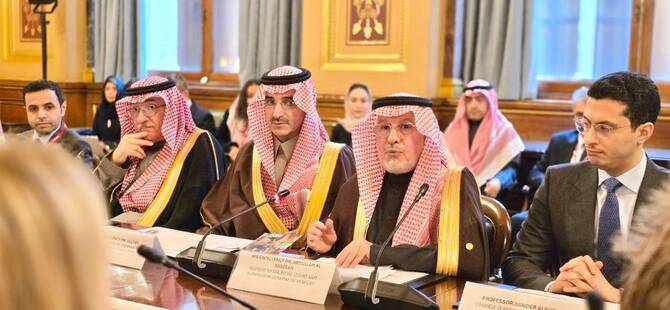
Dr. Abdullah Al-Rabeeah, advisor at the Royal Court and supervisor general of the Saudi aid agency KSrelief, speaks at the Strategic Aid Dialogue, in London. (Supplied)
2 / 4
The opening session of the third Strategic Aid Dialogue on international development and humanitarian assistance between Saudi Arabia and the United Kingdom, in London. (Supplied)
3 / 4
Dr. Abdullah Al-Rabeeah, advisor at the Royal Court and supervisor general of the Saudi aid agency KSrelief, speaks at the Strategic Aid Dialogue, in London. (Supplied)
4 / 4
The opening session of the third Strategic Aid Dialogue on international development and humanitarian assistance between Saudi Arabia and the United Kingdom, in London. (Supplied)
Short Url
Updated 02 December 2025
Follow

Saudi Arabia, UK collaborate to advance sustainable humanitarian aid

  • London hosts third Strategic Aid Dialogue on international development and humanitarian assistance
  • Saudi delegation led by Dr. Abdullah Al-Rabeeah, advisor at the Royal Court and supervisor-general of Saudi aid agency KSrelief

RIYADH: The opening session of the third Strategic Aid Dialogue on international development and humanitarian assistance between Saudi Arabia and the United Kingdom took place in London on Monday.

The Saudi delegation was headed by Dr. Abdullah Al-Rabeeah, advisor at the Royal Court and supervisor-general of Saudi aid agency KSrelief, and included representatives from the Ministries of Foreign Affairs and Finance and the Saudi Fund for Development.

The British side was headed by the UK Minister of State for International Development and Africa, Baroness Jennifer Chapman.

In his opening remarks, the Saudi Aid chief said that since their last meeting in Riyadh in May 2024, there had been a significant increase in the role of both Saudi Arabia and the UK in addressing pressing humanitarian and development challenges worldwide. Further cooperation was anticipated between the two countries going forward.

Al-Rabeeah said Saudi Arabia and the UK had collaborated on five projects to date aimed at serving humanitarian work and promoting opportunities for global peace, security and prosperity, with a total cost exceeding $30 million.

He added a workshop on Saudi-British official development assistance was held in London in June 2025, and that the two sides took part in several other meetings and a joint visit to the Organisation for Economic Co-operation and Development.

Al-Rabeeah said officials from both countries were striving to identify promising opportunities to enhance cooperation between them. Saudi Arabia sees tremendous potential in leveraging its strengths in several areas, he added, such as providing healthcare, developing educational infrastructure and implementing livelihood programs. 

Al-Rabeeah highlighted the Kingdom’s eagerness to explore further avenues of cooperation with the UK Foreign, Commonwealth and Development Office to successfully transform humanitarian interventions into sustainable aid. He also presented a vision for the future that included a strong partnership that integrated the expertise of both countries.

The third Strategic Aid Dialogue is taking place while humanitarian and development needs continue to increase due to ongoing conflicts, climate shocks and economic instability. 

The partnership between Saudi Arabia and the UK is seen as crucial to improving the reality of humanitarian work, with the opening session of the Strategic Dialogue representing an opportunity to review the progress made since the last session and to highlight shared strategic ambitions and priorities.


Saudi authority sets new standards for beach operators on the Red Sea

Updated 19 January 2026
Follow

Saudi authority sets new standards for beach operators on the Red Sea

JEDDAH: The Saudi Red Sea Authority has announced a new regulatory framework for beach operations, redefining beaches as managed operating sites rather than informal recreational spaces, the Saudi Press Agency reported.

The framework introduces standardized requirements for beach operators, focusing on licensing, safety, risk management and service quality across coastal tourism activities.

Under the regulations, beach operations will be permitted only through licensed entities, with license issued for two-year periods. 

Renewal applications must be submitted at least 30 days before expiration. The authority said the system is intended to bring consistency to beach management and provide operators with clearer operational timelines.

The framework applies along more than 1,800 km of Red Sea coastline and establishes a unified national approach to regulating beach activities. The authority said no beach operation will be allowed without an official license. 

The initiative supports the authority’s broader objectives to develop a coastal tourism sector that contributes SR85 billion ($22.66 billion) to GDP by 2030, creates approximately 210,000 jobs, and attracts 19 million visitors, the SPA noted. 

To ensure a smooth transition, the regulations will come into effect one month after their announcement, while existing operators will be granted a one-year grace period to comply. 

Safety forms a central pillar of the new framework. Licensing conditions include environmental permits, insurance coverage, approved safety plans, defined activity zones, and assessments of beach capacity.

Operators will also be required to provide licensed lifeguards, safety equipment, and systems for incident reporting and analysis.

The requirements extend to infrastructure and operation standards, including compliance with the Saudi Building Code to ensure accessibility for people with disabilities and structural safety.

Operators are also encouraged to align with international benchmarks such as Blue Flag standards and the ISO 13009:2024 for beach management, the SPA added.

The authority said this framework is designed to reduce operational risks, improve oversight and support the sustainable development of coastal tourism.

Unified requirements reduce operational risks, minimize inconsistencies, and improve the sector’s ability to attract financing and scale sustainably.