Pakistan cement exports decline for third consecutive month in Nov.

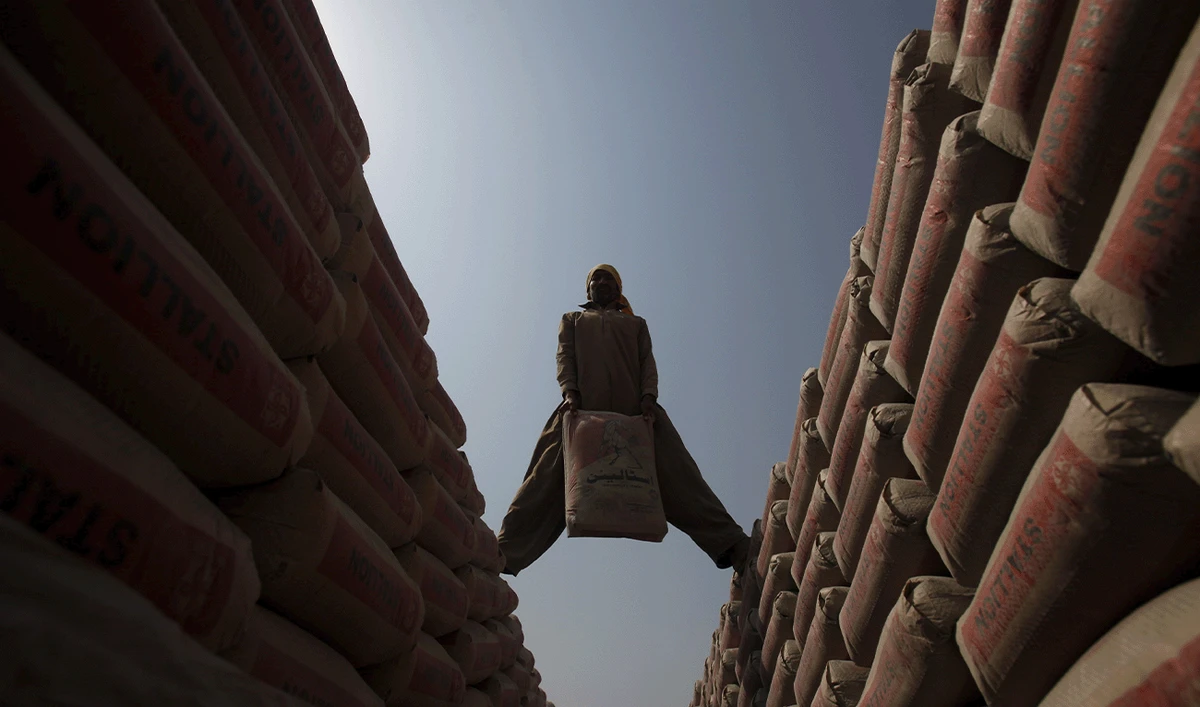
A labourer moves sacks of cement from one truck to another bound for Afghanistan at a transit depot in Peshawar, Pakistan September 16, 2015. (Reuters/File)
Short Url
Updated 02 December 2025
Follow

Pakistan cement exports decline for third consecutive month in Nov.

  • Cement exports declined in November by a massive 26.53 percent to 590,183 tons on a year-on-year basis
  • Manufacturers say the sector can grow provided the government gives concessions on duties and taxes

KARACHI: Pakistan’s cement exports declined for a third consecutive month in November by a massive 26.53 percent to 590,183 tons on a year-on-year basis, the All-Pakistan Cement Manufacturers Association (APCMA) said on Tuesday.

Cement exports declined by around 23 percent in October 2025 and 15 percent in September 2025. The APTCMA logged Pakistan’s total cement exports in Nov. 2024 at 803,258 tons. Domestic cement dispatches in Nov. were 3.549 million tons, showing a marginal increase of 2.23 percent.

The country’s overall cement dispatches last month stood at 4.14 million tons as compared to 4.275 million tons dispatched during the same month of the last fiscal year, showing a decline of 3.17 percent, according to the APTCMA.

A spokesman for the All-Pakistan Cement Manufacturers Association urged the government to frame industry friendly policies that can reduce the cost of business and make Pakistani cement competitive in regional and global markets.

“We can achieve growth provided the government gives concessions on duties and taxes that will ultimately benefit the end-consumer,” the spokesperson said in a statement.

In recent years, Pakistan’s government has withdrawn various subsidies and taxed incomes from agriculture, retail and real-estate sectors as one of the conditions set by the International Monetary Fund (IMF) under its 37-month, $7 billion loan program Islamabad secured in September last year.

The country’s official data for November indicated a substantial contraction in exports, rising import pressures and a widening cumulative trade deficit, posing serious challenges.

Pakistan’s overall exports in November dropped sharply to $2.398 billion, a 15.8 percent decline compared to October 2025, according to the Pakistan Bureau of Statistics (PBS) figures. Imports decreased by 13.7 percent month-on-month, reaching $5.253 billion.

But the reduction in imports was insufficient to offset the export slump and consequently, the monthly trade deficit stood at $2.855 billion, an 11.9 percent increase over October.



Pakistan stocks recover as oil supply fears ease after Islamabad seeks Red Sea route— analyst

Updated 05 March 2026
Follow

Pakistan stocks recover as oil supply fears ease after Islamabad seeks Red Sea route— analyst

  • Pakistan has sought Saudi help to secure oil supplies via Red Sea port after Iran’s closure of Strait if Hormuz
  • Analyst says higher crude oil prices, expectations of IMF releasing next loan tranche also triggered bullish activity

ISLAMABAD: Pakistani stocks marked a sharp recovery when trading closed on Thursday, as institutional activity increased following Islamabad’s move to seek crude oil supplies through the Red Sea port eased oil supply fears, a financial analyst said. 

Pakistani stocks have recorded a sharp decline this week, with the benchmark KSE-100 index recording its largest-ever single-day decline on Monday when it plunged 16,089 points. Escalating conflict in the Middle East triggered panic selling at the Pakistani bourse, forcing a temporary trading halt on Monday. 

The KSE-100 index, however, gained 3.49 percent or 5,433.46 points to close at 161,210.67 when trading ended on Thursday, up from the previous close of 155,777.21 points, according to Pakistan Stock Exchange’s (PSX) data.

Pakistan’s Petroleum Minister Ali Pervaiz Malik met Saudi Ambassador Nawaf bin Said Al-Malki on Wednesday to discuss Iran’s closure of the key Strait of Hormuz, which has threatened Pakistan’s energy supply. Roughly 20 percent of the global oil and gas supply passes through the route. Saudi Arabia indicated it could facilitate shipments through the Red Sea port of Yanbu, offering an alternative route if Gulf shipping lanes remain disrupted, the petroleum ministry said on Wednesday. 

“Stocks staged a sharp recovery at PSX amid institutional activity on easing fuel supply fears after KSA [Kingdom of Saudi Arabia] commits oil supplies through the Red Sea port,” Ahsan Mehanti, chief executive officer at Arif Habib Commodities, told Arab News.

He said higher global crude oil prices and expectations of the International Monetary Fund releasing its next tranche of the $7 billion loan for Pakistan also helped bullish activity at the PSX.

An IMF mission was in Pakistan to hold talks on the third review of a $7 billion Extended Fund Facility multi-year program, and for the second review of the $1.4 billion Resilience and Sustainability Facility this week.

However, the delegation left for Türkiye amid tensions in the Gulf. Pakistani officials have said talks are likely to continue virtually in the coming days. 

Pakistani brokerage Topline Securities said in its daily market review report that strong institutional buying “turned the tide” on Thursday after the market’s recent overreaction to regional issues.

The report added that Hub Power Company (HUBC), Oil & Gas Development Company (OGDC), Fauji Fertilizer Company (FFC), Engro Corporation (ENGROH), and Meezan Bank Limited (MEBL) collectively contributed 2,197 points to the KSE benchmark’s gain.

Topline Securities said 723 million shares were traded on Thursday, with K-Electric Limited (KEL) stealing the spotlight as more than 1.17 billion shares changed hands.

Pakistani investors are closely monitoring developments in the Gulf, particularly around energy routes and further retaliatory actions, as the conflict’s trajectory remains uncertain.