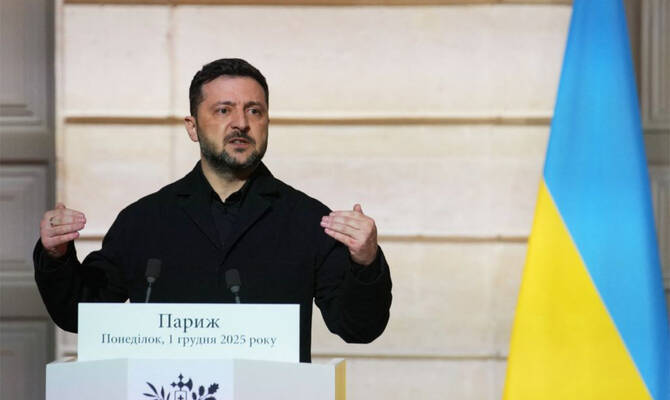
PARIS: Ukraine’s president spoke optimistically Monday about the progress of revising the Trump administration’s peace plan, saying “it looks better” and the work will continue during talks on how to end Russia’s nearly four-year war.
President Volodymyr Zelensky spoke after meeting with France’s president, the latest in discussions aimed at brokering the terms for a potential ceasefire in the largest armed conflict in Europe since World War II.
Meanwhile, Kremlin spokesperson Dmitry Peskov confirmed that Russian President Vladimir Putin would meet with US special envoy Steve Witkoff on Tuesday. Witkoff’s role came under scrutiny last week following a report that he coached Putin’s foreign affairs adviser on how Russia’s leader should pitch to Trump on the Ukraine peace plan.
Zelensky’s visit to Paris followed Sunday’s meeting between Ukrainian and US officials, which Secretary of State Marco Rubio described as productive. The two sides have worked to revise the proposed US-authored plan that was developed in negotiations between Washington and Moscow but criticized as being too weighted toward Russian demands.
The Kremlin late Monday boasted of Russia’s battlefield gains ahead of the talks, claiming Moscow’s troops have captured the key city of Pokrovsk in the eastern Donetsk region. According to Peskov, Putin received a report about Pokrovsk’s capture on Sunday.
Zelensky, however, said in Paris that fighting was still ongoing in Pokrovsk on Monday.
In a ‘preliminary phase’
Zelensky called the topic of Ukraine’s control over its territories “the most complicated” in discussions over the plan.
French President Emmanuel Macron said talks are still in a “preliminary phase” but called the flurry of diplomatic activity “a moment that could be a turning point” for the future of peace in Ukraine and security in Europe.
After criticism from Ukraine and its European allies, President Donald Trump has downplayed his administration’s original 28-point peace framework, which would have imposed limits on the size of Ukraine’s military, blocked the country from joining NATO and required Ukraine to give up territory. He now calls it a “concept” to be “fine-tuned.”
The French leader said he wanted to praise the US peace efforts but insisted that any peace plan can “only be finalized with Europeans around the table.”
Last week, Macron urged Western allies to bring “rock-solid” security guarantees to Ukraine in case a ceasefire or a peace deal is be reached. He has endorsed deploying a “reassurance force” on land, at sea and in the air to help ensure the country’s security.
The French president said Monday that the coming days will see “crucial discussions” between US officials and Western partners, who would aim to clarify US participation in security guarantees.
Macron’s office said he and Zelensky held talks with other European partners including leaders from Britain, Germany, Poland, Italy, Norway, Finland, Denmark and the Netherlands. Also included were European Union officials Antonio Costa and Ursula von der Leyen and NATO Secretary-General Mark Rutte.
Macron and Zelensky also had phone calls with Witkoff, Macron’s office said.
EU foreign policy chief Kaja Kallas on Monday expressed concern that the US-Russia talks might end up with Ukraine having to make more concessions, like being pressured to surrender territory.
“I’m afraid that all the pressure will be put on the victim,” Kallas told reporters in Brussels after chairing a meeting of EU foreign and defense ministers.
Russia claims more battlefield gains ahead of the talks
The Kremlin released footage of Putin in military fatigues, meeting with top military officials on Sunday evening at an unidentified military command post.
Russia’s General Staff chief, Gen. Valery Gerasimov, reported to Putin that the Russian troops have taken full control of Pokrovsk in the Donetsk region — Russia uses the old Soviet name of the city, Krasnoarmeysk — and the city of Vovchansk in the Kharkiv region.
Col. Gen. Valery Solodchuk added that Russian forces were still battling “the remaining small enemy groups” in Pokrovsk.
There were no immediate comments from Ukrainian officials on the claim, which could not be independently verified.
Pokrovsk sits along the eastern front line in part of what has been dubbed the “fortress belt” of Donetsk. The line of heavily fortified cities is crucial to Ukraine’s defense of the region, including Kramatorsk, Sloviansk and Druzhkivka.
Speaking to reporters in Paris, Zelensky also rejected Russia’s earlier claim of capturing the city of Kupiansk in the Kharkiv region. The Ukrainian leader said that Kyiv’s troops “cleared out” almost all of Russian forces in Kupiansk.
In the footage, Putin insisted that the Russian troops “are increasing pressure along the entire front line” and “along the entire line of contact, the initiative is entirely in the hands of our Armed Forces.”
The Kremlin on Monday also condemned Ukrainian strikes on Russian oil infrastructure over the weekend, including an attack on an oil terminal owned by the Caspian Pipeline Consortium, or CPC, and another that targeted two tankers in Turkish waters.
A major oil terminal near the port of Novorossiysk halted operations Saturday after a strike by unmanned boats damaged one of its three mooring points, according to a statement from CPC, which owns the terminal. It came a day after Ukrainian naval drones struck two oil tankers in the Black Sea that were reported to be part of Russia’s “shadow fleet” that evade sanctions.
Ukraine confirmed on Saturday it carried out the attacks.
Peskov described both incidents as “outrageous” and noted of the CPC terminal that “we’re talking about an international facility.”
Meanwhile, Russia’s Ministry of Defense said Russian forces had destroyed 32 Ukrainian drones overnight. The drones were shot down over 11 Russian regions, as well as the Sea of Azov, the ministry said.
An apartment block was damaged during a Ukrainian attack on the city of Kaspiysk in Russia’s Dagestan region, local Gov. Sergei Melikov said. Located on the shore of the Caspian Sea close to Russia’s border with Azerbaijan, the city is more than 1,000 kilometers (620 miles) from the front line.
Daytime strike on Ukrainian city of Dnipro
A Russian missile strike around midday Monday killed four people and wounded 40 others, 11 critically, in the eastern city of Dnipro, according to the head of regional administration Vladyslav Haivanenko.
The strike hit the city center, damaging four residential high-rises, an educational facility and the storage facility of a humanitarian organization, said Mayor Borys Filatov, adding that search and rescue operations were ongoing.
Ukraine’s Air Force said Russia had fired 89 strike and decoy drones overnight Sunday before the attack on Dnipro, of which 63 drones were shot down or jammed.
Overall in November, Russia fired 100 missiles of various types and 9,588 reconnaissance and strike drones into Ukraine, according to the Air Force’s monthly report published Monday.


![]()

Zelensky says US peace plan ‘looks better’ with revisions but work continues
Short Url
https://arab.news/6n8gh
Zelensky says US peace plan ‘looks better’ with revisions but work continues
- Zelensky called the topic of Ukraine’s control over its territories “the most complicated” in discussions over the plan


Latest updates





© 2026 SAUDI RESEARCH & PUBLISHING COMPANY, All Rights Reserved And subject to Terms of Use Agreement.