Indonesia, Thailand race to find missing as flooding toll rises to 480

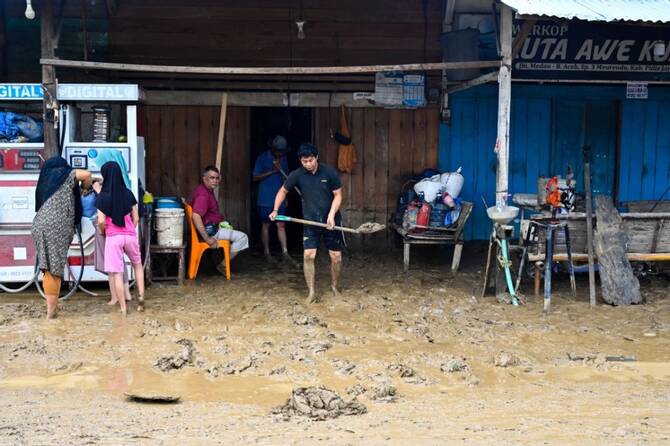
People clear mud from a building entrance following flash floods in Meureudu, Pidie Jaya district in Indonesia. (AFP)
Short Url
Updated 30 November 2025
Follow

Indonesia, Thailand race to find missing as flooding toll rises to 480

  • Heavy monsoon rain overwhelmed swaths of Indonesia, Thailand and Malaysia this week, leaving thousands of people stranded without shelter or critical supplies

PADANG: Indonesian and Thai authorities raced on Sunday to clear debris and find hundreds of people still missing after devastating floods and landslides that killed at least 480 people across Southeast Asia.
Heavy monsoon rain overwhelmed swaths of Indonesia, Thailand and Malaysia this week, leaving thousands of people stranded without shelter or critical supplies.
At least two cities on Indonesia’s worst-affected Sumatra island were still unreachable on Sunday, and authorities said they had deployed two warships from Jakarta to deliver aid.
“There are two cities that require full attention due to being isolated, namely Central Tapanuli and Sibolga,” National Disaster agency head Suharyanto said in a statement. The ships were expected in Sibolga on Monday, he said.
The death toll in Indonesia rose to 316, while 289 were still missing, according to the latest figures from the disaster authority.
In Sungai Nyalo village, about 100 kilometers (62 miles) from West Sumatra’s capital Padang, floodwaters had mostly receded on Sunday, leaving homes, vehicles and crops coated in thick grey mud.
Authorities had not yet begun clearing roads, residents told AFP, and no outside assistance had arrived.
“Most villagers chose to stay; they didn’t want to leave their houses behind,” said Idris, 55, who, like many Indonesians, goes by one name.
Across the island toward the north coast, an endangered Sumatran elephant lay buried in thick mud and debris near damaged buildings in Meureudu town.
In Thailand, where at least 162 people were killed in one of the worst floods in a decade, authorities continued to deliver aid and clear the damage.
Relief measures rolled out by the Thai government include compensation of up to two million baht ($62,000) for households that lost family members.
However, there has been growing public criticism of Thailand’s flood response, and two local officials have been suspended over their alleged failures.
Two people were killed in Malaysia after floods left stretches of northern Perlis state underwater.
The annual monsoon season, typically between June and September, often brings heavy rain, triggering landslides and flash floods.
A tropical storm has exacerbated conditions, and the tolls in Indonesia and Thailand rank among the highest in floods in those countries in recent years.
Climate change has affected storm patterns, including the duration and intensity of the season, leading to heavier rainfall, flash flooding and stronger wind gusts.


WHO chief says reasons US gave for withdrawing ‘untrue’

Updated 25 January 2026
Follow

WHO chief says reasons US gave for withdrawing ‘untrue’

  • US Secretary of State Marco Rubio and US Health Secretary Robert F. Kennedy Jr. announced in a joint statement Thursday that Washington had formally withdrawn from the WHO
  • And in a post on X, Tedros added: “Unfortunately, the reasons cited for the US decision to withdraw from WHO are untrue”

GENEVA: The head of the UN’s health agency on Saturday pushed back against Washington’s stated reasons for withdrawing from the World Health Organization, dismissing US criticism of the WHO as “untrue.”
Tedros Adhanom Ghebreyesus warned that US announcement this week that it had formally withdrawn from the WHO “makes both the US and the world less safe.”
And in a post on X, he added: “Unfortunately, the reasons cited for the US decision to withdraw from WHO are untrue.”
He insisted: “WHO has always engaged with the US, and all Member States, with full respect for their sovereignty.”
US Secretary of State Marco Rubio and US Health Secretary Robert F. Kennedy Jr. announced in a joint statement Thursday that Washington had formally withdrawn from the WHO.
They accused the agency, of numerous “failures during the Covid-19 pandemic” and of acting “repeatedly against the interests of the United States.”
The WHO has not yet confirmed that the US withdrawal has taken effect.

- ‘Trashed and tarnished’ -

The two US officials said the WHO had “trashed and tarnished” the United States, and had compromised its independence.
“The reverse is true,” the WHO said in a statement.
“As we do with every Member State, WHO has always sought to engage with the United States in good faith.”
The agency strenuously rejected the accusation from Rubio and Kennedy that its Covid response had “obstructed the timely and accurate sharing of critical information that could have saved American lives and then concealed those failures.”
Kennedy also suggested in a video posted to X Friday that the WHO was responsible for “the Americans who died alone in nursing homes (and) the small businesses that were destroyed by reckless mandates” to wear masks and get vaccinated.
The US withdrawal, he insisted, was about “protecting American sovereignty, and putting US public health back in the hands of the American people.”
Tedros warned on X that the statement “contains inaccurate information.”
“Throughout the pandemic, WHO acted quickly, shared all information it had rapidly and transparently with the world, and advised Member States on the basis of the best available evidence,” the agency said.
“WHO recommended the use of masks, vaccines and physical distancing, but at no stage recommended mask mandates, vaccine mandates or lockdowns,” it added.
“We supported sovereign governments to make decisions they believed were in the best interests of their people, but the decisions were theirs.”

- Withdrawal ‘raises issues’ -

The row came as Washington struggled to dislodge itself from the WHO, a year after US President Donald Trump signed an executive order to that effect.
The one-year withdrawal process reached completion on Thursday, but Kennedy and Rubio regretted in their statement that the UN health agency had “not approved our withdrawal and, in fact, claims that we owe it compensation.”
WHO has highlighted that when Washington joined the organization in 1948, it reserved the right to withdraw, as long as it gave one year’s notice and had met “its financial obligations to the organization in full for the current fiscal year.”
But Washington has not paid its 2024 or 2025 dues, and is behind around $260 million.
“The notification of withdrawal raises issues,” WHO said Saturday, adding that the topic would be examined during WHO’s Executive Board meeting next month and by the annual World Health Assembly meeting in May.
“We hope the US will return to active participation in WHO in the future,” Tedros said Saturday.
“Meanwhile, WHO remains steadfastly committed to working with all countries in pursuit of its core mission and constitutional mandate: the highest attainable standard of health as a fundamental right for all people.”