

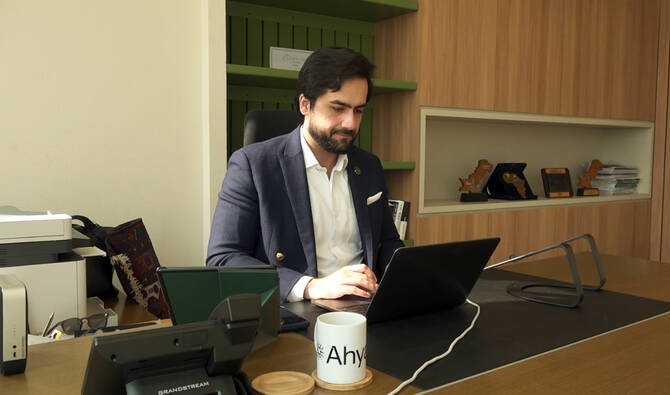

KARACHI: Ahya Technologies, an award-winning, Saudi-based climate tech firm operating in Pakistan, is leveraging artificial intelligence (AI) to help governments and businesses across the Middle East, North Africa and Pakistan (MENAP) transition to net-zero emissions, its founder said on Friday.
The firms operates in Pakistan, Saudi Arabia and the United Arab Emirates (UAE), and provides a platform that tracks emissions, enables carbon trading and builds local infrastructure for carbon markets.
This month, the United Nations (UN) granted Ahya Technologies, one of over 300 global contenders, the 2025 ‘AI for Climate Action Innovation Award’ in recognition of its efforts to leverage AI for the net-zero era.
The firm uses AI for three core purposes, prediction, automation and decision support, and provides guidance on regulatory compliance across Saudi Arabia, the UAE and Pakistan.
“Our mission is to enable not just Saudi or Pakistan but our region’s transition to net-zero with accuracy, transparency and economic growth,” Salaal Hasan, Ahya founder and a chemical engineer, told Arab News, adding that Saudi data scientists and Pakistani environmentalists have been “working hand in hand” to achieve this goal.
“It’s beautiful to see the talent work together and build something that wins an award from the United Nations.”
Ahya entered the Saudi market three years ago with a license from the Kingdom’s investment ministry. The firm piloted projects with companies, including Saudi Basic Industries Corporation (SABIC) and PepsiCo, and now seeks partners aligned with Saudi Vision 2030 and the Middle East Green Initiative.
It also collaborates with Dubai Chambers, a non-profit organization that serves the needs of the business community, to support Environmental, Social and Governance (ESG) Label awardees under the UAE’s new climate-disclosure law that requires all public and private entities to measure, report and reduce their greenhouse gas emissions.
“We were the first and only Saudi and regional company mentioned by the Future Investment Initiative for using AI to solve climate change [problems],” Hasan said.
“We partnered with Dubai Chambers because Dubai Chambers wanted it now to be done on an accurate assessment of emissions and impact.”
Ahya’s AI-powered OS platform for accurate carbon measurement guides in Arabic and English to simplify emissions-tracking and provides tools to handle complex assessments.
It predicts emissions, automates collection from various sources, and provides guidance on regulatory compliance.
“The principle for adaptation is one, which is accuracy in data,” Hasan noted. “In simple terms, what am I saying is that in order to change something, you need to measure it.”
Asked about Pakistan, Hasan stressed the need to have accurate data on national contribution to global emissions and to embrace technology.
“I think the forward-looking step that they took was on the carbon market side. These offer a potential for foreign exchange and FDI (foreign direct investment) coming into the country,” Hasan said.
“Pakistan has a lot of natural projects like the Delta Blue Carbon project which is a mangrove plantation in the province of Sindh and similar projects can also be done in Balochistan as well.”
He urged the Pakistani government to embrace digital public infrastructure for climate action like the UAE to help unlock global funds to address Pakistan’s climate woes.
Ahya Technologies aims to help reduce carbon dioxide equivalent, or CO₂e, by 20 million tons annually, reaching the 150-million-ton target by 2030.
“We envision a future for our region where sustainability is embedded as a source of competitive advantage and of lasting growth for the private sector and the region’s public sector,” Hasan said.
The firm, which is also expanding to Egypt, sees economic opportunities in emissions’ management.
Hasan described sustainability as a competitive advantage in terms of lowering financing costs, increasing export value and enhancing brand equity.
“Now whether you’re a steel manufacturer in the UAE or a textile manufacturer in Pakistan or a rubber manufacturer in Saudi Arabia, if you are showing a decrease in your emissions over time and you can claim that your product has a net-zero carbon footprint which we have supported our clients do in Pakistan’s textile sector or UAE or Saudi’s export sectors, that’s one of the main reasons a net zero product in an export market like EU will generate 25 to 30 percent premium,” he said.


