

Pakistan urges religious scholars to promote unity as global Qirat competition concludes

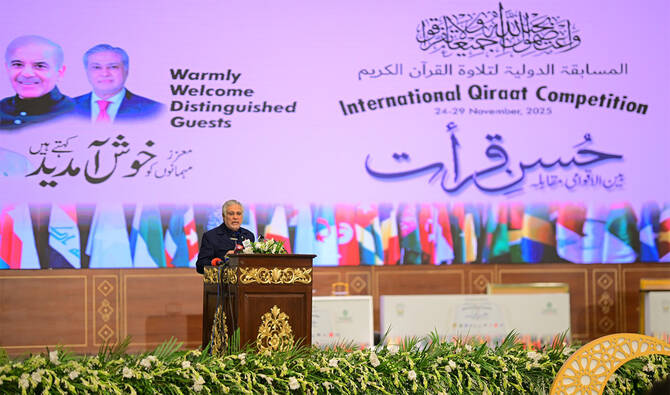
Deputy Prime Minister Ishaq Dar addresses the last day of International Qirat Competition in Islamabad, Pakistan on November 29, 2025. (Ishaq Dar)
Short Url
Updated 29 November 2025
Follow

Pakistan urges religious scholars to promote unity as global Qirat competition concludes

  • Islamabad hosted qirat competition from Nov. 24-29, featuring Qur’an reciters from over 40 OIC countries
  • Deputy PM Dar urges Muslim states to join hands, harness collective strengths for Muslim Ummah’s benefit

ISLAMABAD: Deputy Prime Minister Ishaq Dar urged religious scholars and ulema to promote unity within the Muslim Ummah’s ranks, as the first-ever International Qirat Competition (IQC) hosted by Pakistan drew to a close on Saturday. 

The five-day competition, held from Nov. 24-29, featured over 40 Qur’an reciters from the Organization of Islamic Cooperation (OIC) member countries. They shared the stage in Pakistan’s capital city Islamabad, reciting passages from the holy book.

Pakistan’s state broadcaster said the event aimed to promote the art of Qur’anic recitation while strengthening intercultural and interfaith harmony among Muslim nations. 

“Deputy Prime Minister and Foreign Minister Ishaq Dar has urged the Ulema and religious scholars to champion the cause of unity and solidarity within Muslim Ummah,” state broadcaster Radio Pakistan reported. 

Dar, who was addressing the competition’s closing ceremony, said every Muslim state has its own unique strengths, stressing on the need to unite and harness these collective strengths.

Doing so, the deputy prime minister said, it can be ensured the Muslim Ummah becomes an “invincible force.”

He said all states should join hands to crush the “menace of terrorism” as ordained by god, saying that Pakistan stands committed and resolute to eliminate the challenge. 

Dar praised Pakistan’s religion ministry for organizing the competition and arranging Qur’an reciters from several countries. 

“He suggested that next time Qaris from across the world be invited to participate in this competition,” Radio Pakistan reported. 


Pakistan defeat Japan to qualify for Hockey World Cup after eight years

Updated 07 March 2026
Follow

Pakistan defeat Japan to qualify for Hockey World Cup after eight years

  • The national side was trailing 3-1 in the third quarter and smashed three goals in last nine minutes of the final quarter
  • PM Shehbaz Sharif tells Pakistan players ‘you can win the World Cup by playing with same hard work, determination’

ISLAMABAD: Pakistan defeated Japan 4-3 in the semifinal of the FIH Hockey World Cup qualifier in Egypt on Friday, qualifying for this year’s World Cup.

Pakistan’s victory at the Suez Canal Authority Hockey Stadium has earned them a place in the World Cup after eight years. Belgium and the Netherlands will co-host the tournament in Aug.

The Pakistan hockey team has not qualified for the last three Olympics and were ranked 12th when they last played a World Cup in 2018, despite hockey being the national game of Pakistan.

Prime Minister Shehbaz Sharif on Saturday congratulated the Pakistani side for securing a place in the upcoming World Cup, promising his government support to the players.

“You can win the World Cup by playing with the same hard work and determination,” he said in a statement. “The government will provide you with all the facilities. Your full attention should be focused on outstanding performance in the game.”

The national side, led by Ammad Butt, was trailing 3-1 in the third quarter of Friday’s match against Japan, when it smashed three goals in the last nine minutes of the final quarter to clinch victory.

Separately, President Asif Ali Zardari called the win a “message of encouragement for hockey revival in Pakistan.”

“Sports play an important role in promoting national unity, discipline and a healthy society,” he said, stressing the need to promote hockey and football across the country.

Pakistan’s hockey journey is marked by past glory and ongoing efforts to revive the sport. Once a dominant force with three Olympic golds in 1960, 1968 and 1984 along with four World Cups in 1971, 1978, 1982 and 1994, the country was known for its legendary players like Shahbaz Ahmed and Samiullah Khan.

However, poor management, lack of infrastructure and the rise of cricket from the late 1990s led to a decline. The failure to adapt to modern demands, including fitness and artificial turfs also further deepened the crisis.