

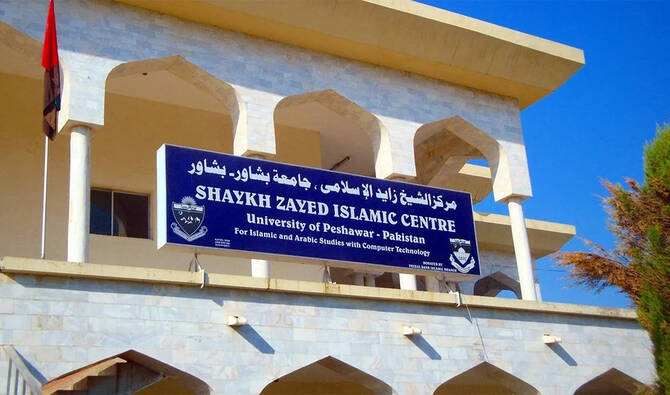

PESHAWAR: The Shaikh Zayed Islamic Center (SZIC) at the University of Peshawar is reshaping religious education in Pakistan by combining traditional Islamic scholarship with modern disciplines such as computer science, law and technology, according to faculty and students at the institute.
Established in 1983 with support from the United Arab Emirates, the center was part of the late Sheikh Zayed bin Sultan Al Nahyan’s efforts to strengthen Pakistan-UAE ties through education. While Pakistan has hundreds of traditional seminaries, few public institutions offer Islamic studies integrated with contemporary subjects, digital literacy or interfaith coursework.
SZIC’s model has therefore become increasingly relevant as demand grows for Islamic banking experts, Sharia-compliant legal practitioners and graduates able to navigate both religious scholarship and modern professional environments.
Prof. Dr. Rashid Ahmad, the current director, said the institution’s mission continues to reflect its founding vision.
“The Shaikh Zayed Islamic Center, it is a gift of brotherhood and fraternity of the late president of United Arab Emirates, Shaikh Zayed Bin Sultan Al Nahyan (RA),” he said, noting that the Peshawar center is one of three in Pakistan, along with Karachi and Lahore.
He said the aim has always been to prepare students for both religious and contemporary responsibilities:
“The late UAE president wanted to enlighten the students of this area, not only in Islamic field but also in the contemporary era.”
Ahmad added: “Since then, when the Islamic Center was established, it strives its hard to incorporate in its curricula such subjects which can serve better to society.” Graduates, he said, have gone on to excel across professions. “You will find in the civil services, in teaching, in the media. They showed not only their presence, but also played a leading role in their field.”
Enrollment has risen sharply in recent years. “I took charge as a director in 2022, the number of students was around about 250. Now it has reached almost 800,” he said.
The center currently offers three major degree tracks, including a BS in Islamic Studies with a focus on Islamic banking and finance. Administrators say they encourage students to pursue this specialty as demand for Sharia-compliant financial expertise is expected to grow in the coming years.
Ahmad described the second track, M.Phil and PhD, as unique for its comparative focus. “In this program we teach the nine different big religions of the world. One major subject of this is interfaith and coexistence and peace and harmony.”
The third program focuses on Sharia-based legal education, introduced as part of the wider national effort toward Islamization of laws. In line with this vision, the center launched its BS in Sharia and Law to contribute to that ongoing process, according to Ahmad.
Former director Dr. Qibla Ayaz said the center was designed from the start as a bridge between Islamic tradition and modern technology.
“It was basically programmed as a center which would produce the scholars, graduates of Islamic Studies at that time, equipped with the computer technology as well,” he said.
He added that alumni are now visible across key sectors:
“It graduated a great number of students who are now contributing in the field of law, in judiciary, in teaching media. Some of them have gone to policymaking departments. Some of them are abroad.”
Ayaz said the center plays a central role in reinforcing Islamic ethics while preparing students to engage with global knowledge.
“The facilities and the training that the teachers of the Shaikh Zayed Islamic Center give to the students is focused on promotion of Islamic ethics, promotion of Islamic principles and Islamic ethos. So that is why actually the Shaikh Zayed Islamic Center is playing very central role in promotion of Islamic traditions.”
Students say the institute provides opportunities that many Islamic studies departments do not.
“If we look in Peshawar, even in Pakistan, Islamic Studies is taught but computer and technology is given less preference (in Islamic Studies),” Faryal Madad, a seventh-semester student in Islamic Studies with Information and Communication Technology, said.
“We can say that Shaikh Zayed Islamic Center is the only institution where computer is also taught along with the Islamic Studies.”
Another student, Ishtiaq Zafar, said he hopes to guide younger students after graduation:
“InshaAllah, I will try that whatever I have learnt here, I will try to teach my juniors.”


