

Pakistan offers assistance to Sri Lanka after floods kill over 50

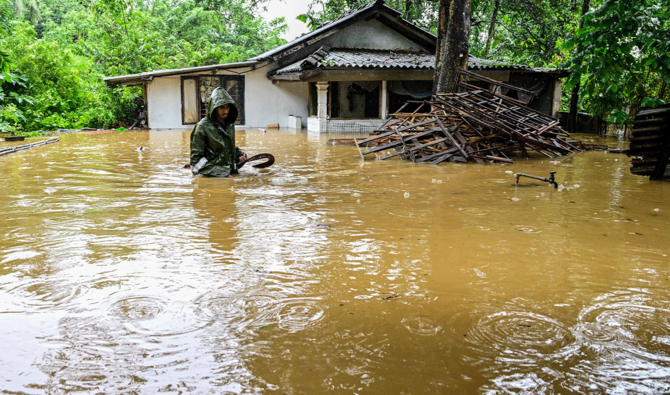
A man wades through floodwaters outside his house after heavy rainfall in Kaduwela on the outskirts of Colombo on November 28, 2025. (AFP)
Short Url
Updated 28 November 2025
Follow

Pakistan offers assistance to Sri Lanka after floods kill over 50

  • Nearly 44,000 people have been affected by floods across Sri Lanka, and many have sought refuge in schools and public shelters
  • Over 20,000 police, military personnel have stepped up evacuations in multiple towns after authorities warned of rising flood waters

ISLAMABAD: Pakistan’s Deputy Prime Minister Ishaq Dar on Friday offered relief support to Sri Lanka after deadly floods killed more than 50 in the tropical South Asian country.

Sri Lanka closed government offices and schools on Friday as the death toll from this week’s floods and landslides rose to 56, with roads, fields and more than 600 houses damaged.

In a post on X, the Pakistani deputy prime minister expressed sorrow over the loss of lives in Sri Lanka and extended his condolences to the families of the deceased.

“Pakistan stands in full solidarity with our Sri Lankan brothers and sisters in this difficult time,” he said in a post on X. “Pakistan is ready to provide all possible support for the relief efforts.”

Nearly 44,000 people have been affected by floods across Sri Lanka, and many have sought refuge in schools and public shelters, according to the Disaster Management Center (DMC).

The Irrigation Department said it expected the floods that have already affected countless areas across southern and eastern Sri Lanka, including many parts of capital Colombo, to spread even further.

Over 20,000 police and military personnel have stepped up evacuations in multiple towns, including the outskirts of Sri Lanka’s largest city Colombo, after authorities warned of rising flood waters.

Pakistan has also been reeling from this year’s floods that killed more than 1,000 people and affected around 3.6 million across the country, where scientists say rising temperatures are making monsoon rains heavier and more erratic.


OIC’s COMSTECH stresses academic collaborations across Muslim world in Islamabad meeting

Updated 4 sec ago
Follow

OIC’s COMSTECH stresses academic collaborations across Muslim world in Islamabad meeting

  • COMSTECH holds annual meeting in Islamabad featuring 30 delegates from Iran, Somalia, Palestine, Indonesia and other OIC states
  • Limited pool of skilled professionals one of the foremost challenges facing Muslim world, notes COMSTECH secretary general 

ISLAMABAD: The OIC Standing Committee on Scientific and Technological Cooperation (COMSTECH) called for stronger academic collaboration across Islamic states to secure the future of higher education in the Muslim world, state-run media reported on Saturday. 

COMSTECH’s Coordinator General Prof. Dr. Muhammad Iqbal Choudhary was speaking at the Annual Meeting of the COMSTECH Consortium of Excellence at the organization’s Secretariat in Islamabad. The event brought together vice chancellors, rectors, and senior representatives from leading universities across OIC member and observer states. 

Nearly 30 international delegates representing universities from Iran, Somalia, Palestine, Indonesia, Malaysia, Thailand, Uganda, Bangladesh, Benin, Cameroon, Gabon, Côte d’Ivoire, and Senegal joined their counterparts from several Pakistani institutions at the meeting. Participants attempted to chart a collective path forward for tertiary education in OIC countries.

“Collaborations, knowledge sharing, best practices, exchange of scholars, technology transfer and joint academic programs are vital for overcoming the educational challenges faced across the OIC region,” Choudhary said, according to the state-run Associated Press of Pakistan (APP).

The COMSTECH secretary general noted that one of the foremost developmental challenges facing OIC nations remains the limited pool of skilled professionals and workforce. 

He said this gap can only be bridged through strengthened tertiary education systems and expanded opportunities for knowledge transfer.

Discussions at the event highlighted the urgent need for competency-driven education, modern pedagogical tools, university–industry partnerships and collaborative training programs designed to equip graduates with the skills necessary to address emerging global challenges.

“The Annual Meeting served as a vital platform for reviewing progress achieved over the past year, identifying future priorities, and deepening academic cooperation to promote scientific excellence and sustainable development across the OIC region,” the APP said.