Pakistani firms showcase beauty products at West Africa expo eyeing trade deals

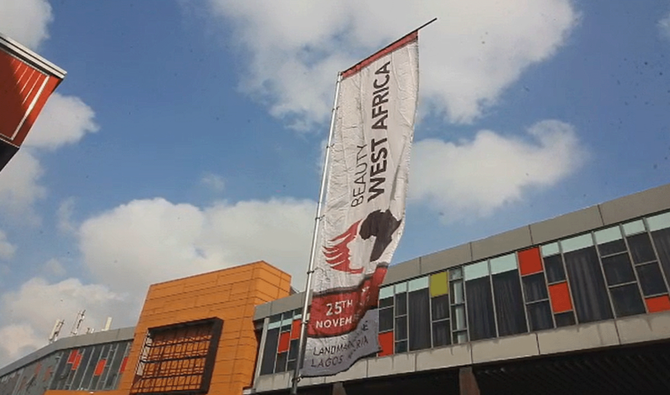
A Beauty West Africa poster at the exhibition site in Nigeria in a picture shared on November 27, 2025. (Ministry of Commerce, Pakistan)
Short Url
Updated 27 November 2025
Follow

Pakistani firms showcase beauty products at West Africa expo eyeing trade deals

  • Pakistan’s participation comes at a time when Africa’s beauty, personal care market is projected to reach $69 billion in 2025
  • Islamabad has intensified its diplomatic, economic engagement with African nations under ‘Engage Africa’ policy in recent years

KARACHI: Nearly 20 Pakistani companies have showcased a range of beauty and personal care products at the Beauty West Africa Exhibition in Nigeria, the commerce ministry said on Thursday, in a bid to trade deals.

The eighth edition of the Beauty West Africa Exhibition, one of the largest annual cosmetics and personal care trade shows in the continent, is being held in Nigeria’s Lagos city on Nov. 25-27.

It brings together international and regional players to showcase beauty, skincare, haircare and wellness products, offering companies a major platform to enter or expand in the fast-growing West African market and build new trade partnerships.

Rana Ihsaan Afzal Khan, coordinator to Pakistan’s prime minister on commerce, inaugurated the Pakistan Pavilion, organized by the Trade Development Authority of Pakistan, at the Nigeria beauty expo.

“In addition to the TDAP-supported exhibitors, several independent Pakistani companies are also participating, reflecting the growing interest of Pakistan’s private sector in the African market,” the Pakistani commerce ministry said in a statement.

Pakistan’s participation in the expo comes at a time when Africa’s beauty and personal care market is projected to reach $69.53 billion in 2025, driven by rising urbanization, youth demographics, and shifting consumer preferences toward natural and eco-friendly products. Nigeria’s rapidly expanding e-commerce market, expected to generate $439.77 million in 2025 in online beauty sales, also presents growing opportunities for cross-border trade, according to the Pakistani commerce ministry.

A networking dinner was also hosted for Pakistani exhibitors, with participation of officials from Nigeria’s National Agency for Food and Drug Administration and Control and the banking sector, to address regulatory challenges and encourage business-to-business (B2B) engagement. Nigerian stakeholders briefed the visiting companies on regulatory requirements for importing cosmetics, product registration processes, compliance standards, and banking procedures— providing

Pakistani businesses with valuable insights into the local market’s operational landscape.

Pakistan has also intensified its diplomatic and economic engagement with African nations under its “Engage Africa” policy in recent years, leading to the opening of new diplomatic missions across the continent to increase trade.

Earlier in the day, Khan held a bilateral meeting with Aisha Rimi, executive secretary of the Nigerian Investment Promotion Commission (NIPC).

“The discussion focused on Nigeria’s investment landscape and the potential for enhanced Pakistani participation in sectors such as manufacturing, agro-processing, IT services, and logistics,” the Pakistani commerce ministry said.

“Both sides also explored strengthening institutional cooperation between NIPC and Pakistan’s Special Investment Facilitation Council (SIFC) to improve information-sharing, streamline procedures, and facilitate investor outreach.”



Imran Khan not a ‘national security threat,’ ex-PM’s party responds to Pakistan military

Updated 4 sec ago
Follow

Imran Khan not a ‘national security threat,’ ex-PM’s party responds to Pakistan military

  • Pakistan’s military spokesperson on Friday described Khan’s anti-army narrative as a “national security threat”
  • PTI Chairman Gohar Ali Khan says words used by military spokesperson for Khan were “not appropriate”

ISLAMABAD: Former prime minister Imran Khan’s Pakistan Tehreek-e-Insaf (PTI) party on Saturday responded to allegations by Pakistan military spokesperson Lt. Gen. Ahmed Sharif Chaudhry from a day earlier, saying that he was not a “national security threat.”

Chaudhry, who heads the military’s media wing as director general of the Inter-Services Public Relations (ISPR), spoke to journalists on Friday, in which he referred to Khan as a “mentally ill” person several times during the press interaction. Chaudhry described Khan’s anti-army narrative as a “national security threat.”

The military spokesperson was responding to Khan’s social media post this week in which he accused Chief of Defense Forces Field Marshal Asim Munir of being responsible for “the complete collapse of the constitution and rule of law in Pakistan.” 

“The people of Pakistan stand with Imran Khan, they stand with PTI,” the party’s secretary-general, Salman Akram Raja, told reporters during a news conference. 

“Imran Khan is not a national security threat. Imran Khan has kept the people of this country united.”

Raja said there were several narratives in the country, including those that created tensions along ethnic and sectarian lines, but Khan had rejected all of them and stood with one that the people of Pakistan supported. 

PTI Chairman Gohar Ali Khan, flanked by Raja, criticized the military spokesperson as well, saying his press talk on Thursday had “severely disappointed” him. 

“The words that were used [by the military spokesperson] were not appropriate,” Gohar said. “Those words were wrong.”

NATURAL OUTCOME’

Speaking to reporters earlier on Saturday, Pakistan’s Defense Minister Khawaja Asif defended the military spokesperson’s remarks against Khan.

“When this kind of language is used for individuals as well as for institutions, then a reaction is a natural outcome,” he said. 

“The same thing is happening on the Twitter accounts being run in his [Khan’s] name. If the DG ISPR has given any reaction to it, then I believe it was a very measured reaction.”

Khan, who was ousted after a parliamentary vote of confidence in April 2022, blames the country’s powerful military for removing him from power by colluding with his political opponents. Both deny the allegations. 

The former prime minister, who has been in prison since August 2023 on a slew of charges he says are politically motivated, also alleges his party was denied victory by the army and his political rivals in the 2024 general election through rigging. 

The army and the government both deny his allegations.