

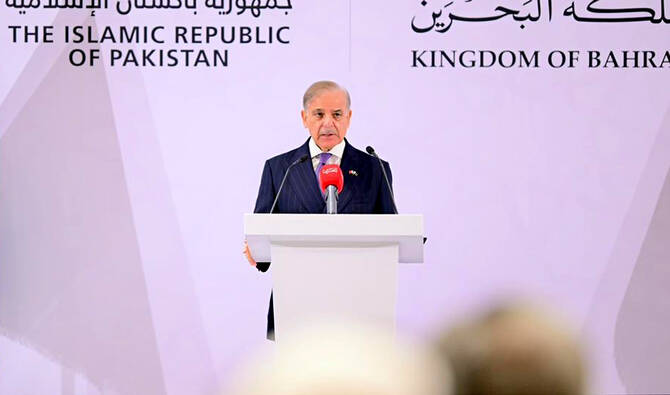

ISLAMABAD: Pakistani Prime Minister Shehbaz Sharif on Thursday urged Bahrain to invest in the South Asian nation’s information technology, artificial intelligence and agribusiness sectors as negotiations on a free trade agreement with the Gulf Cooperation Council (GCC) enter their final stages.
Sharif is on a two-day visit to Bahrain from Nov. 26-27 and made the remarks as he addressed a business event in Manama. Economic engagement between the two countries has accelerated this year following the Pakistan-Bahrain Investment Summit, where contracts worth $13 million were signed.
Pakistan and Bahrain established diplomatic ties in 1971 and maintain close economic, labor and defense cooperation. Bahrain hosts more than 120,000 Pakistanis, making it an important source of remittances for Islamabad.
“We are committed to convert this challenge into great opportunity by empowering our youth, by training them in the field of IT, AI, vocational training, skill training and together with our Bahraini brothers, entrepreneurs we will create a great momentum in this field,” Sharif said in his address.
“We would request you [Bahraini businesses] to come forward and we would like to work together, learn from your great experience and expertise and make Pakistan’s industry, Pakistan agriculture more vibrant with your advice and your knowledge.”.
Sharif also said the long-negotiated Pakistan–GCC Free Trade Agreement, which he described as close to completion, was expected to be signed soon. The pact, which would be Pakistan’s first-ever trade agreement with the six-member Gulf Cooperation Council, is aimed at reducing tariffs and easing market access between Pakistan and GCC states, with Bahrain seen as one of the countries that would benefit most from the expanded trade framework.
Sharif highlighted that Pakistan offered a large pool of young talent and resources along with a growing consumer market, which could hold “immense potential” when combined with Bahrain’s financial expertise and business acumen.
“We have cut red tape forever, strengthened our regulations and opened new sectors such as agribusiness, IT, minerals, energy and tourism for long-term partnership,” he added.
On Wednesday, Bahrain’s King Hamad bin Isa Al Khalifa awarded the Order of Bahrain (First Class) to Sharif during a meeting in Manama, where the two leaders reaffirmed their historic partnership and reviewed political, economic and defense cooperation.
Sharif had also held separate talks with Bahrain’s Crown Prince and Prime Minister Salman bin Hamad Al Khalifa, where the Pakistani leader proposed raising bilateral trade from over $550 million to $1 billion within three years, backed by progress on the Pakistan–GCC FTA and relaxed visa rules.
Meanwhile, Pakistan Interior Minister Mohsin Naqvi separately held a meeting with his Bahraini counterpart General Sheikh Rashid bin Abdullah Al Khalifa in Manama.
“During the meeting, the two sides held detailed discussions on bilateral relations, regional security and matters of mutual interest,” a statement from the interior ministry said.
“Both interior ministers agreed to enhance close cooperation in the field of counter-narcotics, strengthen the capacity of law enforcement agencies, and make information-sharing more effective.”
Deputy Prime Minister and Foreign Minister Ishaq Dar, who is also accompanying the PM to Bahrain, also held a separate bilateral meeting with Bahrain’s Minister of Finance and National Economy of Bahrain, Sheikh Salman bin Khalifa Al Khalifa, in Manama on Thursday.
“They reaffirmed their commitment to further strengthen bilateral relations, with a special focus on economic cooperation particularly in fintech and banking sectors,” Radio Pakistan reported.
“The two sides also discussed exploring central bank collaboration and establishing joint teams to develop a roadmap for enhanced economic partnership.”


