Pakistan’s gold market still 90% informal as $54 billion Reko Diq output nears — report

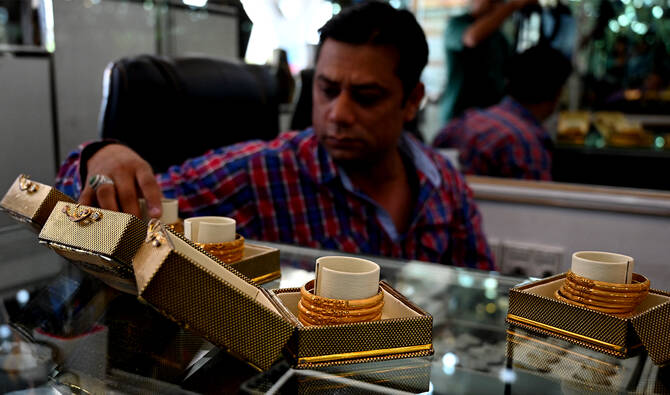
In this pictures taken on April 22, 2019, a Pakistani jeweller checks gold bangles at his shop in Rawalpindi. (AFP/File)
Short Url
Updated 27 November 2025
Follow

Pakistan’s gold market still 90% informal as $54 billion Reko Diq output nears — report

  • UN-backed study warns Pakistan’s weak, informal gold market cannot absorb upcoming 17.9m oz from Reko Diq gold mines 
  • Calls for setting up Gold and Gemstone Authority to prevent Reko Diq’s incoming gold supply from being lost to informal economy

KARACHI: Pakistan’s gold sector remains overwhelmingly informal, with an estimated 90 percent of all gold trade occurring outside formal channels, leaving the country unprepared to manage the huge supply expected from the Reko Diq gold-copper project unless sweeping reforms are introduced, according to a new UNDP-supported competition assessment.

The ‘Competition Assessment Study of the Gold Market in Pakistan 2025’ report, released by the Competition Commission, says the country is on the verge of a major shift: the Reko Diq mine is projected to produce 17.9 million ounces of gold worth around $54 billion, a level of output that could transform Pakistan’s domestic supply. But the report warns the existing market is highly fragmented, dominated by unregulated dealers, hampered by weak oversight, and distorted by smuggling and price manipulation.

Pakistan currently consumes 60–90 tons of gold a year, most of it imported, exposing the market to global price swings and currency pressures. With no centralized regulator, no mandatory hallmarking system, and limited refining capacity, the sector “remains largely informal, opaque and inconsistent in enforcement,” the study notes. These structural weaknesses have made consumer protection, quality control and price transparency difficult to enforce.

“Without urgent reforms, Reko Diq’s output risks being absorbed into the same inefficient system, perpetuating informality, price distortions, and missed export potential,” the report said. 

The study says Pakistan’s gold trade is constrained by “the absence of a unified regulatory framework,” with key institutions withholding essential market and import data. Daily price setting is still driven by informal sarafa market associations, while most gold transactions evade documentation, tax compliance and quality checks.

To prevent Reko Diq’s incoming gold supply from being lost to the informal economy, the report calls for a Pakistan Gold and Gemstone Authority (PGGA) to centralize regulation, implement nationwide hallmarking and assaying, and introduce digital traceability tools such as blockchain. It also proposes a “gold banking” model to formalize household gold and improve financial inclusion.

The study warns that unless Pakistan modernizes its gold governance, the country risks allowing one of its largest-ever resource windfalls to disappear into informal networks rather than contribute to exports, investment, and fiscal stability. It notes that aligning reforms with the Reko Diq production timeline would allow Pakistan to “formalize 50+ tons of annual gold supply” and potentially develop into a regional refining hub.


OIC’s COMSTECH stresses academic collaborations across Muslim world in Islamabad meeting

Updated 4 sec ago
Follow

OIC’s COMSTECH stresses academic collaborations across Muslim world in Islamabad meeting

  • COMSTECH holds annual meeting in Islamabad featuring 30 delegates from Iran, Somalia, Palestine, Indonesia and other OIC states
  • Limited pool of skilled professionals one of the foremost challenges facing Muslim world, notes COMSTECH secretary general 

ISLAMABAD: The OIC Standing Committee on Scientific and Technological Cooperation (COMSTECH) called for stronger academic collaboration across Islamic states to secure the future of higher education in the Muslim world, state-run media reported on Saturday. 

COMSTECH’s Coordinator General Prof. Dr. Muhammad Iqbal Choudhary was speaking at the Annual Meeting of the COMSTECH Consortium of Excellence at the organization’s Secretariat in Islamabad. The event brought together vice chancellors, rectors, and senior representatives from leading universities across OIC member and observer states. 

Nearly 30 international delegates representing universities from Iran, Somalia, Palestine, Indonesia, Malaysia, Thailand, Uganda, Bangladesh, Benin, Cameroon, Gabon, Côte d’Ivoire, and Senegal joined their counterparts from several Pakistani institutions at the meeting. Participants attempted to chart a collective path forward for tertiary education in OIC countries.

“Collaborations, knowledge sharing, best practices, exchange of scholars, technology transfer and joint academic programs are vital for overcoming the educational challenges faced across the OIC region,” Choudhary said, according to the state-run Associated Press of Pakistan (APP).

The COMSTECH secretary general noted that one of the foremost developmental challenges facing OIC nations remains the limited pool of skilled professionals and workforce. 

He said this gap can only be bridged through strengthened tertiary education systems and expanded opportunities for knowledge transfer.

Discussions at the event highlighted the urgent need for competency-driven education, modern pedagogical tools, university–industry partnerships and collaborative training programs designed to equip graduates with the skills necessary to address emerging global challenges.

“The Annual Meeting served as a vital platform for reviewing progress achieved over the past year, identifying future priorities, and deepening academic cooperation to promote scientific excellence and sustainable development across the OIC region,” the APP said.