

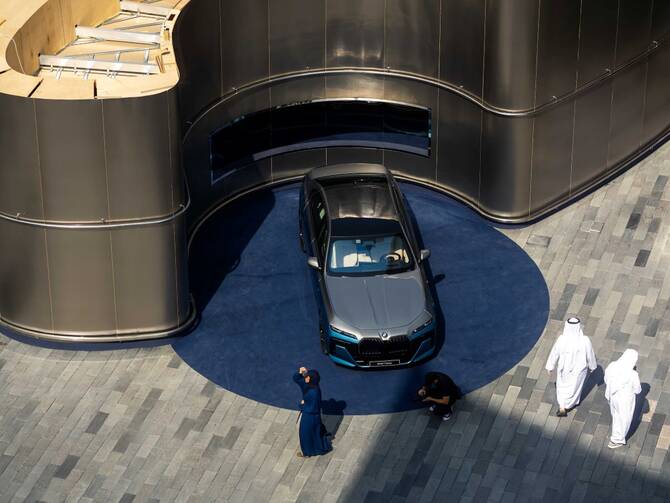

DUBAI: BMW showcased a custom-designed pavilion by Jeddah-based architecture and design studio Bricklab — founded by brothers Abdulrahman and Turki Gazzaz — at Dubai Design Week earlier this month.
The BMW 7 Series was displayed prominently at the entrance to the pavilion, setting the tone before visitors progressed through the space. A curated selection of Saudi and regional artworks and design objects came next, presented on clean plinths in a gallery-like setting.

The pavilion’s gallery area. (Supplied)
“When BMW approached us to design the pavilion for their 7 Series car, we were really thinking about the contrasting experience of being on the highway versus being inside a luxury car,” Turki told Arab News. He described the highways in the region as “a very harsh environment; you’re moving very fast,” but said the interior of the car offers “a completely different environment, a completely different experience.”
That contrast shaped the way Bricklab approached the pavilion’s layout and experience. The project brief from BMW included multiple components: a space to showcase the car, a gallery of objects designed by regional designers reflecting BMW’s design principles, and an area to host conversations and discussions around design.
“With these different program requirements, we developed the pavilion’s elliptical shape,” he said. The ellipse, he explained, “breaks the angular geometries of the site here in Dubai Design District.”
The gallery area was the first pavilion zone that visitors encountered. From there, the pathway “seamlessly takes you to a sunken seating area. It’s a place for conversations, more intimate, smaller gatherings,” Turki said. He noted that the configuration was intended to “foster more dialogue amongst the participants or the attendees.”
The artworks and objects exhibited inside the pavilion were selected for their relevance to contemporary regional design themes. According to Turki, the showcased works “really tackle issues of sustainability or craftsmanship or material resourcing. And they do that in a way that’s tied to the region, in terms of the process. They’re more in tune with the contemporary challenges that we are facing today.”
The brothers also drew from automotive references when designing the pavilion.
“It was a chance for us to experiment also with shapes that are kind of reminiscent of automotive design,” Turki said. “The ellipse is a bit of an aerodynamic shape. It has a history in the automotive industry.”
For the interior finishes, they focused on softness and comfort. Turki described the interior experience as one that “transport[s] the visitor into a completely different atmosphere from the busy district around.”

The pavilion's seating area. (Supplied)
The BMW team was “very supportive,” Turki said. “They were very open to different ideas. They were really focused on the principles and the ethos of design, and they weren’t so fixated on just the promotion of the brand or the car.”
He described the project as “an interesting opportunity to look at a car, because it’s really something that we use every day … especially in this part of the world.”
Bricklab, founded in 2015, has become an integral part of the Kingdom’s burgeoning design scene. The brothers have exhibited at the British Museum, curated the first summer edition of 21,39 Jeddah Arts, and represented Saudi Arabia at the 2018 Venice Architecture Biennale with an exhibition titled “Spaces in Between.” They are currently finalizing the design of Hayy: Cinema — part of Art Jameel’s Hayy Jameel complex in Jeddah.
Reflecting on the evolution of design in Saudi Arabia, Turki said: ““When we first started our practice, we felt like we were the only ones. Or, at least, it felt like we were isolated.
Now, there are so many interesting designers that are producing great work, and there are more platforms to share not just design outcomes, but also design processes.
“It’s really important to maintain this critical angle to design and to understand its social, political and economic implications,” he continued. “That way, it can really effectively improve our daily lives, and the lives of different communities around our cities.”


