HONG KONG: As firefighters battled floor by floor in Hong Kong’s flaming Wang Fuk Court housing complex overnight to find survivors and reunite them with fearful relatives, another band of volunteers swung into action to rescue the estate’s pets.
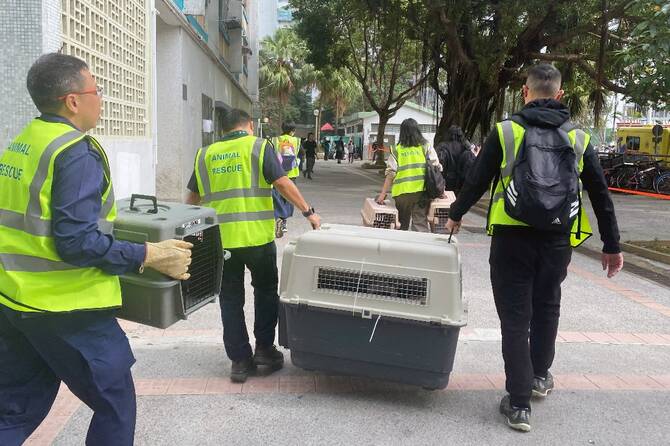
Dozens of workers from Hong Kong’s animal welfare agencies turned out with oxygenated pet carriers and animal ambulances to search for pets in the blazing complex, as social media posts depicted elderly people weeping for animals they left behind in the rush to save human lives.
Some animal welfare workers carrying cages negotiated with police to allow them through cordons keeping out the public, as the fire raged in the complex on Thursday.
“Pet owners contacted our alliance and we compiled a list of more than 100 cases,” said Anson Cheng, of the animal welfare group Hong Kong Guardians.
“We shared the cases with firefighters so that they can help check the flats and pick up the pets if they see them.”
Cheng said as of Thursday morning, at least 10 cats, seven dogs and several turtles had been rescued.
The fire, which is still burning, has killed at least 44 people and left nearly 300 missing. Police said on Thursday the blaze may have been spread by
unsafe scaffolding
and foam materials used during maintenance work.
Hong Kong’s system of micro-chipping dogs and cats meant it was possible that some survivors could be reunited with pets that managed to escape the blaze, said Cheng.
Huddling under a blanket in a nearby park, a woman surnamed Law said she had been waiting for her cat overnight and had been searching online platforms for news. She had left 10-year-old Fa when she fled her apartment, expecting to return.
“It was a very small fire when I went down,” she said. “Half an hour later, the fire already went all the way to the top. Nearby areas were also burning, there’s no way to get back in. I feel bad.”
Despite Hong Kong’s often cramped apartment lifestyles, pet ownership is increasingly popular — from dogs and cats to rabbits and hamsters — animal welfare agencies say.


Volunteers seek lost pets amid Hong Kong deadly inferno wreckage
https://arab.news/nqmnw
Volunteers seek lost pets amid Hong Kong deadly inferno wreckage

- As of Thursday morning, at least 10 cats, seven dogs and several turtles had been rescued


Sri Lanka hospital releases 22 rescued Iranian sailors
- Sri Lankan authorities said the survivors from the Dena were being handled according to international humanitarian law
COLOMBO: Sri Lanka discharged from hospital 22 Iranian sailors who were plucked from life rafts after their warship was sunk by a US submarine, officials said Sunday.
The sailors were treated at Karapitiya Hospital in the southern port city of Galle since Wednesday after the IRIS Dena was torpedoed just outside Sri Lanka’s territorial waters.
“Another 10 are still undergoing treatment,” a medical officer at the hospital told AFP.
He said the bodies of 84 Iranians retrieved from the Indian Ocean were also at the hospital.
Those discharged from hospital overnight had been taken to a beach resort in the same district.
Sri Lankan authorities said the survivors from the Dena were being handled according to international humanitarian law, and the government had contacted the International Committee of the Red Cross for assistance.
The island is also providing safe haven for another 219 Iranian sailors from a second ship, the IRIS Bushehr, that was allowed to berth a day after the Dena was sunk.
Sailors from the Bushehr have been moved to a Sri Lanka Navy camp at Welisara, just north of the capital Colombo, and their ship taken over by Sri Lanka’s navy.
Sri Lanka announced it was taking the Bushehr to the north-eastern port of Trincomalee, but an engine failure and other technical and administrative issues had delayed the movement, a navy spokesman said.
Sri Lanka has denied claims that it was under pressure from Washington not to allow the Iranians to return home, and said Colombo will be guided solely by international law and its own domestic legislation.
A US State Department spokesperson said the disposition of the Bushehr crew and Iranian sailors rescued at sea was up to Sri Lanka.
“The United States, of course, respects and recognizes Sri Lanka’s sovereignty in the handling of this situation,” the spokesperson told AFP in Washington.
India, meanwhile, said Saturday that it had allowed a third Iranian warship, the IRIS Lavan, to dock in one of its ports on “humane” grounds after it too reported engine problems.
The three ships were part of a multi-national fleet review held by India before the war in the Middle East started last week.
“I think it was the humane thing to do, and I think we were guided by that principle,” Indian Foreign Minister Subrahmanyam Jaishankar said on Saturday.
The Lavan docked in the south-west Indian port of Kochi on Wednesday.
“A lot of the people on board were young cadets. They have disembarked and are in a nearby facility,” Jaishankar said.


