CONCORD, N.H.: A Massachusetts woman who was once engaged to the brother of White House press secretary Karoline Leavitt remains in ICE custody two weeks after being arrested on her way to pick up the son she shares with her former fiance.
Bruna Ferreira, 33, was driving to her son’s school in New Hampshire on Nov. 12 when she was pulled over in Revere, Massachusetts, her attorney, Todd Pomerleau, said Wednesday.
“She wasn’t told why she was detained,” he said. “She was bounced from Massachusetts, to New Hampshire, to Vermont, to Louisiana on this unconstitutional merry-go-round.”
Pomerleau said Ferreira’s 11-year-old son lives with her former fiance, Michael Leavitt, in New Hampshire, but they have shared custody and maintained a co-parenting relationship for many years since their engagement broke off. He said the boy lived with both parents at one point and later split his time between them, spending numerous nights and weekends with his mother.
“She was detained for no reason at all. She’s not dangerous. She’s not a flight risk. She’s not a criminal illegal alien,” he said. “She’s a business owner who pays taxes and has a child who was wondering where mommy was after school two weeks ago.”
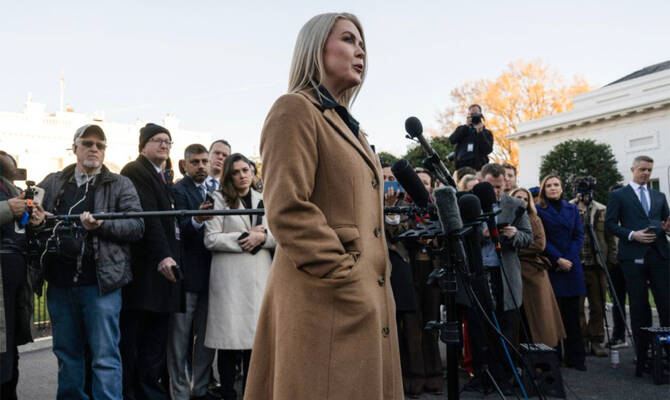
Michael Leavitt did not respond to a message sent to his workplace. The White House press secretary declined comment. Karoline Leavitt grew up in New Hampshire, and made an unsuccessful run for Congress from the state in 2022 before becoming Trump’s spokesperson for his 2024 campaign and later joining him at the White House.
Pomerleau said his client was 2 or 3 when she and her family came to the US from Brazil, and she later enrolled in the Deferred Action for Childhood Arrivals program, the Obama-era policy that shields immigrants who were brought to the US as children. He said she was in the process of applying for a green card.
The Department of Homeland Security said Ferreira entered the US on a tourist visa that required her to leave in 1999. A department spokesperson said Ferreira had a previous arrest for battery, an allegation her attorney denied.
An online search of court cases in several Massachusetts locations where she has lived found no record of such a charge. In New Hampshire, court records show, she had two motor vehicle violations in 2020: speeding and driving an unregistered vehicle. The charges were placed on file without a finding on the condition that she enroll in a safe driving course and remain on good behavior for one year.
“They’re claiming she has some type of criminal record we’ve seen nowhere. Show us the proof,” Pomerleau said. “She would’ve been deported years ago if that was true. And yet, here she is in the middle of this immigration imbroglio.”
A DHS spokesperson confirmed Ferreira is being held in Louisiana.
President Donald Trump’s efforts to broadly reshape immigration policy have included changing the approach to DACA recipients. Homeland Security Assistant Secretary Tricia McLaughlin recently issued a statement saying that people “who claim to be recipients of Deferred Action for Childhood Arrivals (DACA) are not automatically protected from deportations. DACA does not confer any form of legal status in this country.”


![]()

Immigrant with family ties to White House press secretary Karoline Leavitt is detained by ICE
Short Url
https://arab.news/n5tk6
Immigrant with family ties to White House press secretary Karoline Leavitt is detained by ICE
- The Department of Homeland Security said Ferreira entered the US on a tourist visa that required her to leave in 1999


Latest updates




© 2026 SAUDI RESEARCH & PUBLISHING COMPANY, All Rights Reserved And subject to Terms of Use Agreement.